

In the world of off grid energy, the inverter acts as the heart of the entire system. It is not merely a tool for converting direct current into alternating current. It is the final guardian of power quality. While high frequency models are popular for their light weight and low cost, low frequency inverters remain the gold standard for heavy duty applications. For owners of remote mines, large farms, or high energy factories, stable electricity represents the right to operate without interruption. This guide explores why the heavy duty architecture of low frequency inverters is the only professional choice for those who value long term certainty.
What is a Low Frequency Inverter?
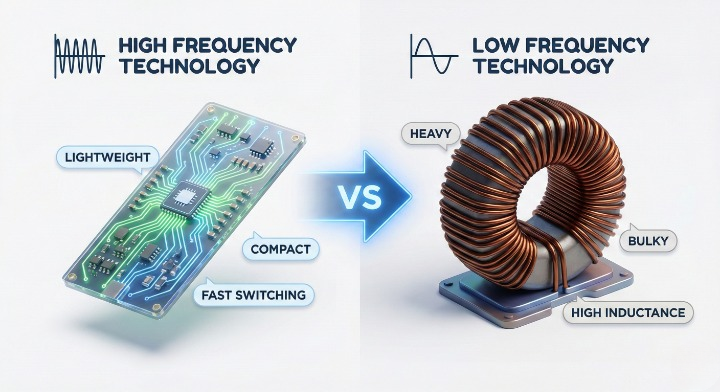
A low frequency inverter is defined by its use of a massive copper transformer. Unlike high frequency units that use electronic switching to step up voltage, these machines rely on electromagnetic induction via a large toroidal or square transformer. This physical mass is not a disadvantage: it is a functional reservoir of energy.
How it Works: The Electromagnetic Flywheel Effect
The core of low frequency inverters functions much like a mechanical flywheel. In a high frequency system, the power path is almost entirely electronic. When a massive motor starts, the sudden surge can overwhelm the delicate transistors. In contrast, the internal transformer of a low frequency unit provides physical inertia. When a water pump or air compressor demands a massive burst of current, the magnetic field in the transformer acts as a buffer. It provides the necessary power instantly without the risk of an electronic shutdown. This physical isolation also protects the rest of the solar system from electrical noise and feedback.
Built for Extreme Durability
Professional grade low frequency inverters are engineered with high thermal redundancy. The power MOSFETs are usually oversized and mounted on massive heat sinks. The transformer itself is wound with high grade copper wire to minimize heat and maximize efficiency. This robust construction allows the machine to operate in environments where cheaper electronics would fail due to heat or dust.
Low Frequency vs High Frequency Inverters: 5 Critical Differences
When evaluating equipment, it is important to shift the logic from initial price to risk management. The following table highlights why low frequency technology is superior for professional applications.
| Feature Category | Low Frequency Inverters | High Frequency Inverters | Business Impact |
| Peak Power Surge | 300 percent for over 20 seconds | 150 to 200 percent for milliseconds | Determines if you can start water pumps or heavy motors |
| Electromagnetic Interference | Extremely Low | Higher | Critical for medical tools or 5G communication towers |
| Impact Resistance | Excellent via physical isolation | Vulnerable to electronic spikes | Determines survival during lightning or grid surges |
| Service Life | 10 to 15 years | 5 to 7 years | Lowers the total cost of energy over the system life |
| Repairability | Modular and field serviceable | High integration requires total replacement | Reduces downtime in remote areas where shipping is slow |
Why Choose a Low Frequency Inverter for Your System?
For many users, the decision comes down to the types of appliances being powered. Most industrial and agricultural tools are inductive loads. These include anything with a motor, such as refrigerators, air conditioners, and irrigation pumps.
Handling Inductive Loads
Inductive loads require a startup current that is often five to seven times higher than their rated operating power. For example, a 2kW water pump might need 12kW just to start spinning.
If you use a high frequency inverter, you would need to buy a 15kW or 20kW model just to handle that brief startup spike. This leads to massive overspending on equipment that remains mostly idle. However, a high quality 5kW low frequency inverter can often handle a 15kW surge for several seconds. By choosing low frequency inverters, you can match the inverter size to the running load rather than the startup spike. This saves roughly 20 percent on initial equipment costs and prevents the need for oversized battery banks.
Enhanced Protection for Sensitive Electronics
In modern scenarios like 5G base stations or rural data centers, power purity is nonnegotiable. Low frequency inverters produce a pure sine wave that is often cleaner than the public utility grid. The transformer acts as a natural filter, blocking DC offsets and high frequency noise from the battery side. This reduces the risk of server crashes and hardware aging, effectively lowering the annual failure rate of connected equipment to below 0.1 percent.
Best Application Scenarios
As an expert consultant, SNADI/SNAT Solar always recommend looking at the cost of downtime. If one day without power costs more than the inverter itself, you must choose a low frequency solution.
Industrial and Mining Sites
Mining operations in remote regions face the harshest conditions: thick dust, high ambient temperatures, and heavy vibration. Machines like crushers and conveyor belts put immense stress on the power system. A low frequency inverter with an IP54 rated enclosure is the only viable path here. It acts as an insurance policy against lost production time.
Medical Facilities and Laboratories
In a rural hospital, power is literally a matter of life and death. Precision instruments like ECG machines or blood analyzers cannot tolerate electromagnetic interference. The ultra low noise profile of low frequency inverters ensures that medical data remains accurate and equipment remains functional during critical surgeries.
How to Select the Right Solution for Your Project
Selecting an inverter requires a shift from looking at parts to analyzing the total lifecycle. Do not simply ask for the wattage. Ask about the heaviest simultaneous load.
Calculating Your Peak Load Requirements
To find the right fit, use a simple calculation table. List every device that might start at the same time. Multiply the motor driven devices by five to account for the surge. If the total surge exceeds 200 percent of the running load, low frequency inverters are the only safe option.
Why Pure Sine Wave is the Only Standard
SNADI/SNAT firmly believe in pushing for pure sine wave technology. While modified sine wave inverters are cheaper, they cause motors to run hot and fail prematurely. In an off grid setting, the cost of replacing a damaged pump motor far outweighs the small savings from a cheaper inverter. High quality low frequency inverters always provide a pure sine wave output, ensuring the longevity of your entire appliance portfolio.
Conclusion
A low frequency inverter is not just a more expensive component. It is a way to achieve a lower total cost of ownership over a 15 year period. When you factor in the initial cost, the 15 year maintenance requirements, and the cost of potential downtime, the ROI of low frequency technology is clear.
For any business or homeowner seeking long term certainty in an unpredictable environment, the choice is simple. Low frequency inverters provide the strength, stability, and survival capability that modern off grid life demands.
✉️Email: exportdept@snadi.com.cn
Website:
FAQ
The primary benefit is the heavy duty transformer which allows the unit to handle high surge power requirements. This makes it much more reliable for starting inductive loads like pumps or refrigerators compared to high frequency alternatives that may fail under sudden stress.
2. How do I determine the correct power rating for my off-grid system?
3. Why is battery voltage compatibility important when choosing an inverter?
4. Are low frequency inverters less efficient than high frequency models?
5. What protection features should I look for in a reliable inverter?