


For an farm operator, power is not a luxury. It is the lifeblood of irrigation pumps, automated feeding systems, and climate control for livestock. When you invest in a premium energy storage system, the primary concern is not the hardware itself but the long term reliability of that asset. Understanding how to test lithium battery health effectively is the difference between a high performing agricultural operation and a sudden, multi thousand dollar loss in produce or livestock.
Why Health Testing Is The Foundation Of Asset Management
The traditional approach to battery maintenance has often been reactive. Operators wait for a system failure before investigating the cause. However, for large scale agricultural investments, this approach is financially unsustainable. Periodic health checks allow a manager to quantify the (State of Health) or SoH of their battery bank. This metric represents the current capacity of the battery compared to its original rated capacity.
By implementing a rigorous testing schedule, a farm owner can transition from guessing to knowing. Instead of wondering if the batteries will survive the next harvest season, they possess a clear data point that predicts future availability. This allows for precise financial planning, ensuring that replacement costs are factored into the farm budget years before they are actually required.
A professional power audit provides a clear picture of the remaining useful life of your energy storage. If a battery bank shows an SoH of 85 percent after three years of heavy usage, the owner knows the asset is degrading at an acceptable rate. If that number drops to 70 percent within the same timeframe, it indicates environmental stressors or improper configuration that must be addressed to protect the remaining investment.
Three Core Ways To Achieve Precision Cost Reduction
Maximizing the return on investment requires more than just keeping the lights on. It involves deep technical oversight of the storage medium. Here are the three pillars of a professional agricultural battery audit.
1. Physical Integrity Audit In Harsh Environments
Farms are notoriously difficult environments for power electronics. High levels of dust, moisture, and corrosive gases like ammonia from livestock areas can lead to rapid terminal degradation.
Environmental Check: Inspect the battery enclosure for ingress of particulates. Dust acts as an insulator, trapping heat and accelerating chemical aging.
Terminal Analysis: Look for micro corrosion on the poles. Even minor oxidation increases resistance, leading to heat generation during high current draw scenarios like pump startups.
Value for the Owner: By performing a quarterly cleaning and anti corrosion treatment, the service life of connection points can be extended by up to 40 percent. This simple step eliminates the risk of localized fires caused by high resistance connections.
2. Dynamic Capacity Verification Under Load
Static voltage readings are almost useless for assessing the health of a lithium battery. A battery might show 53.3V while idle but collapse to 48V the moment a 10kW irrigation pump starts up.
Real World Simulation: Testing must occur at the actual discharge rates the farm requires. We recommend using a 0.5C or 1C discharge rate to observe the voltage drop curve.
Voltage Sag Monitoring: Record the instantaneous drop when heavy inductive loads are engaged. A healthy battery should maintain a stable voltage plateau. A failing battery will show a sharp, precipitous drop that could trigger inverter low voltage cutoffs.
Value for the Owner: This ensures that when the critical cooling systems are needed most, the battery bank has the actual physical capacity to deliver that energy without a system shutdown.
3. Predictive Analysis Through BMS Data Extraction
Modern lithium batteries are equipped with a (Battery Management System). This internal computer tracks every cycle, every over voltage event, and every temperature spike.
Cell Voltage Gap Analysis: Extract the data for individual cell voltages. If the gap between the highest and lowest cell exceeds 30mV during discharge, the pack is out of balance.
Active Balancing Implementation: Recognizing these gaps early allows for active balancing or offline equalization charging.
Value for the Owner: Identifying a single weak cell cluster early allows for targeted maintenance. This prevents a single failed module from compromising the entire battery string, potentially saving up to 70 percent in total replacement costs.
| SoH Level | Operational Status | Strategic Action Required |
| 85 to 100 percent | Optimal Health | Maintain current protocols. Optimize (Depth of Discharge) to 80 percent to maximize cycle life. |
| 70 to 85 percent | Vigilance Period | Reconfigure load priorities. Ensure core irrigation is primary. Review thermal management. |
| 55 to 70 percent | Warning Phase | Implement partial bank replacement or load shedding. Move non critical lighting to separate circuits. |
| Below 55 percent | End of Life | Decommission from core power room. Transition to low value use like perimeter fence power. |
Avoiding The Three Fatal Mistakes In Farm Power Testing
Many operators believe they are performing a valid test when in reality they are looking at misleading data.
Ignoring Temperature Compensation
The chemical activity inside a lithium iron phosphate battery is highly sensitive to temperature. A battery tested at 45 degrees Celsius will show a different internal resistance than one tested at 20 degrees. If the testing software or the technician does not calibrate for the ambient temperature of the farm shed, the SoH result will be inaccurate.
Relying On Static Voltage For SoC
Voltage is a poor indicator of the (State of Charge) for lithium batteries due to their flat discharge curve. A battery can be at 20 percent or 80 percent capacity and show very similar voltage readings. Always test lithium battery capacity through a full discharge cycle or by reading the integrated shunt data from the BMS.
Using Non Industrial Grade Tools
Farms often use basic multimeters found at local hardware stores. These tools lack the precision required to measure millivolt differences in cell balancing. Professional grade, calibrated clamp meters and data loggers are mandatory for accurate asset auditing.
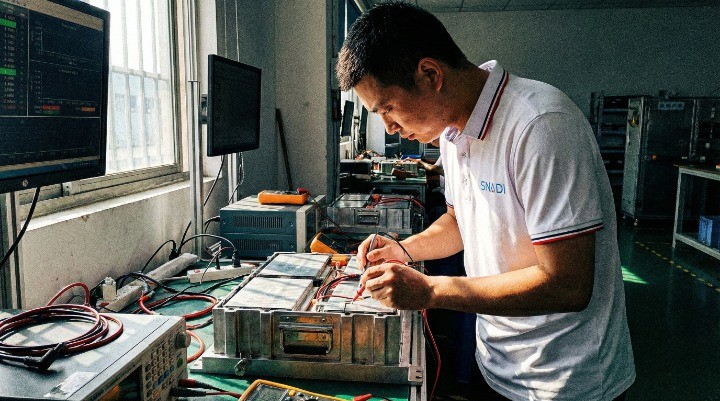
Nigeria Cassava Farm With SNADI/SNAT Solar, July 2024
In the Nigeria, manager Pieter Marais oversaw a 500 hectare cassava operation. The farm relied on a large off grid lithium storage system for its export grade packing facility. In July 2024, during the peak of the harvest, the system began experiencing unexplained shutdowns during the evening shift.
Instead of replacing the entire 200kWh battery bank, our marketing manager Tao after arriving at the scene, a comprehensive health audit was performed. The data extraction revealed that while 90 percent of the modules were at 92 percent SoH, one specific module in the third string had a cell voltage gap of 150mV. This single module was triggering the safety cutoff for the entire system.
By replacing only the faulty module and recalibrating the charge controllers for the local winter temperature, the farm restored full power. The total cost of the intervention was less than 2,000 dollars, whereas a full bank replacement would have exceeded 60,000 dollars. This real world example highlights why testing is the ultimate ROI protector.
Global Industry Insights And Data Trends
The adoption of lithium iron phosphate (LFP) in agriculture has surged due to its safety and longevity. Recent data from BloombergNEF indicates that while the initial capital expenditure for LFP is higher than lead acid, the total cost of ownership over ten years is roughly 35 percent lower in off grid applications.
| Metric | Traditional Lead Acid | Modern LFP Lithium |
| Typical Cycle Life (80 percent DoD) | 500 to 1,200 Cycles | 6,000 to 8,000 Cycles |
| Round Trip Efficiency | 75 to 85 percent | 95 to 98 percent |
| Maintenance Requirement | Monthly (Water/Cleaning) | Quarterly (Data Audit) |
| Performance at 40°C | Rapid Degradation | Stable Operation |
According to the International Energy Agency (IEA), off grid agricultural storage capacity is expected to grow by 25 percent annually through 2030 as farmers seek independence from unstable centralized energy networks.
Conclusion
As a leading provider of energy storage solutions, SNADI/SNAT Solar philosophy is that we do not just sell a product, we sell the certainty of power. A battery is an investment, and like any investment, it requires oversight to remain profitable.
By integrating periodic health audits into your farm operations, you ensure that your energy storage remains an asset rather than a liability. Every test result is a piece of evidence that supports your bottom line, ensuring that your farm has the power to grow, harvest, and succeed in a completely off grid environment.
✉️Email: exportdept@snadi.com.cn
Website:
FAQ
Lithium batteries offer a much higher depth of discharge and longer cycle life, meaning they last years longer than lead acid alternatives. While the upfront cost is higher, the cost per kilowatt hour over the lifetime of the battery is significantly lower. This efficiency leads to a faster return on investment through reduced replacement frequency and lower maintenance needs.
Q2: What metrics are essential for testing farm battery performance?
Q3: How do lithium batteries impact operational costs in agriculture?
Q4: What is the expected lifespan of lithium batteries in solar farm setups?
Q5: How can farmers accurately calculate the total cost of ownership for energy storage?