


In any off grid energy storage system, the battery serves as the sole heart of operations. For stakeholders managing remote mining sites, 5G telecommunications towers, or luxury residential villas, a sudden battery failure is more than a technical glitch: it represents a total business shutdown. As a leading provider of energy solutions, SNADI/SNAT Solar understand that you do not just need hardware, you need absolute control over your power security. Navigating the market to find the best lithium battery tester is the first step in transitioning from reactive repairs to predictive mastery.
Why You Need a Professional Tester for Off Grid Systems
Many site managers still rely on a standard multimeter as their primary diagnostic tool. However, in the professional world of off grid power, a multimeter can be a dangerous distraction. The phenomenon is common: a technician measures the voltage of a LiFePO4 bank and sees 13.3V or 53.2V, concluding the system is healthy. The essence of the problem lies in the physics of lithium chemistry. Lithium Iron Phosphate has an exceptionally flat discharge curve. By the time the voltage drops significantly enough for a multimeter to detect a problem, the cells are often already damaged beyond recovery. If you wait for a energy storage system to fail before identifying a bad battery, the cost of remediation: involving emergency truck rolls, technician overtime, and service level agreement penalties: is typically 20 times higher than the cost of preventative testing. In 2026, the industry standard has shifted. You need to measure AC Resistance (ACR) and perform controlled capacity tests. Internal resistance is the pulse of your battery. It can signal a failure up to 15 days before the system actually crashes.
The Best Lithium Battery Tester for Business Use Cases
Choosing the right tool depends on your specific infrastructure. Below is a breakdown of SNADI/SNAT Solar leading solutions for various industrial applications.
| Model Category | Primary Target Scenario | Core Commercial Value | Technical Highlight (2026 Std.) |
| Precision Master | High frequency commercial cycles | Predictive maintenance: locks in aging cells 30 days early | 4 wire Kelvin measurement, 0.1mΩ resolution |
| The Heavy Duty | Mining and off grid factories | Safety verification: supports 1000V plus high voltage packs | 1500V Isolation rating with IP67 housing |
| Cloud Link Pro | Distributed 5G tower networks | Operational efficiency: remote data sync and auto reporting | Bluetooth 5.3 with encrypted cloud integration |
| Budget Solution | Modern farming and single units | Cost control: basic capacity checks to stop fake cells | 20A Discharge capability with clear LCD output |
| Solid State Ready | Research and high end data centers | Future compatibility: supports solid state battery logic | Multi chemistry algorithms for 2027 tech |
How to Test a Lithium Battery
To truly protect your investment, you must move beyond simply pressing buttons. You must interpret data to stop financial losses.
Step 1: Visual and Safety Inspection
Check the battery terminals for signs of oxidation, which increases resistance, and inspect the casing for micro swelling. In 2026, professional inspections should also include a thermal imaging scan to identify internal hot spots that indicate a short circuit risk. Physical damage is the root of almost all electrical failures.
Step 2: Open Circuit Voltage (OCV) Measurement
Measure the voltage only after the battery has rested for at least 2 hours. If the voltage difference between cells in a series exceeds 30mV, the pack is out of balance. This is a critical conversion point for owners: an imbalanced pack triggers the BMS to shut down early, effectively wasting 20% of the purchased capacity.
Step 3: Load Testing and Capacity Analysis
This is the core of accounting for your energy. Perform a discharge test at a 0.5C rate to 100% Depth of Discharge. Use the formula: Actual Capacity / Nominal Capacity = State of Health (SOH). If the SOH is below 80%, the battery can no longer guarantee the required backup time during rainy days or peak loads.
Step 4: Internal Resistance (IR) Diagnostics
Utilizing Electrochemical Impedance Spectroscopy (EIS) technology is now standard. An increase in internal resistance of 25% compared to the factory baseline indicates the battery is nearing its end of life. By establishing an IR log for every site visit, you can create a trend map. When the slope steepens, it is the perfect time to plan for a system upgrade before a blackout occurs.
Mining Continuity in Nigeria
A remote iron ore mine in Nigeria experienced intermittent power drops in their off grid site office. Traditional voltage checks showed no issues. By deploying a high precision lithium battery tester, SNADI/SNAT Solar's engineers discovered that three cells in a 48V string had internal resistance levels 40% higher than the rest. The team replaced only those three cells during scheduled maintenance, avoiding a site wide blackout that would have cost the company 50,000 USD per hour in lost production time.
Professional Buyers Guide
When selecting or recommending a testing tool for a high stakes environment, look for these two non negotiable indicators:
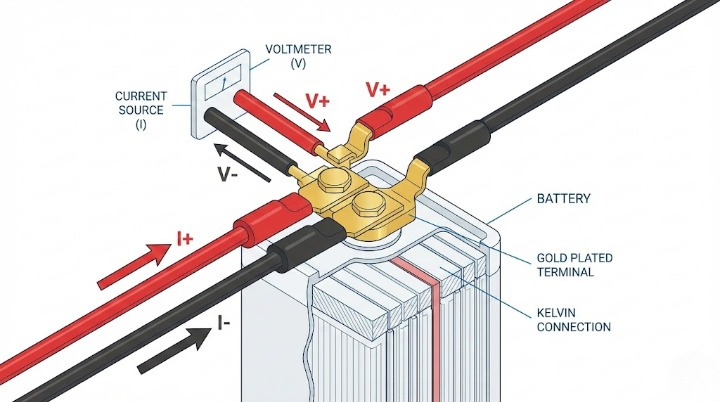
4 Wire Kelvin Measurement: This is the divider between hobbyist toys and professional grade tools. It eliminates the resistance of the test leads themselves, ensuring that mΩ readings are accurate and repeatable.
Multi Chemistry Support: The tool must be compatible with LiFePO4 and the emerging semi solid state batteries. Ensure the firmware can be updated to handle new discharge algorithms as technology evolves.
Conclusion
When SNADI/SNAT Solar provide this level of diagnostic depth to a hospital or a factory, we are no longer just a vendor. You are a consultant providing certainty. We are showing them:
1. How to avoid million dollar losses caused by a single power outage.
2. How to extend the service life of an entire energy storage system by 2 to 3 years.
3. How to maximize the Return on Investment (ROI) of their green energy transition.
The best lithium battery tester is not just a device: it is the guardian of your energy independence.
✉️Email: exportdept@snadi.com.cn
Website:
FAQ
Top testers now integrate Bluetooth connectivity and mobile apps for remote monitoring. High-precision measurement of internal resistance and support for multi-cell balancing are also standard requirements for professional grade equipment.
Q2: Is a specialized tester necessary for LiFePO4 batteries?
Q3: How does data logging assist in long term battery management?
Q4: Can these testers be used for automotive battery diagnostics?
Q5: Why is measuring internal resistance important for solar storage?