

Are you tired of watching your business profits vanish into high energy bills? Power expenses are a major drain on corporate margins, especially for facilities operating entirely off the main power network. That is exactly why commercial rooftop solar panels are no longer just an environmental initiative. They are a pure business survival strategy.
Recent publications heavily support the transition to independent business energy. According to the World Bank Off Grid Solar Market Trends Report published in late 2024, the global industry requires a massive twenty one billion dollar investment to achieve universal energy access by 2030. The report notes that over six hundred and sixty million people still lack reliable power, making independent solar a critical infrastructure requirement. Furthermore, the International Energy Agency Renewables 2025 analysis projects a global renewable capacity increase of almost four thousand six hundred gigawatts between 2025 and 2030. Their latest data clearly highlights that distributed commercial and industrial applications will drive a massive portion of this growth.
When you control your power generation, you secure your financial future. Let me walk you through exactly how industrial solar panels and energy storage can protect your business from unpredictable diesel costs and power outages.
Why Commercial Rooftop Solar Panels Make Business Sense
Defining Off Grid Commercial Solar Power
For businesses located far from stable city infrastructure, keeping the lights on requires independent power generation. A standalone system uses solar panels to generate direct current electricity from the sun. This energy flows through a charge controller to charge a large battery bank. From there, a low frequency or high frequency inverter converts the stored energy into alternating current to run heavy machinery, lighting, and office equipment. Unlike grid tied setups, these systems operate entirely independently, giving you total energy sovereignty.
Rising Energy Costs and Business Impact
Energy prices are climbing globally. If your business relies on diesel fuel, you already know how volatile logistics and fuel transport costs can be. Every time fuel prices spike, your profit margins shrink. Investing in rooftop solar energy for business creates a fixed cost for your electricity. Once the equipment is installed, the fuel is essentially free. This predictable overhead allows you to accurately forecast expenses and allocate capital to actual business growth.
Environmental and CSR Benefits
Consumers and B2B partners increasingly demand sustainable practices. Adopting solar power for commercial buildings drastically lowers your carbon footprint. By replacing diesel exhaust with clean solar generation, you protect local air quality and align your brand with global sustainability targets. The environmental benefits of commercial solar energy often translate into stronger brand loyalty and an easier time securing corporate partnerships.
Key Applications for Industrial Solar Panels
Remote Mining Operations and Agriculture
Mining camps and large scale agricultural farms often sit miles away from the nearest transmission line. Running heavy equipment on diesel is extremely expensive and logistically difficult. By deploying energy efficient rooftop solar panels for factories and mining sites, operators can power their administrative buildings, water pumps, and staff quarters silently and affordably. Solar arrays provide the reliable daytime energy needed to process materials without the constant roar of engines.
Off Grid Warehouses and Island Facilities
Island resorts and remote storage hubs face incredible challenges with power reliability. An independent warehouse requires constant climate control and lighting for inventory management. Installing large scale rooftop solar panels for warehouses transforms these massive, unused roof spaces into miniature power plants. Paired with robust lithium iron phosphate batteries, these facilities can operate twenty four hours a day without external grid dependence.
Key Considerations for Installing Commercial Rooftop Solar Panels
Roof Size Orientation and Load Capacity
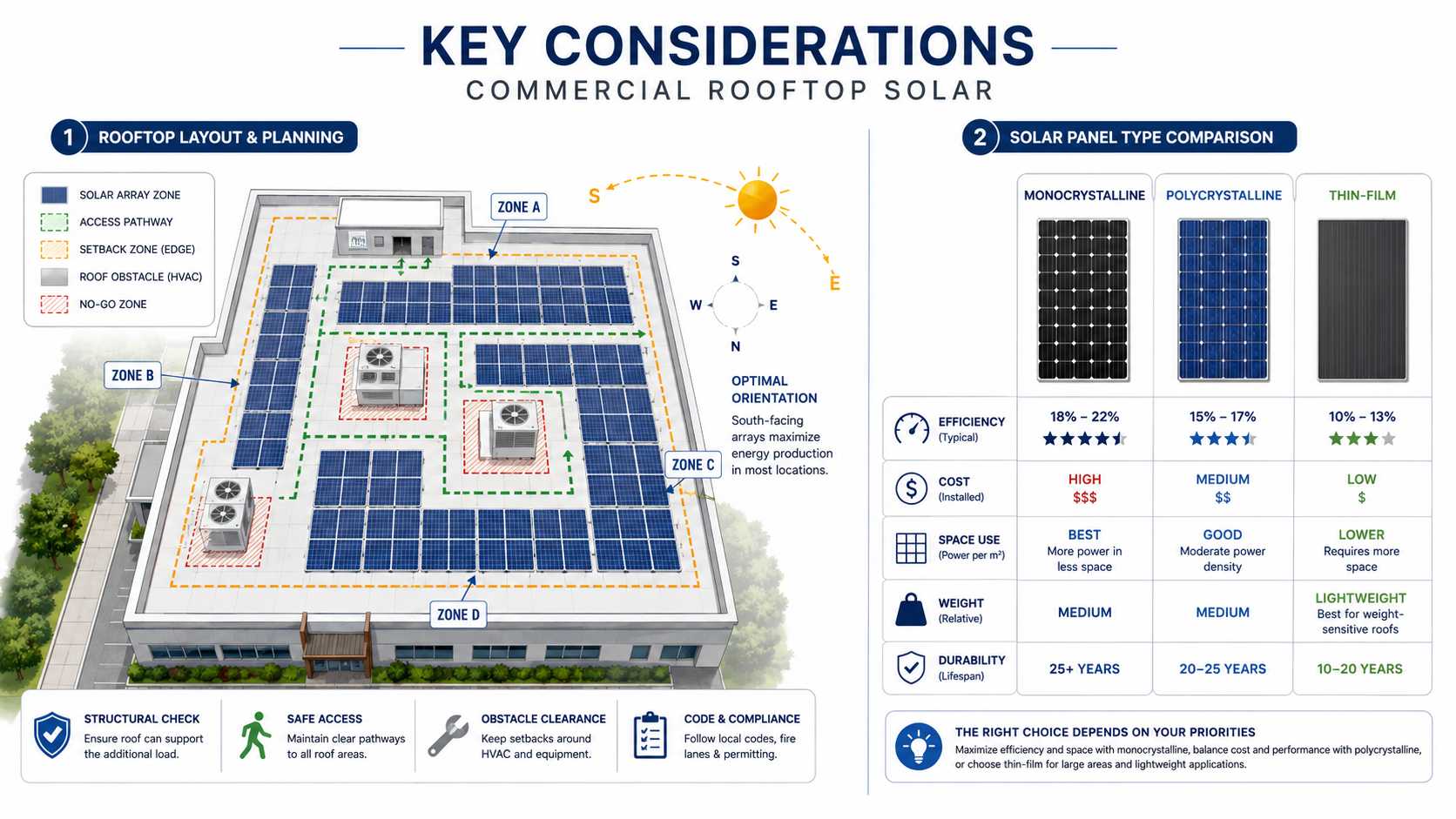
Before buying any equipment, you must evaluate your physical real estate. Maximizing rooftop space with solar panels requires a structural assessment. Industrial buildings generally have flat or slightly pitched roofs, making them ideal for solar arrays. However, you must verify that the roof structure can support the added weight of the panels and the mounting hardware. Facing the arrays toward the equator yields the best daily sunlight exposure.
Capacity Calculation Checklist for Solar Systems
Correct sizing is everything. If you underestimate your load, your business will suffer blackouts. Use this checklist to determine your needs:
List every piece of electrical equipment in your facility.
Note the continuous wattage for each device.
Identify the surge wattage for heavy machinery with induction motors.
Calculate the total daily watt hours required by multiplying wattage by hours of use.
Factor in a minimum twenty percent buffer for future expansion and system losses.
Determine your battery storage capacity based on how many days of autonomy you need during cloudy weather.
Common Mistakes in Solar Sizing and Selection
Most businesses lose money because of bad system sizing. It is entirely avoidable if you understand the technical logic.
When designing your system, you cannot simply match the inverter rating to your standard running load. You must account for surge power. Heavy industrial equipment pulls three to five times its rated power upon startup. If your hybrid inverter lacks this margin, the system will overload and shut down instantly. Always select an inverter with a peak surge rating that comfortably exceeds your heaviest equipment startup draw.
Another area where businesses fail is battery temperature management. If you use standard lead acid batteries, the charge voltage must decrease as the ambient temperature rises. Victron Energy technical guidelines dictate that lead acid systems require a voltage reduction of four millivolts per cell for every degree Celsius above twenty degrees. Failing to adjust this will boil and destroy the batteries during hot summers. However, modern lithium batteries do not require this. You must set the temperature compensation to zero for lithium storage to prevent chronic undercharging.
Cost Analysis and ROI of Commercial Solar Panels
Installation Costs Breakdown
Understanding commercial solar systems cost is vital for your financial planning. The upfront investment includes the photovoltaic panels, hybrid inverters, battery banks, mounting hardware, and skilled labor. While panels have become highly affordable, the heavy duty inverters and lithium storage batteries make up the bulk of the initial capital for independent systems. However, these premium components ensure decades of reliable free energy.
Commercial Solar Panels vs Diesel Generators
To truly understand the value, you must compare solar against traditional power generation. Reducing electricity bills with commercial solar happens immediately after activation. Once installed, your monthly operating costs plummet. Our internal data shows that businesses typically recover their initial investment within four to six years through diesel fuel savings alone. After this payback period, the system generates pure profit by eliminating energy overhead for the remaining twenty years of its operational lifespan.
Choosing the Right Commercial Solar Provider
Vendor Selection Criteria and Solution Services
When sourcing equipment, the biggest trap is buying from a basic source factory. A source factory just sells individual boxes and walks away. If the inverter fails to communicate with the battery, you are left stranded. Instead, you must partner with a comprehensive solution service provider. SNADI/SNAT Solar engineers the entire system, ensuring the photovoltaic input, maximum power point tracking controllers, and energy storage integrate perfectly. They offer complete system design, technical troubleshooting, and unified performance guarantees.
Pre Inquiry Checklist for Business Owners
Before contacting a supplier, gather this critical information to get an accurate system quote:
Your total daily power consumption in kilowatt hours.
The peak surge wattage of your heaviest facility machinery.
The physical dimensions of your available roof space.
The average daily sunlight hours in your specific geographic location.
Your preference between lead acid or lithium iron phosphate storage architectures.
Maximizing the Value of Your Rooftop Solar Investment
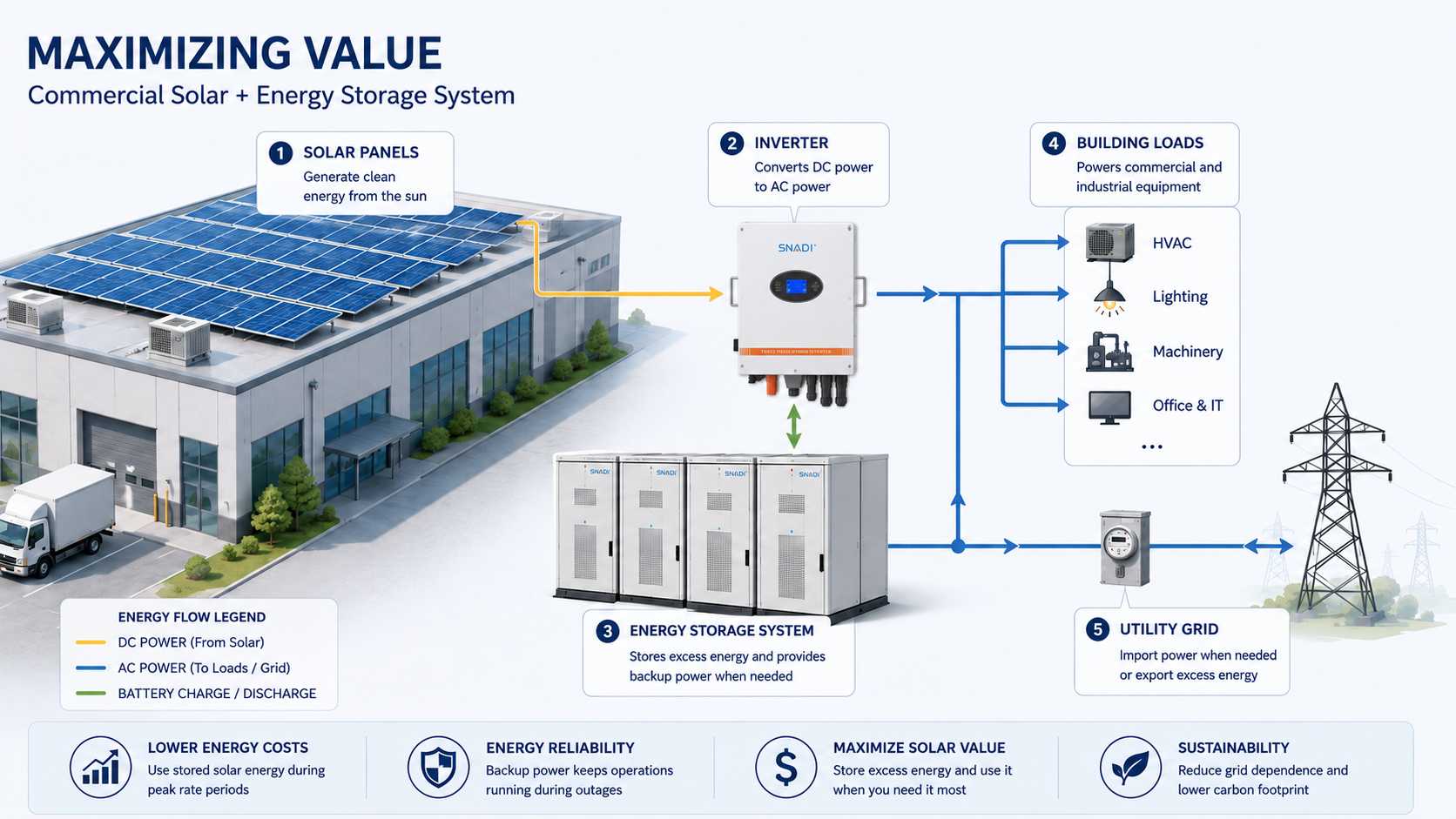
Integrating Energy Storage Solutions
Solar arrays only produce power while the sun shines. To maximize your investment, integrating solar energy storage solutions for businesses is absolutely mandatory. Lithium iron phosphate batteries offer excellent energy density, deep discharge capabilities, and a service life exceeding six thousand cycles. Proper storage ensures your facility continues operating smoothly through the night and during heavy rainstorms.
Performance Monitoring and Optimization
You cannot manage what you do not measure. Commercial solar panel monitoring systems allow you to track energy production and consumption in real time. By analyzing this data, you can shift heavy machinery usage to peak sunlight hours, preserving your battery capacity for the night. Many modern inverters include wireless monitoring interfaces that send alerts directly to your mobile device if any system anomalies occur.
Scaling Up Multi Site Solar Deployment
Once you see the financial benefits at one location, you will likely want to expand. Scaling up requires standardized equipment. Using the exact same brand of hybrid inverters and batteries across all your facilities simplifies maintenance routines and staff training. A reliable solution service provider can help you roll out identical power architectures to every new branch you open across different regions.
How to Get Started Today
The best time to take control of your energy costs was yesterday. The second best time is today. Stop letting fluctuating fuel prices dictate your corporate profitability. Reach out to a professional solution provider to secure a comprehensive solar assessment for your specific industrial facility.
✉️Email: exportdept@snadi.com.cn
Website:

FAQ
Installing off-grid solar systems creates a fixed overhead for electricity. Once the initial setup is complete, the energy generated is essentially free. This predictable cost structure protects profit margins from fluctuating diesel prices and often pays for itself within four to six years.
What is the most common mistake businesses make when sizing a commercial solar system?
Why should a business choose a comprehensive solar solution provider over a basic source factory?
What types of batteries are best for off-grid commercial solar installations?