


Lithium ion technology serves as the backbone of modern energy independence. For professionals managing off grid solar systems or industrial energy storage solutions, understanding the safest way to store lithium ion batteries is not merely a recommendation: it is a critical operational requirement. Proper storage directly influences the lifecycle of the investment and, more importantly, the safety of the surrounding infrastructure.
Why Storage Safety Matters
The high energy density of lithium ion cells is what makes them efficient, but it also presents unique challenges. When these batteries are stored incorrectly, they become susceptible to chemical instability.
The Science of Thermal Runaway
Thermal runaway is the primary hazard associated with lithium ion chemistry. This process occurs when a cell enters an uncontrollable, self heating state. If a battery is stored in an environment that is too hot or if it suffers from internal mechanical stress, the internal separator can fail. This leads to a short circuit, which generates more heat, further accelerating the chemical reaction. In a large scale energy storage system, this can lead to a chain reaction where one cell ignites the next. Preventing this starts with maintaining the correct storage environment.
Impact of Improper Storage on Battery Cycle Life
Safety is one side of the coin: longevity is the other. Lithium ion batteries are subject to capacity fade even when not in use. This is known as calendar aging. Storing batteries at a full charge in high temperatures accelerates the degradation of the electrolyte and the electrodes. This results in a permanent loss of capacity, meaning your off grid system will hold less energy over time. Following the safest way to store lithium ion batteries ensures that the depth of discharge remains stable and the internal resistance does not climb to unusable levels.
The 5 Pillars of the Safest Storage Environment
To mitigate risks, energy professionals must adhere to five core environmental standards. These pillars form the foundation of any robust safety protocol.
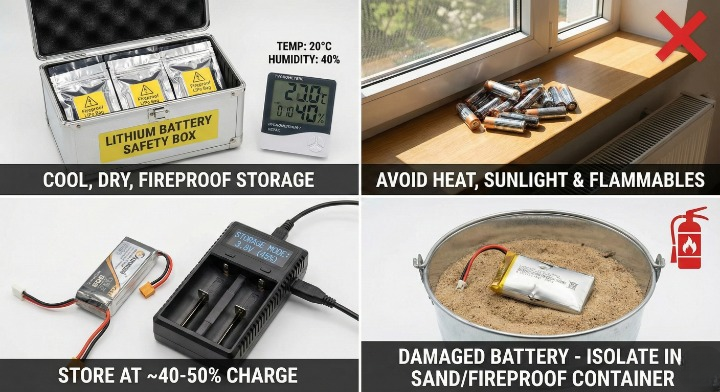
1. The Goldilocks Zone (15°C to 25°C)
Temperature is the most significant factor in battery health. The ideal range for storage is between 15°C and 25°C (59°F to 77°F). Exposure to temperatures above 60°C can trigger immediate safety risks, while prolonged exposure to temperatures above 30°C speeds up chemical degradation. Conversely, storing batteries in freezing conditions can cause lithium plating on the anode during the next charge cycle, which increases the risk of internal shorts.
2. Ideal State of Charge (SoC)
A common misconception is that batteries should be stored at 100% to be ready for use. In reality, storing a lithium ion battery at full voltage puts excessive stress on the cell chemistry. The safest way to store lithium ion batteries for long periods is at approximately 40% to 60% state of charge. This level provides a balance: it is high enough to prevent the battery from falling into a deep discharge state (which can brick the battery) but low enough to minimize chemical stress.
3. Preventing Internal Short Circuits
Humidity levels should remain below 60%. High moisture environments can lead to corrosion on the terminals or the internal Protection Circuit Module (PCM). Proper ventilation is equally vital. In the rare event that a cell begins to outgas, a well ventilated area ensures that flammable gases do not accumulate to explosive concentrations.
4. Physical Protection
The physical housing of the battery acts as the last line of defense. For smaller portable power stations, fireproof storage bags made of fiberglass are effective. However, for professional off grid installations, heavy duty metal enclosures with integrated fire suppression are the industry standard. These enclosures should be designed to contain a fire for a specific duration, allowing emergency responders time to act.
5. Keeping Batteries Away from Flammables
Large battery banks should be separated from other flammable materials like fuel, wood, or chemicals. A distance of at least 3 meters is recommended between large battery racks and other equipment. This isolation strategy ensures that if a localized fire occurs, it does not spread to the rest of the facility.
Short Term vs. Long Term Storage
The protocols for storage shift depending on the duration. Professionals must distinguish between active inventory and long term decommissioning.
| Feature | Short Term (Under 1 Month) | Long Term (Over 3 Months) |
| Target State of Charge | 60% to 80% | 40% to 50% |
| Inspection Frequency | Bi weekly visual checks | Monthly voltage monitoring |
| Temperature Range | 10°C to 30°C | 15°C to 25°C (Strict) |
| Maintenance Action | Minimal | Top up charge every 3 to 6 months |
For off grid systems that are seasonally inactive, such as remote cabins or summer research stations, the long term protocol is essential. Failing to check the voltage every few months can lead to the battery dropping below the critical 2.5V per cell threshold, at which point most Battery Management Systems (BMS) will permanently disable the unit for safety reasons.
Advanced Safety Protocols for Large Scale Storage
For enterprises managing significant energy storage assets, manual checks are insufficient. Advanced technology must be leveraged to maintain the safest way to store lithium ion batteries.
Monitoring Systems
SNADI/SNAT Solar off grid inverters and storage cabinets are equipped with sophisticated BMS units. These systems should be configured to log data even during storage. Remote monitoring via WiFi or GPRS allows operators to receive real time alerts if the temperature in the storage area spikes or if a specific string of batteries shows an abnormal voltage drop.
Regulatory Compliance
Compliance with international standards is mandatory for professional credibility. The UN 38.3 standard governs the safety of batteries during transport and storage. Furthermore, adhering to NFPA 855 (Standard for the Installation of Stationary Energy Storage Systems) provides a framework for fire protection, including requirements for automatic fire extinguishing devices.
Common Myths About Lithium Battery Storage
Misinformation can be dangerous in the solar industry. Let us clarify two frequent misunderstandings.
Myth: Storing batteries in the fridge is best.
Fact Check: While cold temperatures slow down chemical reactions, refrigerators are high humidity environments. Condensation can form on the battery terminals, leading to short circuits or terminal corrosion. A cool, dry cupboard is far superior to a refrigerator.
Myth: Always store at 100% charge to be ready.
Fact Check: This is the fastest way to kill a lithium ion battery. High voltage causes the electrolyte to decompose over time. If you need a battery ready for an emergency, store it at 50% and use a high speed charger to bring it to 100% only when needed.
The 2023 UL Solutions Storage Safety Analysis
In a 2023 safety report conducted by UL Solutions (formerly Underwriters Laboratories), researchers examined a storage facility in North America that housed over 500 kWh of lithium ion modules. The facility experienced a localized cooling failure during a heatwave in July 2023.
Because the facility utilized a tiered separation strategy and active BMS monitoring, the system detected a temperature rise in Rack B within 120 seconds. The automated HVAC system was overridden to maximum cooling, and the specific modules were remotely disconnected from the parallel bus. This prevented a potential thermal runaway event. The study concluded that the safest way to store lithium ion batteries in large quantities involves a combination of environmental control and automated logic.
Vistra Moss Landing Safety Enhancements (2024 Update)
Following incidents in earlier years, the Moss Landing Energy Storage Facility in California implemented new storage and operational safety layers that were highlighted in technical reviews in early 2024. They shifted toward a more granular monitoring system where every individual module is tracked for temperature deviations of even 2 degrees. This proactive approach to storage safety has set a new benchmark for utility scale projects, proving that data is as important as physical enclosures.
Summary Checklist
Use this checklist to ensure your facility meets the highest safety standards:
Verify the storage area is maintained between 15°C and 25°C.
Check that all batteries are discharged or charged to 50% SoC before storage.
Ensure the storage room is dry with humidity levels below 60%.
Install smoke detectors and specialized fire extinguishers (Class D or specialized lithium fire suppressants).
Implement a monthly log for voltage checks on long term storage units.
Confirm that all storage racks are at least 3 meters away from other equipment.
Check that all battery terminals are covered with non conductive caps to prevent accidental shorts.
Conclusion
By following these professional guidelines, you protect your investment and ensure that your off grid energy system remains a reliable and safe power source for years to come.
✉️Email: exportdept@snadi.com.cn
Website:
FAQ
Keeping the battery at a 50 percent state of charge is ideal for long term storage. This level minimizes chemical stress on the cells and prevents them from reaching a critically low voltage that could lead to permanent failure.
2. How does temperature affect lithium ion battery lifespan?
3. Should lithium ion batteries be disconnected during seasonal storage?
4. What are the warning signs of lithium battery failure during storage?