

Energy independence is no longer a luxury for the agricultural sector; it is a financial necessity. As we move into 2026, the volatility of fossil fuel prices and the prohibitive costs of extending the traditional utility grid to remote acreage have forced a paradigm shift. For modern agribusinesses, the transition to off grid modular systems is the most effective way to secure long term operational stability. By integrating a high performance residential energy storage battery into a scaled agricultural framework, farm owners are transforming what was once a heavy utility expense into a predictable, profit generating capital asset.
Why Energy Storage is the New Irrigation for Modern Farms
For decades, irrigation was the primary focus of farm infrastructure investment. Today, energy reliability holds equal weight. Remote farms often face a binary choice: pay astronomical fees to the local utility for grid extension or rely on diesel generators (gen sets). However, gen-sets carry hidden burdens including rising fuel logistics, high maintenance frequency, and carbon footprints that are increasingly penalized by global supply chains.
| Metric | Diesel Generator (Off-Grid) | Solar + Residential Energy Storage Battery |
| LCOE (per kWh) | $0.45 - $0.65 | $0.08 - $0.15 |
| Operational Lifespan | 5-7 Years (High Maintenance) | 10-15 Years (Low Maintenance) |
| Maintenance Frequency | Every 250 - 500 Hours | Remote Monitoring / Annual Check |
| Energy Stability | High (but fuel dependent) | Very High (with proper sizing) |
| Environmental Impact | High Emissions | Zero Local Emissions |
Source: BloombergNEF Energy Outlook 2025 & International Renewable Energy Agency (IRENA) 2026 Projections.
Engineering Reliability
Agricultural environments are notoriously difficult for electronics. High dust levels, significant humidity fluctuations, and ambient temperatures exceeding 45°C can quickly degrade inferior battery chemistries. This is why Lithium Iron Phosphate (LiFePO4) has become the industry standard for the 2026 agricultural market. Unlike standard ternary lithium batteries, LiFePO4 offers superior thermal stability and a significantly higher cycle life, typically exceeding 6,000 to 8,000 cycles at 80% Depth of Discharge (DoD). For a farm, this means a residential energy storage battery can provide over a decade of daily deep cycling without significant capacity loss.
To survive the farm test, the hardware must feature:
IP54/IP65 Ingress Protection: This ensures that fine particulate matter from harvesting or tilling does not penetrate the casing, preventing internal short circuits.
Active Balance BMS: In large scale off grid arrays, cell voltage divergence is common. Active balancing redistributes energy between cells during the charge/discharge cycle, ensuring the entire stack maintains peak efficiency and extending the system's usable life by up to 20%.
Advanced Thermal Management: While semi solid state batteries are gaining traction in laboratory settings, the 2026 market continues to favor LiFePO4 for its proven safety profile in high temperature regions like Sub Saharan Africa and the Australian Outback.
How to Audit Your Farm’s Load Profile for Maximum ROI
One of the most common mistakes in off grid engineering is over provisioning. Buying more capacity than needed traps capital that could be used for other farm improvements. A professional audit distinguishes between Irrigation Peak Loads and Baseline Operational Loads.
For instance, a vineyard may require massive energy spikes for water pumps during the summer months but only minimal power for security and sensors during the winter. A modular residential energy storage battery allows for a 1+N expansion strategy. A farmer can start with a base unit to cover critical cold storage and then add parallel modules as the operation scales or as seasonal demands increase.
The Audit Methodology:
Identify Inductive Loads: Catalog all motors and pumps. These require high inrush current (often 3-5x their running wattage).
Determine Autonomy Requirements: How many days of no sun must the system survive? In most agricultural contexts, a 1.5 to 2-day buffer is the sweet spot for ROI.
Modular Parallel Expansion: By using a residential energy storage battery designed for parallel stacking, the system remains flexible. If a new greenhouse is added in 2027, the storage capacity can be doubled without replacing the original inverter or wiring.
Solving the High Inrush Current Challenge
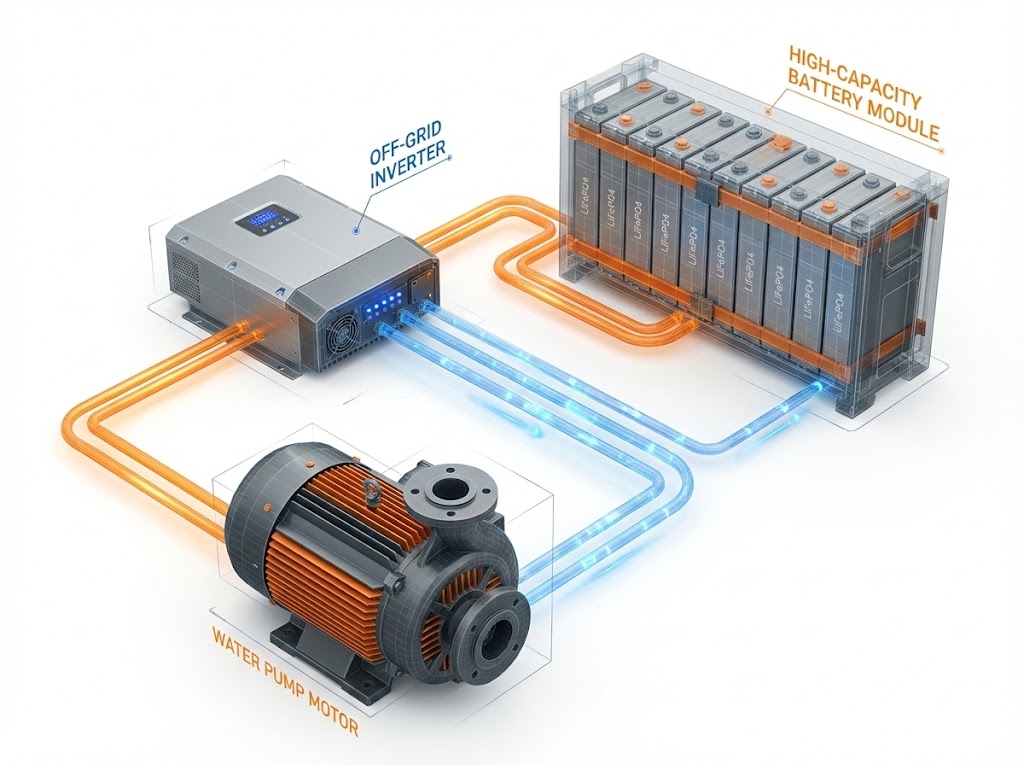
Water pumps are the backbone of many farms, but they are also the primary cause of off grid system failures. When a pump starts, it demands a massive surge of power. If the battery and inverter cannot handle this momentary peak, the system will trip, leading to downtime and potential crop loss. In 2026, the most reliable off grid solution is a DC coupled architecture. In this setup, the solar panels and the residential energy storage battery are linked on the DC side of the system. This allows the battery to discharge directly to meet surge demands more efficiently than AC coupled systems, which require an extra stage of conversion. Furthermore, high tier inverters paired with these batteries now support Surge Power Management, capable of delivering 300% of their rated capacity for short bursts (up to 10 seconds). This ensures that even heavy duty irrigation pumps start smoothly every time.
The 2025 Brazil Wheatbelt Project
In January 2025, the azenda Sol Nascente do Vale Verde farm in Brazil transitioned their remote grain handling facility to a fully off grid modular ESS. The facility was previously powered by two SNADI 100kVA diesel generators, costing the farm approximately R$310,000 Real annually in fuel and servicing.
Project Specifics:
Date: Completed June 2025.
System Configuration: 150kW Solar PV array coupled with a 400kWh modular residential energy storage battery system (consisting of 40 stacked units).
Results: Within the first six months of operation, the farm reduced its diesel consumption by 92%. The only remaining fuel use was for emergency backup during an uncharacteristic two weeks storm front.
Financial Impact: The projected payback period for the investment is 3.8 years. With the batteries warrantied for 12 years, the farm is looking at over 8 years of virtually free energy, contributing an estimated R$2,180,000 Real to their bottom line over the next decade.
For a farmer, downtime is more than an inconvenience; it is a threat to the harvest. Modern off grid systems must be self healing to an extent. Through the use of IoT enabled gateways, every residential energy storage battery in a cluster can be monitored remotely. Predictive maintenance protocols can now identify a failing cell or a temperature spike before the module shuts down. Moreover, the shift toward Plug and Play modularity means that if a single battery module requires service, it can be bypassed or swapped out by the farm's onsite mechanic in less than 15 minutes, without needing a specialized solar engineer to fly in from the city. This decentralized service model is essential for maintaining 99.9% uptime in remote locations.
Conclusion
The evolution of energy storage has reached a tipping point where off grid reliability exceeds that of the aging centralized grid. By implementing a high capacity residential energy storage battery system, agricultural enterprises are doing more than just going green."They are insulating themselves from energy market volatility, reducing their LCOE, and ensuring that their power supply is as resilient as the land they farm.
✉️Email: exportdept@snadi.com.cn
Website:
☎️WhatsApp / WeChat: +86 18039293535
FAQ
Q1. Is a modular ESS powerful enough to handle high surge agricultural equipment like irrigation pumps?
Modern modular systems are designed with high discharge capabilities specifically to manage the heavy inductive loads common in farming environments. When large motors or irrigation systems start up, they often create significant power spikes. A well configured modular ESS acts as a buffer, providing the necessary surge current locally. This not only ensures reliable operation of your machinery but also protects you from expensive peak demand penalties often charged by utility providers when such spikes occur on the grid.
Q2. How does switching to a modular ESS translate into measurable profit for a commercial farm?
Transforming energy costs into profit involves two main strategies: peak shaving and load shifting. By storing energy when it is cheapest, either from solar panels during the day or from the grid during off-peak hours, and using it when rates are at their highest, you directly reduce operational overhead. This saved capital can then be reinvested into farm infrastructure or technology. Furthermore, the modular nature reduces maintenance costs and downtime, ensuring that your energy asset continues to contribute to your bottom line for its entire 15 to 20 years lifespan.
Q3. How do these systems perform in harsh agricultural environments with dust and humidity?
Our modular energy storage solutions are built with ruggedized enclosures that typically carry high ingress protection ratings, such as IP54. This ensures that the internal electronics and battery cells are shielded from the dust, moisture, and debris prevalent in barns or outdoor agricultural settings. Additionally, they feature advanced thermal management systems that regulate internal temperatures during extreme heat or cold, maintaining peak efficiency and preventing the hardware degradation that often affects less robust power solutions.

FAQ
The energy consumption standards for household appliances are usually regulated by relevant national departments, and different products have different energy efficiency level standards. Consumers can choose energy-saving products based on their energy efficiency levels.
What are the precautions for repairing and maintaining household appliances?
What is the service life of household appliances?
What issues should be noted when purchasing household appliances?
What issues should be noted when purchasing household appliances?