

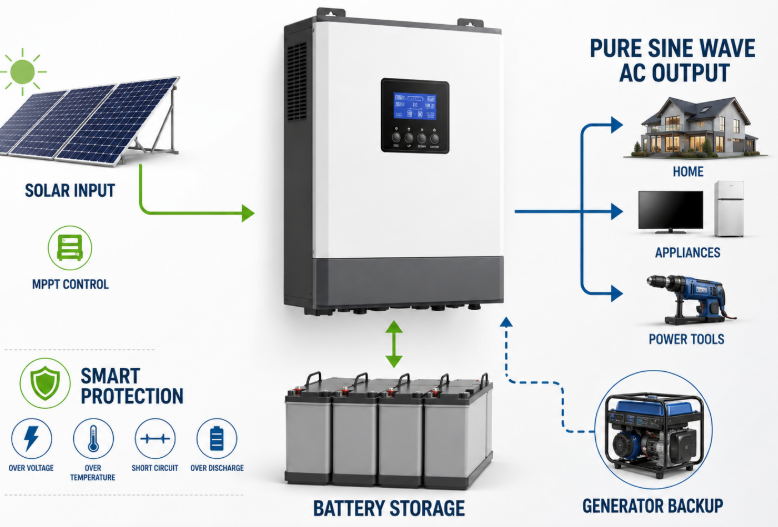
An off-grid inverter is a specialized electronic device that converts direct current (DC) electricity stored in batteries or generated directly by solar panels into stable alternating current (AC) electricity for independent power grids. Functioning as the central management unit of an autonomous electrical system, the off-grid inverter regulates solar energy input, manages battery charging and discharging cycles, and dynamically balances power supply to meet local household or industrial loads without relying on a public utility grid.
At a Glance
Section | Summary |
What Is an Off Grid Inverter? | This section defines the fundamental purpose, architecture, and core operations of off-grid inverters, highlighting how they enable total power autonomy by converting stored direct current into usable alternating current. |
How Does an Off Grid Inverter Work? | An in-depth analysis of the operational stages of off-grid inversion, detailing the precise steps of power conversion, voltage stepping, signal filtering, and battery interaction to deliver clean power. |
Choosing the Right Off-Grid Inverter for Your Needs | A practical engineering guide evaluating key factors such as continuous wattage rating, surge capacity, battery bank voltage compatibility, and low-frequency versus high-frequency system architectures. |
What Is an Off Grid Inverter?
An off-grid inverter is an electrical power converter that acts as the core of an autonomous solar energy system, converting direct current from batteries or solar arrays into standard utility-grade alternating current for local consumption. By operating independently from the national electricity distribution grid, this component ensures that isolated structures, remote industrial sites, and telecommunication hubs receive reliable, continuous, and regulated power under all atmospheric conditions. The off-grid inverter is highly critical for ensuring consistent power flow when grid electricity is unavailable.
Traditional grid-tied systems rely on the external grid's voltage and frequency signals to synchronize their output; however, an off-grid inverter must establish its own voltage, frequency, and phase from scratch. This independence requires high-precision internal oscillators and advanced microprocessing units to generate a highly stable, low-distortion pure sine wave. To achieve seamless power delivery, the off-grid inverter is typically coupled with a dedicated battery bank, which acts as a buffer to store excess solar generation during peak sunlight hours and discharge it during night-time or periods of low solar irradiance. As an essential component, the off-grid inverter continuously balances storage level inputs with active consumption profiles.
From an engineering perspective, modern off-grid inverters are not mere static conversion blocks; they are smart energy coordinators. The off-grid inverter monitors input voltages from multiple sources, tracks load demands in real-time, and executes complex protection algorithms to safeguard sensitive electronics against overvoltage, thermal runaway, and short-circuit conditions. European markets, in particular, show a strong preference for robust, transformer-based low-frequency off-grid inverter models due to their exceptional thermal resilience and ability to handle high starting currents from inductive loads. This ensures the off-grid inverter delivers uninterrupted performance in harsh environments.
To maximize system efficiency and longevity, standard system architectures integrate either pulse-width modulation (PWM) or maximum power point tracking (MPPT) charge controllers directly into the off-grid inverter chassis. This integrated approach, often referred to as a hybrid off-grid inverter, reduces installation complexity, minimizes DC distribution losses, and provides operators with a single, unified communication interface to monitor the entire energy generation and storage ecosystem. Choosing a heavy-duty off-grid inverter ensures that all downstream electrical loads remain highly stable under peak operational stress.
Parameter | Standard Industrial Specification | High-Capacity Residential Specification |
Rated Output Power | 5000W to 12000W | 3000W to 5000W |
Surge Power Capacity | 300% of rated power for 5 seconds | 200% of rated power for 5 seconds |
Nominal DC Input Voltage | 48V DC / 96V DC | 24V DC / 48V DC |
AC Output Voltage Range | 220V / 230V / 240V AC (Single-phase) | 110V / 120V AC (Single-phase) |
Output Frequency | 50Hz / 60Hz (Auto-sensing) | 50Hz / 60Hz (Manual/Auto) |
Peak Inversion Efficiency | Greater than 94% | Greater than 91% |
Output Waveform | Pure Sine Wave (THD < 3%) | Pure Sine Wave (THD < 5%) |
Battery Type Compatibility | LiFePO4, Gel, AGM, Flooded Lead-Acid | LiFePO4, AGM, Gel |
Maintenance and Operational Tip: To ensure long-term thermal stability, off-grid inverters must be installed in well-ventilated, dust-controlled environments. High-performance off-grid inverter models featuring heavy-duty toroidal copper transformers should be checked annually for dust accumulation on internal heat sinks and cooling fans, as thermal throttling can reduce maximum conversion efficiency by up to fifteen percent.
How Does an Off Grid Inverter Work?
An off-grid inverter works by executing a multi-stage power conversion process that transforms unstable low-voltage direct current into stable high-voltage alternating current while simultaneously managing the charge and discharge parameters of the connected battery system. Through high-frequency switching and advanced control loops, the off-grid inverter maintains a clean sinusoidal output that mimics or exceeds the quality of traditional utility grids, ensuring that all connected appliances operate within their designed electrical limits. This fundamental conversion mechanism allows the off-grid inverter to deliver dependable independent energy.
The functional sequence of an off-grid inverter begins at the DC input terminals, where the off-grid inverter continuously samples voltage from the PV array and battery bank. Utilizing high-speed insulated-gate bipolar transistors (IGBTs) or metal-oxide-semiconductor field-effect transistors (MOSFETs), the off-grid inverter control board modulates the incoming continuous DC voltage into a series of high-frequency pulses. These pulse-width-modulated waves are then routed through step-up transformers or multi-stage boost converters to elevate the low-voltage DC to the high levels required to reconstruct standard AC voltage.
In the final stage, the stepped-up high-voltage pulse-train is passed through a low-pass LC filter consisting of heavy-duty inductors and capacitors. This filter smooths the rapid transitions of the square waves, removing high-frequency harmonic distortion and shaping the output of the off-grid inverter into a smooth pure sine wave. Simultaneously, built-in communication buses dynamically adjust the output phase and voltage levels based on feedback loops, ensuring that the off-grid inverter minimizes voltage drop even under heavy start-up loads.
1. Convert Solar DC to AC Electricity
The primary task of an off-grid inverter is the efficient inversion of direct current into alternating current. Solar photovoltaic cells generate electricity when photons liberate electrons, producing a continuous one-way flow of current. However, standard commercial and domestic infrastructure is engineered for alternating current, which periodically reverses direction. The off-grid inverter resolves this incompatibility by utilizing an H-bridge switching network that alternates the polarity of the DC input, producing a robust AC waveform matching the regional grid standard. The off-grid inverter ensures this output remains clean and synchronized.
2. Optimize Energy Production with MPPT
To maximize the electrical output from solar arrays, modern off-grid inverter systems utilize Maximum Power Point Tracking (MPPT) technology. An MPPT algorithm in the off-grid inverter continuously monitors the voltage and current output of the PV modules, calculating the exact point where power generation is at its maximum. By dynamically adjusting the input impedance of the charge controller section, the off-grid inverter forces the solar panels to operate at this peak efficiency point regardless of shifting cloud cover, ambient temperature, or shading. This heavily increases the daily yield managed by the off-grid inverter.
3. Energy Distribution and Storage
Efficient energy routing is essential for maintaining power in independent systems. During periods of high solar irradiance, the off-grid inverter prioritizes powering the local AC load; any excess electricity is directed by the off-grid inverter to charge the battery bank. Conversely, when local load demand exceeds the real-time solar output—such as during sudden industrial machine start-ups or during overcast periods—the off-grid inverter instantly shifts to draw energy from the battery bank to bridge the generation gap, ensuring complete power continuity.
4. Smart Energy Management
Advanced processing units within the off-grid inverter run smart energy management software to coordinate multiple power sources. Many off-grid inverter models are designed to interface with auxiliary AC generators or a backup utility connection. If the battery bank falls below a programmed Depth of Discharge (DoD) threshold and solar generation is unavailable, the off-grid inverter sends a start signal to an external diesel or gas generator, synchronizing and routing the generator's AC output to support the load and replenish the battery bank under smart control.
5. Safety Functions
Safety is paramount in independent power grids where fault currents can cause catastrophic system failures. The off-grid inverter continuously runs self-diagnostic protocols, monitoring for conditions such as short-circuits, overloads, over-temperature, and battery overcharging. If any parameters exceed safe operational thresholds, the off-grid inverter activates solid-state relays or opens physical contactors within milliseconds, disconnecting the load or the battery bank to prevent fire hazards and component damage. This continuous monitoring by the off-grid inverter secures the entire installation.
6. Enable Energy Independence
By combining conversion, optimization, storage, and safety into a single, unified device, the off-grid inverter acts as the foundation of complete energy independence. Users of an off-grid inverter are no longer vulnerable to utility rate hikes, rolling blackouts, or grid instabilities. For facilities requiring continuous uptime, such as healthcare clinics, server farms, and agricultural storage, a high-quality off-grid inverter system ensures operational continuity regardless of external grid conditions, providing peace of mind and long-term cost savings.
Component | Primary Engineering Function | Material / Technology Used |
H-Bridge Inverter Stage | Converts high-voltage DC into raw AC pulses | High-speed IGBTs or Silicon Carbide (SiC) MOSFETs |
Step-Up Transformer | Increases low battery voltage to AC peak voltage | Toroidal copper windings (Low Frequency) or Ferrite cores (High Frequency) |
LC Output Filter | Smooths high-frequency pulses into a clean pure sine wave | High-temperature inductors and metalized polypropylene capacitors |
Control Microprocessor | Executes MPPT, thermal management, and safety protocols | 32-bit ARM Cortex or Digital Signal Processor (DSP) |
Heat Sink Assembly | Dissipates thermal energy generated by switching components | Extruded aluminum alloy with temperature-controlled fans |
Transfer Relay | Switches source path between inverter, generator, and utility | High-durability electromagnetic contactors (typical < 10ms transfer time) |
Choosing the Right Off-Grid Inverter for Your Needs
Selecting the correct off-grid inverter requires an accurate analysis of your total continuous load, peak start-up surge requirements, battery chemistry compatibility, and environmental operating conditions. An undersized off-grid inverter will frequently trip due to overload conditions when high-power appliances start up, while an oversized off-grid inverter system will operate inefficiently during low-load periods, leading to unnecessary battery drain and higher system costs. Therefore, selecting the appropriate off-grid inverter size and type is critical for the efficiency of the entire microgrid.
To begin the selection process, engineers must calculate the total wattage of all appliances intended to run simultaneously. This value represents the minimum continuous power rating the off-grid inverter must support. Additionally, special attention must be paid to inductive loads—such as water pumps, refrigeration units, air conditioners, and power tools—which require a massive start-up surge current that can be three to five times higher than their rated running wattage. The chosen off-grid inverter must possess a surge capacity capable of delivering this transient startup power without experiencing voltage sag or triggering safety shutdowns.
Another critical design choice is selecting between low-frequency and high-frequency off-grid inverter topologies. Low-frequency off-grid inverter designs utilize large toroidal transformers to handle heavy surges and provide galvanic isolation, making them the preferred choice for heavy industrial machinery and demanding environments. High-frequency off-grid inverter units, conversely, utilize electronic switching circuits and smaller transformers, offering a lighter, more compact footprint with higher conversion efficiency at lower loads, making them ideal for light residential and office applications where space is premium.
For industrial-grade reliability, selecting a premium off-grid solar inverter ensures high efficiency, seamless power routing, and robust thermal protection under harsh conditions. For heavy-duty industrial environments where high inductive loads are common, integrating a heavy-duty low frequency inverter is highly recommended due to its exceptional surge capacity and superior thermal stability under continuous peak loads. This specific design choice guarantees that the off-grid inverter remains fully functional during high-power startups.
Operational Feature | Low-Frequency Toroidal Inverters | High-Frequency Electronic Inverters |
Peak Surge Capacity | Excellent (Up to 300% rating for several seconds) | Moderate (Typically 150% to 200% for brief milliseconds) |
Weight and Footprint | Heavy, large footprint due to copper transformer | Extremely lightweight, compact, and easy to wall-mount |
Idle Power Consumption | Higher (Continuous excitation current for transformer) | Lower (High-frequency switching reduces idle draw) |
Galvanic Isolation | Yes (Physical separation between DC and AC circuits) | No (Typically utilizes electronic isolation barriers) |
Inductive Load Handling | Outstanding (Easily runs compressors, pumps, and motors) | Limited (Sensors may trip under continuous inductive stress) |
Lifespan & Durability | High (Simple robust analog components resist voltage spikes) | Medium (Shorter lifespan due to sensitive electronic components) |
Furthermore, system designers must align the off-grid inverter selection with the nominal voltage of the battery storage system. Residential installations typically standardise on 24-volt or 48-volt off-grid inverter architectures, while larger commercial installations often utilize high-voltage DC buses ranging from 96 volts up to several hundred volts. A higher DC bus voltage reduces the current flowing through the cabling, allowing for smaller wire gauges, minimizing resistive power losses, and simplifying overall system wiring. The off-grid inverter selection must therefore match these technical parameters closely.
When selecting equipment, European customers consistently prioritize off-grid inverter models featuring integrated smart monitoring, built-in dry contact relays for automated generator control, and comprehensive protection parameters. By investing in a high-quality off-grid inverter that matches your exact power profile, you secure a reliable, autonomous energy system capable of delivering clean, safe, and uninterrupted power for years to come. For specific industrial projects with highly variable loads, choosing a dedicated low frequency inverter ensures maximum uptime, high reliability, and exceptional operational resilience.
Maintenance and Operational Tip: Battery voltage configuration is critical. Always match the nominal DC voltage of the battery bank to the specific input requirements of the off-grid inverter. Connecting a 24V battery bank to a 48V rated off-grid inverter will result in a failure to boot, while connecting a 48V battery bank to a 24V off-grid inverter will cause catastrophic overvoltage damage to the input capacitors and input switching transistors, instantly voiding the product warranty.
