
The landscape of commercial energy management is undergoing a fundamental shift. For businesses operating in regions with unstable grids or total off grid requirements, energy is no longer a utility expense, it is a strategic asset. Traditional models focused on the initial cost of hardware, but top tier providers now recognize that true value lies in operational independence. To achieve this, the focus must move toward maximizing solar self consumption. By prioritizing the use of generated solar power directly at the source and storing the surplus in advanced Energy Storage Systems (ESS), businesses can decouple their financial performance from volatile fuel prices and unreliable infrastructure. This is the path to "Energy Financial Freedom."
Moving from CAPEX to Strategic OPEX
For hotel owners, commercial farmers, and educational administrators, the primary deterrent to adopting solar has historically been the high upfront cost (CAPEX). However, a professional energy audit reveals that the true cost of inaction—high diesel prices, equipment damage from voltage surges, and lost revenue during outages, far outweighs the investment in a robust ESS.
The Diesel Substitution Ratio (DSR)
The most immediate metric for success in off grid environments is the DSR. In 2024, data from the International Energy Agency (IEA) indicated that businesses using hybrid solar diesel systems reduced their Levelized Cost of Energy (LCOE) by 45% to 65% compared to pure diesel generation. When a system is optimized for solar self consumption, every kilowatt hour generated by the sun replaces a kilowatt hour that would have cost significantly more in fuel and maintenance for a generator.
Avoiding the "Invisible Losses"
Beyond fuel, unreliable power delivery damages terminal equipment. Air conditioning compressors, industrial water pumps, and laboratory instruments are designed for stable sine wave input. Frequent power fluctuations in unstable regions can reduce the lifespan of these assets by up to 30%. A high quality off grid inverter acts as a buffer, delivering clean, stable power that protects these capital investments.
5 Execution Strategies for High-Efficiency Business Energy
To transform a commercial property into an energy independent entity, the implementation must be precise. It requires more than just installing panels; it requires an intelligent architecture.
1. Load Shifting and Peak Load Management
The most effective way to improve solar self consumption is to align energy intensive activities with peak solar production. Through an integrated Energy Management System (EMS), businesses can automate "Load Shifting."
Hospitality Sector: Laundry facilities, pool filtration systems, and central cooling can be programmed to run during the 10:00 AM to 3:00 PM window. This converts excess solar energy into "thermal" or "mechanical" storage, reducing the depth of discharge required from the batteries at night.
Agricultural Sector: Large scale irrigation pumps can be synchronized with the photovoltaic curve. This "Solar to Water" strategy ensures that the heaviest loads are powered directly by the sun, using the battery only as a system buffer.
2. UPS-Grade Seamless Backup
For critical infrastructure like schools and medical clinics, power interruptions are unacceptable. Modern off grid hybrid inverters feature a transfer time of less than 10ms. This ensures that servers, laboratory equipment, and lighting remain operational without rebooting. This level of reliability removes the need for manual intervention, providing peace of mind for facility managers.
3. Advanced Hybrid Control Architecture
A common misconception is that solar must entirely replace diesel generators immediately. In reality, the most efficient systems use the ESS to push the generator into its "high efficiency zone." Internal combustion engines are most fuel efficient when running at 70-80% load. When a property's load is low (e.g., at night), running a large generator is incredibly wasteful. An intelligent ESS will shut down the generator during low load periods, supplying power from the batteries. When the batteries reach a predetermined depth of discharge, the generator is triggered to run at its optimal efficiency point, both powering the load and recharging the batteries simultaneously.
4. Modular Blueprinting for Scalability
Capital sensitivity is a reality for many growing businesses. A professional off grid solution should offer a modular "Phase In" plan. By deploying a core ESS unit with a scalable DC bus, a business can prove the ROI in Phase 1. The savings generated from reduced fuel consumption in the first 18 months can then be reinvested to expand battery capacity in Phase 2, allowing the project to "self fund" its own expansion.
5. Simplified Maintenance and Autonomous Monitoring
The goal for any commercial owner is a "set and forget" system. Modern systems now provide weekly "Energy Financial Reports" rather than just technical data. Property managers do not need to be electricians; they simply need to see the reduction in energy expenditure and the health of their assets through a unified dashboard.
Data-Driven Comparison:
To understand the shift in the market, we must look at the performance data comparing legacy lead acid systems with modern LiFePO4 based ESS solutions for commercial applications.
| Feature | Legacy Lead-Acid System | Modern LiFePO4 ESS (Current Std) | Business Impact |
| Cycle Life (80% DoD) | 1,200 - 1,500 Cycles | 6,000+ Cycles | 4x longer asset life |
| Round-Trip Efficiency | 75% - 80% | 95% - 98% | Less wasted solar power |
| Weight & Footprint | Heavy / Large | Compact / High Density | Reduced installation costs |
| Maintenance | Regular watering/venting | Zero Maintenance | Lower labor costs |
| Depth of Discharge | 50% Recommended | Up to 90% | More usable energy per kg |
Data Source: 2024 BloombergNEF Storage Outlook and Global Solar Council Industrial Surveys.
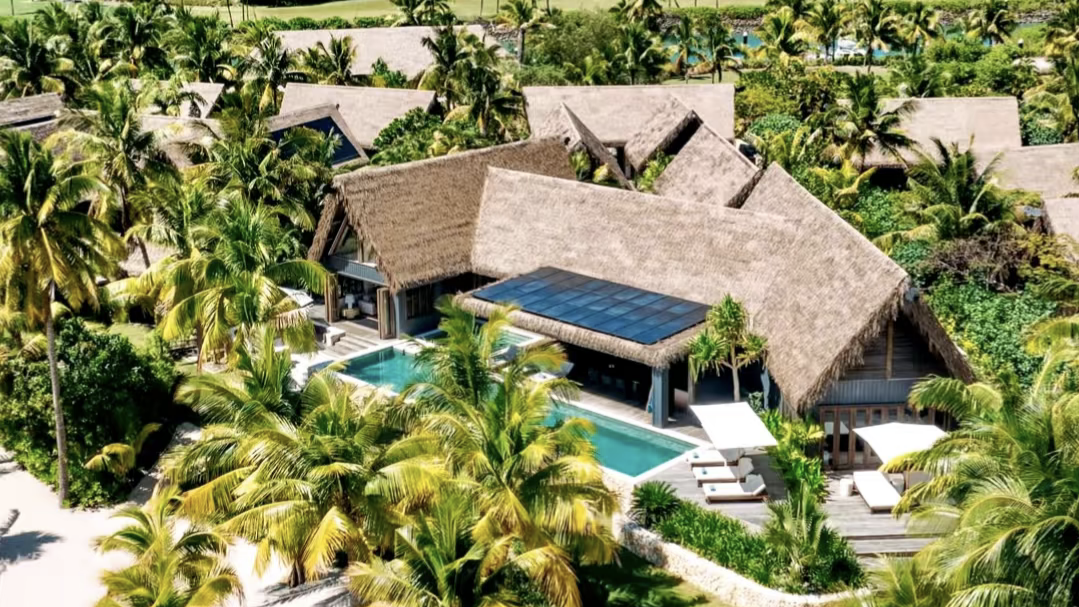
SNADI Solar's Energy Retrofit for the Mount Meru Hotel in Tanzania
In June 2024 – March 2025, Mount Meru Hotel, a premier 178 rooms hospitality property. The hotel faced chronic power instability and relied heavily on two 500kVA diesel generators. During peak tourism seasons, monthly fuel costs exceeded $18,000. Additionally, frequent voltage spikes from the local grid caused repeated failures in the hotel's central chiller system and laundry equipment. A comprehensive off grid hybrid system was implemented, focusing on maximizing solar self consumption. The installation included a 450kWp solar array integrated into carports and rooftop spaces, paired with a 1.2MWh LiFePO4 Energy Storage System. The system was configured with a "Silent Night" logic. Between 11:00 PM and 7:00 AM, the generators were programmed to remain off, with the entire hotel load supported by the ESS. During the day, the laundry and pool heating systems were automated to trigger only when solar production exceeded the hotel's baseline demand.
The Results:
Fuel Reduction: Monthly diesel consumption dropped by 72%, saving the property approximately $13,000 per month.
Asset Protection: Zero reported compressor failures in the chiller system since commissioning due to the clean sine wave output of the high-frequency inverters.
Customer Satisfaction: Guest complaints regarding generator noise and vibration during the night were completely eliminated.
ROI: The projected payback period for the entire system was revised from 5.5 years to 4.2 years due to rising local fuel taxes.
Tailored Solutions for Specific Sectors
Hospitality: The "Green Quiet" Strategy
Hotels require silence and reliability. By using an ESS to handle night-time loads, you eliminate the noise and exhaust of generators. This not only saves money but enhances the guest experience, allowing the hotel to market itself as a "Green/Eco-Friendly" destination, often commanding a premium room rate.
Agriculture: The "Irrigation Buffer"
For remote farms, the distance from the grid makes extension costs prohibitive. A high-peak-power inverter system can handle the massive "in-rush" current required to start large irrigation motors. By prioritizing solar self consumption, farmers can move water during the day for free, using the ESS to power essential security lighting and cold storage overnight.
Education: The "Energy Asset" Model
Schools often have high daytime loads but low night-time usage. This makes them perfect candidates for solar. The ESS ensures that computer labs and science equipment are protected from surges. Furthermore, the transparent monitoring system can be used as a teaching tool for students to learn about sustainable resource management.
Conclusion:
In the off-grid and unstable grid markets, you are not selling hardware; you are selling the certainty that the lights will stay on and the costs will stay down. By mastering the science of solar self consumption, commercial properties can transition from being victims of their infrastructure to masters of their own energy destiny.
✉️Email: exportdept@snadi.com.cn
Website:
www.snatsolar.com
www.snadisolar.com
☎️WhatsApp / WeChat: +86 18039293535
FAQ
Q1. How can a large facility like a hotel or school transition to a self consumption model effectively?
Transitioning starts with a professional energy audit to identify your facility's peak usage hours and baseload demand. For schools or hotels, we recommend a phased approach where smart inverters are integrated first to manage daytime loads. By analyzing your specific consumption patterns, we can size your solar array to cover your primary daytime operations, ensuring that nearly every watt produced is consumed on-site. This strategy provides the fastest path to energy freedom by reducing reliance on the grid during its most expensive periods.
Q2. Is battery storage mandatory to achieve true energy freedom with a solar system?
While you can achieve significant energy independence during the day without batteries, storage is essential for reaching 24 hour energy freedom. Without a battery, any excess energy produced at midday is sent back to the grid, and you must purchase power at night. For a farm with nighttime irrigation needs or a hotel with round the clock lighting, adding battery storage allows you to store that excess daytime sun and use it whenever the grid is most expensive or unavailable, truly completing the energy freedom cycle.
Q3. Does a self consumption system protect my business from utility grid outages?
Standard grid tied self consumption systems are designed to shut down during a utility outage to protect line workers. However, to achieve true energy freedom and resilience, you can choose an inverter with backup or off grid capabilities. When paired with battery storage, these advanced systems can automatically switch to "island mode" during a blackout. This ensures that your critical loads, such as school security systems or hotel refrigeration, continue to operate seamlessly even when the local utility grid fails.
Q4. How do I track my progress and verify that I am actually reaching energy freedom?
Modern self consumption solutions include sophisticated cloud based monitoring platforms that provide real time visibility into your energy balance. You can see exactly how much solar energy your facility is generating, how much you are consuming, and how little you are drawing from the utility grid. For a business owner, this data is vital for calculating your self sufficiency ratio. By monitoring these trends via a mobile app, you can fine tune your operations, such as scheduling heavy laundry or machinery use during peak sun hours, to further maximize your independence.

FAQ
The energy consumption standards for household appliances are usually regulated by relevant national departments, and different products have different energy efficiency level standards. Consumers can choose energy-saving products based on their energy efficiency levels.
What are the precautions for repairing and maintaining household appliances?
What is the service life of household appliances?
What issues should be noted when purchasing household appliances?
What issues should be noted when purchasing household appliances?