

Energy independence is no longer a luxury reserved for remote cabins. As global utility rates increased by an average of 12 percent in 2024 according to the International Energy Agency, the drive for self sufficiency has entered the mainstream. For those living in tiny homes, mobile units, or smaller urban properties, the transition to renewable power begins with a strategic understanding of small home solar panels. This technology allows residents to bypass the traditional grid entirely, providing a reliable and sustainable energy source that scales perfectly with reduced square footage.
Why Small Home Solar Panels are the Future of Urban Living
The shift toward smaller living spaces demands a reimagining of energy production. Traditional solar arrays often require vast roof areas that small properties simply do not possess. However, the latest advancements by SNADI/SNAT Solar in photovoltaic technology have shifted the focus from quantity to quality, making small scale installations more viable than ever before.
Space Efficiency: Maximizing output in limited rooftop or balcony areas
In limited environments, every square inch must work twice as hard. Modern high efficiency modules now reach conversion rates exceeding 22 percent. This means a compact array of small home solar panels can generate the same amount of electricity that previously required much larger setups. For a balcony or a small flat roof, using premium monocrystalline cells ensures that even a few panels can support essential electronics and lighting. In 2025, N type TopCon technology became the industry standard for these space constrained applications, offering better performance in low light conditions and higher energy density per square meter.
Cost Effectiveness: Breaking down the ROI for small scale installations
The return on investment for small systems is often faster than for large residential projects. Because the total system cost is lower, homeowners can often fund the project without high interest loans. A typical setup for an off grid small home involves fewer mounting structures and simplified wiring, which reduces labor costs significantly. Data from the 2024 Renewable Global Status Report indicates that small scale solar users see a full return on their investment within 4 to 6 years, depending on local sunlight hours and energy consumption habits.
Choosing the Right Components for a Small Home System
A successful off grid system is more than just panels. It is a synchronized ecosystem of generation, conversion, and storage. Selecting the correct hardware is the difference between a system that fails during a cloudy week and one that provides consistent power year round.
High Efficiency Panels: Why N type cells are better for limited spaces
When space is the primary constraint, the cell chemistry matters immensely. N type solar cells have a lower degradation rate and a better temperature coefficient compared to older P type technology. This means that as the panels heat up in the summer sun, they maintain their output more effectively. For anyone looking at small home solar panels, choosing N type monocrystalline modules ensures that the system provides maximum wattage during the peak sun hours. This efficiency is crucial when you only have room for three or four panels.
Compact Inverters & Battery Storage: Integrated solutions for minimal footprints
The heartbeat of your system is the inverter. For smaller properties, a compact inverter for small house setups is essential to save interior space. SNADI/SNAT integrated units now combine the solar charge controller, the inverter, and sometimes even the battery management system into a single wall mounted box. This reduces the complexity of the installation and minimizes the vampire power loss that occurs when using multiple separate components. Coupling these with Lithium Iron Phosphate (LiFePO4) batteries provides a safe and long lasting storage solution. These batteries offer over 6000 cycles, meaning they can last upwards of 15 years with daily use in an off grid small home.
How to Calculate Your Small Home Solar Needs
Precision is vital when sizing an off grid system. Overestimating leads to wasted capital, while underestimating leads to blackouts. Professional solar system sizing involves a deep dive into your daily watt hour consumption. To calculate the total power required for your specific needs, use the following professional formula:
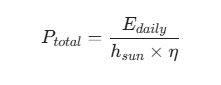
In this equation:
Edaily represents your total daily energy consumption in kilowatt hours (kWh).
hsun is the average peak sun hours for your specific geographic location.
n is the system efficiency coefficient, which typically ranges from 0.75 to 0.85 to account for losses in wiring and conversion.
Calculating Battery Capacity
Storage is the most expensive part of any off grid system. To ensure you have power during the night or through a rainy day, your battery bank must be sized correctly. A common rule of thumb for a reliable off grid small home is to have 2 to 3 days of autonomy. If your daily use is 5 kWh, a 15 kWh battery bank would be ideal. LiFePO4 chemistry is preferred here because it allows for a 90 percent depth of discharge without damaging the cells, unlike lead acid batteries which should only be discharged to 50 percent.
Inverter Sizing: Balancing peak load vs panel output
Your inverter must be able to handle the simultaneous startup of your most power hungry appliances. While small home solar panels might only be producing 1 kW of power, your microwave or water pump might require a 2 kW surge to start. Therefore, selecting an inverter for small house applications requires checking both the continuous power rating and the peak surge rating. For most tiny homes, a 3 kW pure sine wave inverter is the sweet spot, providing enough headroom for a fridge, laptop, and small kitchen appliances without being excessively bulky.
Top 2 Factors to Consider Before Installing Small Solar Systems
Before purchasing equipment, SNADI/SNAT Solar reminds you that environmental and regulatory factors must be audited to ensure the system performs as expected.
Shading & Orientation
In urban or wooded areas, shading is the primary enemy of solar panel efficiency. Even a small shadow from a chimney or a nearby tree falling across a single corner of one panel can reduce the output of the entire string by 30 percent or more. When planning an off grid small home, use a solar pathfinder or a mobile app to track potential shadows throughout the seasons. Proper orientation toward the true south (in the northern hemisphere) at an angle equal to your latitude is the standard for maximizing year round collection.
Local Regulations & Incentives
Even for off grid systems, local building codes may apply. Many regions now offer significant tax incentives for residential energy storage systems. In the United States, the Inflation Reduction Act provides a 30 percent federal tax credit for solar and battery installations through 2032. Checking local permits ensures that your system is safe and adds legal value to your property.
Comparison Table: Typical Small Home Solar Configurations
The following table compares common setups based on property size and energy needs to help you determine the best path forward.
| Property Type | Daily Consumption | Solar Array Size | Battery Storage | Inverter Capacity |
| Mobile Van / RV | 1 to 3 kWh | 300W to 600W | 2 to 4 kWh | 1000W to 2000W |
| Tiny House / Studio | 4 to 7 kWh | 1.2kW to 2.4kW | 5 to 10 kWh | 3000W |
| Small Apartment | 8 to 12 kWh | 3kW to 5kW | 10 to 20 kWh | 5000W |
| Off Grid Cabin | 12 to 18 kWh | 5kW to 8kW | 20 to 40 kWh | 8000W |
The 2024 Austin Tiny Home Initiative
In May 2024, the Green Horizon Project in Austin, Texas, implemented a series of modular off grid systems for a community of fifteen tiny homes. Each unit was equipped with 1.6 kW of high efficiency small home solar panels and a 10 kWh lithium storage unit.
The project lead, Sarah Jenkins, reported that by using a high quality inverter for small house designs, the residents were able to maintain a modern lifestyle, including air conditioning during the Texas summer, without ever connecting to the local utility grid. The project demonstrated that solar system sizing, when done correctly, can eliminate energy bills entirely. By the end of the first six months, the community recorded a 98 percent energy uptime, even during a week of heavy cloud cover in November. This success has sparked similar initiatives in Oregon and Colorado for 2025.
Conclusion
The landscape of domestic energy is changing. Choosing small home solar panels is a declaration of independence from rising costs and aging infrastructure. By focusing on solar panel efficiency and proper solar system sizing, any small property can become a self sustaining haven. Whether you are building an off grid small home or looking for the best inverter for small house upgrades, the technology is now mature enough to provide seamless, reliable power.
✉️Email: exportdept@snadi.com.cn
Website:

FAQ
N-Type TopCon modules are currently the top choice because they offer higher efficiency and better low light performance than standard PERC panels, allowing for more energy production in smaller areas.
Q2: How do I determine the right size for a small home solar system?
Q3: Are small solar panels durable enough for harsh weather?
Q4: Can small home solar systems run heavy appliances like refrigerators?
Q5: What maintenance is required for small home solar panels?