

The landscape of residential energy has undergone a fundamental transformation as we move through 2026. The strategic focus has shifted from mere capacity sales to sophisticated energy self sufficiency and the optimization of the Levelized Cost of Storage (LCOS). In this professional guide, we break down the complex variables required to determine exactly how many batteries to power a home in the current technological era.
From Capacity to Self Sufficiency
In the 2026 market, the most successful resident implementations are those that prioritize the resilience of the system over the raw size of the battery bank. We categorize modern residential requirements into three distinct tiers to help you align your investment with your actual lifestyle goals.
The Essential Load Profile: Survival Assurance
This profile focuses on the core logic of survival. The goal is to maintain critical infrastructure such as Wi Fi routers, basic LED lighting, and refrigeration. For these users, the primary objective is ensuring that business operations or home safety are never interrupted, even under the most constrained budgets.
The Whole Home Backup Profile: Quality of Life
This approach targets a seamless transition from traditional utility reliance to total independence. It covers high draw appliances like air conditioners, dryers, and electric vehicle chargers. The objective here is to maintain a luxury urban living experience without any awareness of the transition between power sources.
The Off Grid Independence Profile: Asset Value Enhancement
Designed for remote villas, mining outposts, or telecommunication base stations, this profile views energy as a capital asset. By removing the exorbitant costs of extending a utility grid to a remote location, these systems pay for themselves through property value appreciation and zero monthly utility bills.
The 2026 Industrial Grade Sizing Formula
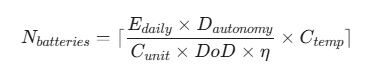
To apply this formula correctly, you must understand each variable:
Edaily: This represents the total daily energy consumption measured in kilowatt hours (kWh).
Dautonomy: This is the number of consecutive cloudy or rainy days the system must operate without solar input. For reliable residential performance, we recommend 2 to 3 days.
Cunit: The nominal capacity of a single battery module, typically 5kWh or 10kWh in 2026 models.
DoD: The Depth of Discharge. Current LiFePO4 technology allows for a 0.95 DoD, meaning you can safely use 95 percent of the stored energy.
n: The combined system efficiency. This includes losses from the solar inverter, cabling, and chemical conversion. For off grid systems, we use a conservative factor of 0.85.
Ctemp: The temperature compensation coefficient. In regions with harsh winters or high altitude mining sites, we apply a factor of 1.15 to 1.20 to account for reduced chemical activity in the cells.
If you fail to account for the 15 percent system loss (n), your system will likely shut down on the third day of rain, leading to potential business or property losses that far exceed the cost of an extra battery module.
2026 Scenario Based Configuration Standards
The following table provides a benchmark for various applications based on real world performance data collected in early 2026.
| Application Type | Daily Consumption (Est.) | Core Requirement | Recommended Capacity | 2026 Module Count (5kWh/unit) |
| Modern Agriculture (Irrigation) | 60 to 100 kWh | High Starting Current | 80 to 120 kWh | 16 to 24 Units |
| Luxury Single Villa (HVAC/EV) | 45 to 60 kWh | Fast Charging & Comfort | 40 to 60 kWh | 8 to 12 Units |
| 5G Remote Base Station | 10 to 20 kWh | Ultra High Cycle Life | 30 to 40 kWh | 6 to 8 Units |
| Remote Mining Camp Dorms | 30 to 50 kWh | Durability & Scalability | 40 to 60 kWh | 8 to 12 Units |
Translating Technical Parameters into Commercial Value
Understanding how many batteries to power a home is only half the battle. The commercial value lies in how that hardware performs under stress.
Solving for Peak Current vs. Energy Capacity
A common mistake is focusing solely on the total kWh. A homeowner might buy 10kWh of storage but still find their system tripping when the air conditioner starts. This is because of peak current demands. In 2026, SNADI/SNAT premium solar inverter systems support up to 2 times overload capacity for starting motors. This means you do not need to double your battery bank just to handle a 3 horsepower compressor.
The Electric Vehicle Integration Logic
As EV adoption peaks in 2026, the battery bank serves as an energy router. By adding 10kWh of additional storage, you are not just buying a backup. You are creating a buffer that allows you to capture excess solar energy during the day and transfer it to your vehicle at night, potentially saving thousands of dollars in off grid charging costs annually.
Analyzing the Levelized Cost of Storage (LCOS)
While some brands may offer lower upfront costs, the true metric of success is the LCOS. A cheap battery might degrade to 70 percent capacity after 3000 cycles. In contrast, high grade LiFePO4 solutions are engineered to maintain 80 percent capacity even by the year 2036.
| Metric | Budget Solution (Brand A) | Professional Solution (2026 Standard) |
| Upfront Investment | 20 Percent Lower | Baseline |
| Degradation Rate | 30 Percent after 5 years | 10 Percent after 5 years |
| Cycle Life Expectancy | 3000 Cycles | 6000 to 8000 Cycles |
| 10 Year Cost per kWh | Higher due to replacement | 15 Percent Lower |
The Windhoek Expansion (June 2025)
To illustrate the practical application of these principles, consider the expansion project at the Windhoek in Namibia, completed in June 2025. The facility required a robust off grid solution for a dormitory housing 50 workers.
The engineers initially estimated the load based on simple lighting and fans. However, after applying the 2026 sizing formula, they discovered that the peak starting currents for the communal industrial kitchen and the high temperature compensation factor Ctemp required a 30 percent larger battery bank than originally planned. By installing 120kWh of integrated LiFePO4 storage, the hub achieved 100 percent energy autonomy throughout the 2025 winter season, avoiding the use of expensive diesel generators which cost approximately 0.50 USD per kWh to operate. This project proved that knowing exactly how many batteries to power a home or facility is the difference between a failing system and a profitable asset.
Action Guide: Implementing a One Stop Service
To succeed in 2026, the delivery chain must be optimized through three specific methodologies.
How to Design
Contact SNADI/SNAT dedicated customer service directly one-on-one. This builds immediate trust and showcases EEAT to the end user.
How to Deliver
The industry is moving toward "All in One" pre fabricated modular designs. By integrating the batteries, solar inverter, and power distribution into a single cabinet, you reduce on site installation errors. Lowering the error rate is the most effective way to reduce long term after sales costs.
How to Maintain
Establish a full life cycle health record for every system. Utilizing off grid monitoring via LoRa or satellite links allows for preventative maintenance without relying on public internet infrastructure. This ensures that the question of how many batteries to power a home remains answered and optimized for the next decade.
✉️Email: exportdept@snadi.com.cn
Website:

FAQ
To find the correct count, you must use a formula that multiplies your daily kilowatt hour consumption by the desired days of autonomy. This total is then divided by the product of the individual battery capacity, the depth of discharge, and the overall system efficiency factor. In 2026, it is standard to use a 0.95 depth of discharge for lithium systems.
Q2: What are the main factors that influence residential battery system sizing?
Q3: Why is Levelized Cost of Storage more important than upfront battery price?
Q4: Can a home battery system handle high power appliances like air conditioners and electric vehicles?
Q5: What maintenance is required to ensure a home battery system lasts until 2036?