

For the vast majority of commercial and residential facilities, the rooftop photovoltaic array presents minimal complexity during a storage expansion. The solar panels will continue producing DC electricity without disturbance. Real engineering challenges reside inside the balance of system electrical hardware: evaluating inverter compatibility, establishing safe interconnection points, verifying overcurrent protection, and establishing how the facility transitions during grid outages.
Every comprehensive site evaluation begins with three items: the nameplate ratings of the existing inverter, the electrical service entrance panel, and historical electrical demand data. If the current solar inverter includes dedicated storage terminals and integrated battery management system communication capabilities, battery integration proceeds rapidly. If the site operates a conventional grid tied string inverter that remains in good condition, an AC coupled storage inverter connects directly to the AC distribution bus without disturbing rooftop string wiring.
Additional electrical engineering becomes essential when the service panel has no spare circuit breaker spaces, when the electrical busbar cannot accept additional backfeed under local electrical standards, or when a commercial facility requires three phase whole building backup. Scenarios like these frequently require an automatic transfer switch, external isolation contactors, a dedicated subpanel for protected circuits, or a main electrical service upgrade. System protection must guarantee that the battery inverter cannot backfeed utility distribution lines during a grid blackout.
Why Retrofit Energy Storage Now?
An energy storage retrofit delivers positive financial returns only when addressing specific operational and economic hurdles. Across Latin America, system owners navigate a challenging mix of reduced solar export compensation, rising peak demand charges, grid instability, and substantial commercial losses caused by utility outages.
Brazil provides a clear demonstration of this market shift. Federal Law 14.300 altered the financial landscape for distributed generation by phasing in grid usage charges tied to the distribution network wire component known as Fio B. Midday solar exports must now be measured against modern compensation structures rather than assuming exported kilowatt hours match the monetary value of imported electricity. Compounding this, regulated retail electricity rates climbed by an average of 8.6 percent based on ANEEL 2026 InfoTarifas data. For commercial enterprises, factoring both retail power inflation and reduced export credits is critical when evaluating battery payback schedules.
Commercial facilities across Mexico, Colombia, and Central America face comparable energy dynamics. Facilities operating under capacity based industrial rate schedules must synchronize battery dispatch with active billing windows, peak kilowatt demand, and facility operating shifts. For industrial users on Mexican CFE tariffs such as GDMTO or GDMTH, battery value comes directly from shaving utility demand during specific peak windows. An automated, load responsive dispatch strategy delivers tangible utility savings, whereas arbitrary fixed timers frequently fail to capture peak billing charges.
Grid reliability represents an equally urgent factor. Fitch Ratings outlined mounting pressures on regional electrical infrastructure and utility operating conditions in its 2026 industry outlook. When an unexpected outage strikes a cold storage warehouse, food packaging line, manufacturing plant, or logistics terminal, the real cost extends far beyond unserved electricity. Financial harm includes ruined inventory, halted production lines, dispatch delays, and prolonged system restarts. Standard diesel backup generation costs between $0.35 and $0.65 per generated kilowatt hour once fuel consumption, regular servicing, maintenance, and logistics are accounted for. Solar charged battery storage offers a clean alternative that mitigates utility interruptions without recurring fuel expenses.
AC Coupled vs. DC Coupled Retrofit
The selection between AC and DC coupling involves a clear architectural distinction that must be matched to site conditions. AC coupling connects battery storage downstream from the existing solar inverter on the alternating current distribution bus. DC coupling removes the legacy string inverter and installs a multi port hybrid inverter that manages both the solar array and the battery bank directly.
AC Coupled Electrical Architecture:
Photovoltaic Array feeds Existing Solar Inverter, which connects to the Main AC Distribution Panel, with a dedicated Battery Inverter and Battery Bank operating on a parallel AC storage circuit.
DC Coupled Electrical Architecture:
Photovoltaic Array and Battery Bank connect directly to a New Hybrid Inverter, which supplies the Main AC Distribution Panel and dedicated Critical Load Subpanels.
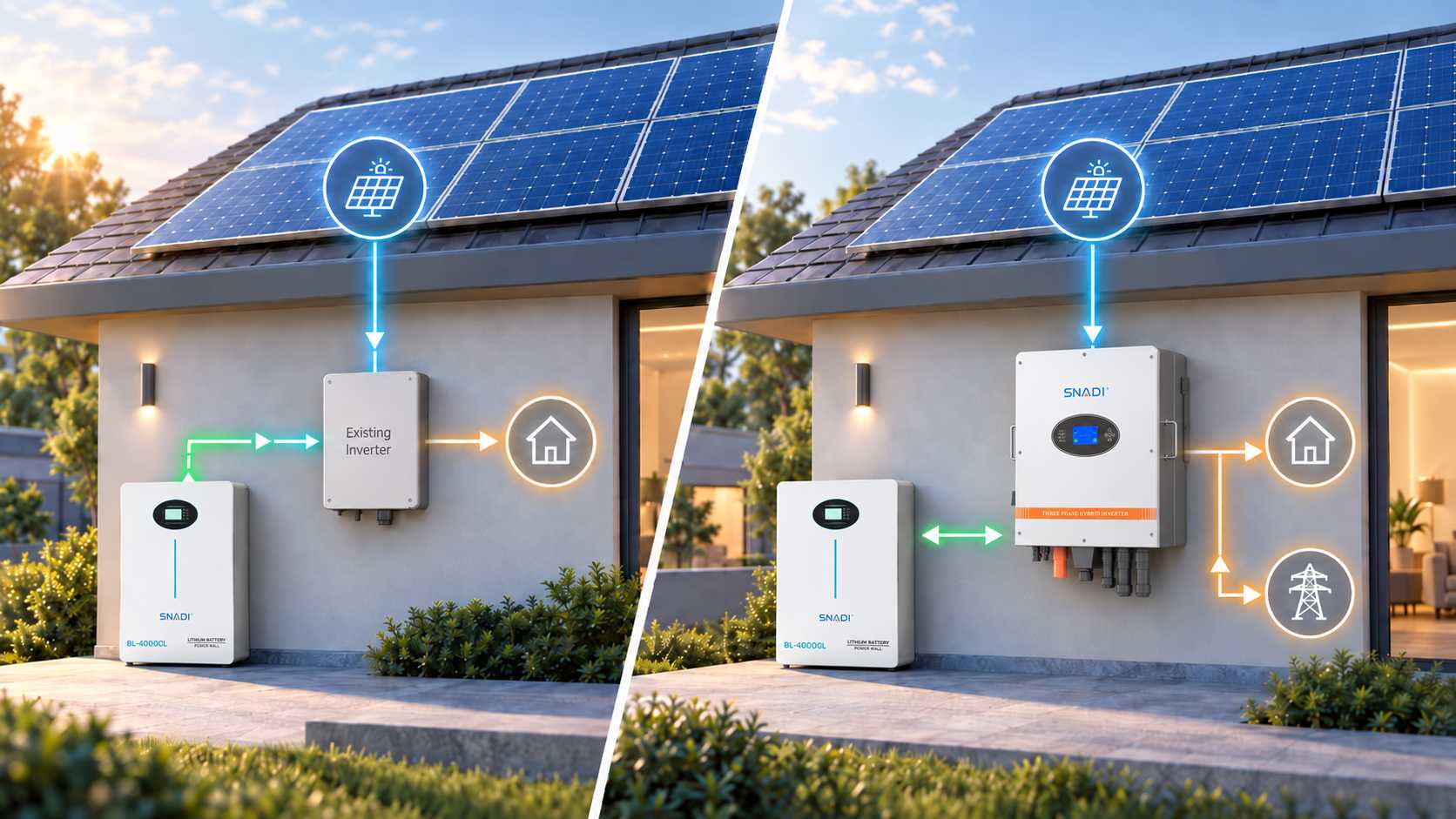
How AC Coupling Preserves Existing Grid Tied Inverters
For facilities with modern string inverters or microinverter systems in good operating condition, AC coupling provides an unobtrusive retrofit pathway. The solar generation equipment continues operating without alteration. A separate bidirectional battery inverter connects to the main AC switchboard, monitoring facility power flow via current transformers installed at the electrical service entrance.
Whenever rooftop solar output exceeds facility electrical consumption, the battery inverter draws surplus AC power from the switchboard bus, rectifies it to DC, and charges the battery bank. When peak tariff hours commence or a utility outage occurs, the battery inverter reverses direction to deliver AC power directly to protected facility circuits.
Engineering Advantages:
The rooftop DC array, module level power electronics, and DC wiring remain completely undisturbed. This eliminates commissioning risks on older photovoltaic arrays and preserves existing equipment warranties.
Engineering Tradeoffs:
Electrical energy experiences multiple conversion stages. Industry benchmarks show a round trip efficiency between 84 percent and 89 percent for AC coupled storage systems. Total efficiency varies depending upon battery chemistry, ambient temperatures, operating load points, and inverter characteristics.
How DC Coupling Works via Hybrid Inverter Replacement
DC coupling proves most advantageous when an existing solar inverter is already scheduled for lifecycle replacement. The electrical contractor decommissions the legacy string inverter and routes existing solar strings along with the new battery bank into a unified hybrid unit. A proven hardware option for this upgrade pathway is the SNADI Solar Hybrid Inverter Series. The legacy solar array requires thorough electrical verification before connecting to the new maximum power point tracking inputs.
Critical electrical checks include open circuit voltage, short circuit current, string sizing, inverter MPPT operating windows, temperature voltage coefficients, insulation resistance, and DC overcurrent protection. While a hybrid inverter reduces hardware footprint by consolidating power electronics into a single cabinet, it requires meticulous validation of the existing photovoltaic array.
Technical Comparison Matrix: AC vs. DC Retrofits
The following engineering matrix serves as a planning and screening resource. Final project engineering must rely upon certified equipment data sheets and local electrical codes.
Engineering Parameter | AC Coupled Battery Retrofit | DC Coupled Hybrid Inverter Upgrade |
Existing Inverter Status | Kept in active service with zero rooftop electrical modifications | Decommissioned and replaced by a unified hybrid inverter |
Rooftop Wiring and Array Impact | Downstream electrical work only, leaving rooftop conductors untouched | Legacy strings must be measured and matched to new MPPT voltage and current windows |
Round Trip Efficiency | 84 percent to 89 percent due to multiple conversion cycles | 90 percent to 94 percent through direct DC charging from solar array |
Wall and Equipment Footprint | Requires mounting an additional battery inverter alongside existing solar unit | Replaces old inverter with a single enclosure housing solar and storage controls |
Best Project Application | Newer solar inverters possessing substantial remaining warranty life | Inverters nearing replacement or sites with constrained wall space |
Islanding and Black Start | Requires compatible grid forming controls and frequency shift power regulation | Integrated directly within hybrid inverter platform for automated island transition |
Do You Need to Replace Your Solar Inverter to Add a Battery?
An operating solar inverter should not be decommissioned automatically simply to accommodate energy storage. Hardware decisions must reflect installed equipment age, operating condition, and communication capabilities.
1. Existing Hybrid or Battery Ready Inverters
If an operating inverter already includes battery terminals and compatible communication hardware, adding storage is straightforward. Even so, the selected battery bank must match operating DC voltage ranges, charge and discharge current thresholds, CAN or RS485 communication protocols, and protective firmware settings. The SNADI Household Energy Storage System offers a reliable storage solution for residential and light commercial applications. Installers should always verify digital protocol compatibility with the specific inverter model prior to installation.
2. Standard Grid Tied String Inverters
A conventional grid tied inverter cannot connect directly to battery cells because it lacks internal battery charging circuits and requires a reference AC voltage from the utility to function. However, this does not necessitate removing the equipment. An AC coupled battery inverter can operate adjacent to the existing solar inverter, utilizing current transformers at the service entrance to coordinate battery charging whenever solar generation exceeds site demand.
3. Aging Inverters Nearing End of Life
When an installed solar inverter approaches the conclusion of its expected operating lifespan, owners should examine full project economics before adding separate equipment. Paying for an AC coupled storage installation today and having to replace a failed solar inverter shortly thereafter doubles installation labor, permitting expenses, and site disruptions. In such cases, upgrading directly to a hybrid inverter delivers a more economical lifecycle investment. Equipment replacement decisions should be based on operational history, warranty status, and inverter health rather than chronological age alone.
How to Size a Battery Storage System: kWh vs. kW
Accurate battery sizing requires evaluating two distinct technical parameters: energy capacity measured in kilowatt hours and continuous power output measured in kilowatts. Confusing these two figures often leads to undersized systems that fail during critical operations.
Energy Capacity in Kilowatt Hours:
Governs how many hours connected circuits can run before battery reserves are depleted.
Continuous Power Output in Kilowatts:
Governs how much electrical equipment can run concurrently and whether the inverter can sustain inductive motor starting surges.
Consider an industrial workshop requiring 15 kilowatt hours of backup energy to bridge a two hour utility outage. While 15 kilowatt hours represents a modest storage capacity, if the backup panel powers three phase computer numerical control machinery, hydraulic pumps, or heavy dust extraction fans with high locked rotor starting currents, a 5 kilowatt inverter will trip on overcurrent even with a fully charged battery bank. Both continuous electrical loads and total energy storage capacity must be engineered in tandem.
CAPEX, OPEX, and Operational Risks
Initial equipment purchase price represents only one component of total retrofit economics. Installation labor, switchgear upgrades, utility interconnection studies, recurring maintenance, round trip conversion losses, and avoided outage costs all influence the optimum system choice. The figures below provide realistic planning benchmarks for evaluating project proposals.
Financial and Operational Metric | Strategy A: Low Voltage AC Coupled Retrofit | Strategy B: High Voltage DC Hybrid Upgrade | Strategy C: Diesel Generator Hybridization |
Initial CAPEX | Moderate, $380 to $550 per stored kWh | Moderate to high, $450 to $650 per stored kWh | Lower upfront equipment expense, $200 to $350 per kVA |
Routine OPEX and Maintenance | Low, limited to periodic inspection, terminal torque checks, and cleaning | Low, unified within a single integrated power electronics platform | High, recurring fuel consumption, oil and filter replacements, and engine overhauls |
Levelized Cost Comparison | $0.09 to $0.14 per cycled kWh based on benchmark modeling | $0.08 to $0.12 per cycled kWh based on benchmark modeling | $0.35 to $0.65 per generated kWh including fuel and engine wear |
Permitting and Interconnection | Straightforward downstream connection under most regional interconnection standards | May require an updated utility interconnection filing due to inverter replacement | Electrical tie in may be simple, but environmental, noise, and fuel storage codes apply |
Primary Technical Risk | Inadequate control coordination between battery inverter and existing solar inverter | Voltage or current mismatch between legacy solar strings and new inverter MPPT | Fuel degradation, starter battery failures, and mechanical breakdown risks |
Primary ROI Driver | Maximizing self consumption and mitigating utility power interruptions | Commercial peak shaving combined with high efficiency solar self consumption | Emergency backup protection only, offering zero daily tariff optimization value |
Common Pitfalls in Commercial and Residential Storage Retrofits
Most operational problems in storage retrofits stem from improper equipment coordination and site mismatches rather than battery cell chemistry failures. Three issues demand thorough engineering attention during project design.
1. Installing Excessive Storage Relative to Solar Yield:
Bigger battery banks do not equate to superior project economics. If an existing solar array produces only 12 kilowatt hours of surplus electricity on a typical afternoon, installing a 30 kilowatt hour battery bank leaves significant storage capacity sitting unused unless the facility utilizes an active off peak grid charging strategy. Battery capacity must be sized against verified surplus generation and discharge goals, rather than arbitrary solar array ratings. Capturing between 70 percent and 90 percent of verified daily solar surplus provides a balanced baseline.
2. Overlooking High Ambient Operating Temperatures:
While lithium iron phosphate cells offer exceptional thermal safety, physical enclosure location remains paramount. Battery cabinets installed inside unconditioned sheet metal outbuildings or unshaded outdoor locations can experience internal temperatures far exceeding 45 degrees Celsius across hot regions such as northern Mexico or coastal Brazil. Under elevated temperatures, battery management systems automatically restrict charge and discharge currents to preserve cell health, reducing available power when the facility needs it most.
3. Relying on Open Loop Voltage Control:
Operating modern lithium battery systems without active digital communication represents a major engineering compromise. In open loop mode, the inverter estimates battery state of charge solely from terminal voltage, an approach that is inherently imprecise due to the flat discharge curve of lithium iron phosphate chemistry. Lacking real time digital telemetry, the system experiences inaccurate state of charge tracking, premature cutoffs, and unnecessary cell degradation. System designers should always deploy closed loop communication profiles supported by the hardware manufacturers.
✉️Email: marketing@snadi.com.cn
Website:
☎️WhatsApp / WeChat: +86 1803929353

FAQ
Yes. When an existing solar inverter is in good operational condition, an AC coupled storage system connects directly to the AC distribution panel. The battery inverter monitors site electricity flow via current transformers and charges from available solar surplus without requiring a direct DC battery connection to the legacy solar inverter.
Will adding a battery keep my power on during a grid blackout?
What is the difference between LiFePO4 and lead acid for solar retrofits?
Can an AC coupled battery retrofit charge directly from the grid if solar production is low?