

One installer may propose a hybrid inverter with a DC coupled battery. Another may keep the existing solar inverter and add an AC coupled battery. Both quotations promise usable power, yet they place conversion equipment in different locations. That difference affects backup behavior, expansion, monitoring, service access, and the amount of equipment that must work together.
People searching for dc ac solar therefore need more than a definition. They need to know where electricity changes form, which device controls that change, and whether the proposed energy path still works after a battery, generator, or grid connection is added.
The short answer is direct. Photovoltaic modules produce direct current. Most building circuits and the public grid use alternating current. A solar inverter converts panel output into controlled AC that matches the electrical system. The real design decision begins after that answer because conversion can occur at one central inverter, at every module, or through a hybrid platform that also manages a battery.
Solar Starts as DC, but the Design Question Is Larger
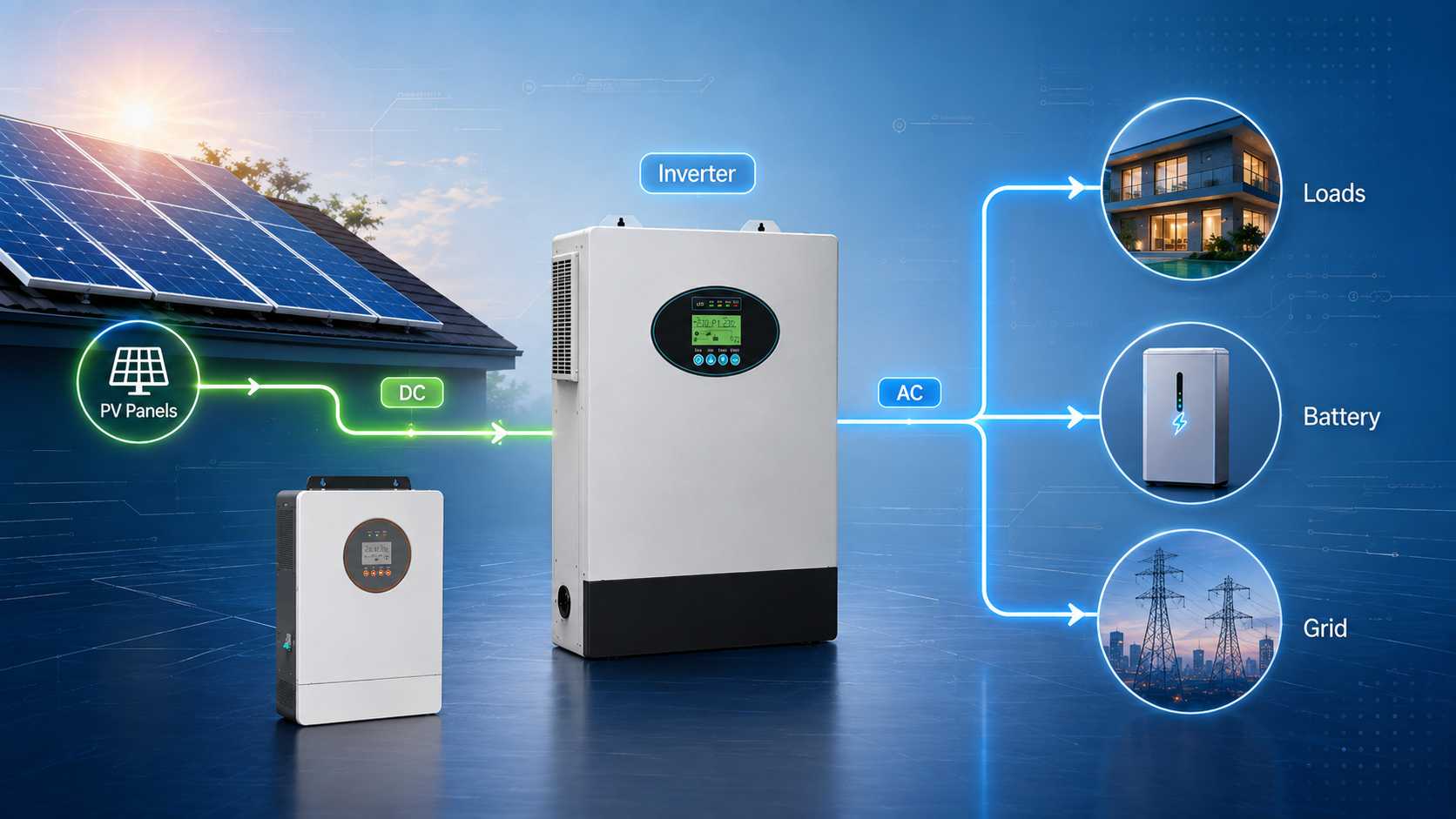
Sunlight causes electrical charge to move through the cells in a photovoltaic module. The resulting current flows in one direction, so it is DC. Modules connected in a string still produce DC, even though string voltage can be much higher than the voltage of one module.
An ordinary AC appliance cannot accept raw PV output. It expects a stable supply with the correct voltage, frequency, and waveform. A solar DC to AC inverter does more than reverse current direction. It tracks available array power, controls output quality, monitors operating conditions, and applies protection logic suited to the intended system.
Power and energy ratings also need to stay separate. Panel and inverter power are normally expressed in kilowatts. Battery energy is expressed in kilowatt hours. A 6 kW inverter describes power available at a moment. A 12 kWh battery describes stored energy. Backup time depends on both ratings, usable battery capacity, conversion loss, and the actual load profile.
Follow the Solar Conversion Point Through Four Locations
Conversion at a String Inverter
Modules are connected in one or more DC strings and routed to a wall mounted string inverter. The inverter performs maximum power point tracking and supplies AC to the distribution board. This arrangement gives the owner one clear conversion point and usually one main service location.
The simplicity does not remove engineering limits. Array voltage, current, string count, and cold weather open circuit voltage must remain inside the selected inverter range. A uniform roof can suit this design well. A roof with several orientations or uneven shading needs closer review because modules in a shared string influence the operating point of the connected group.
Conversion at Each Microinverter
A microinverter sits near each module and converts module DC into AC on the roof. The building receives an AC branch instead of a long DC string from the array.
For a buyer, ask where monitoring data is collected, how a roof device can be replaced, and how a future battery would connect. The term micro does not mean conversion disappears. It means conversion happens earlier and at more physical locations.
Conversion Inside a Hybrid Inverter
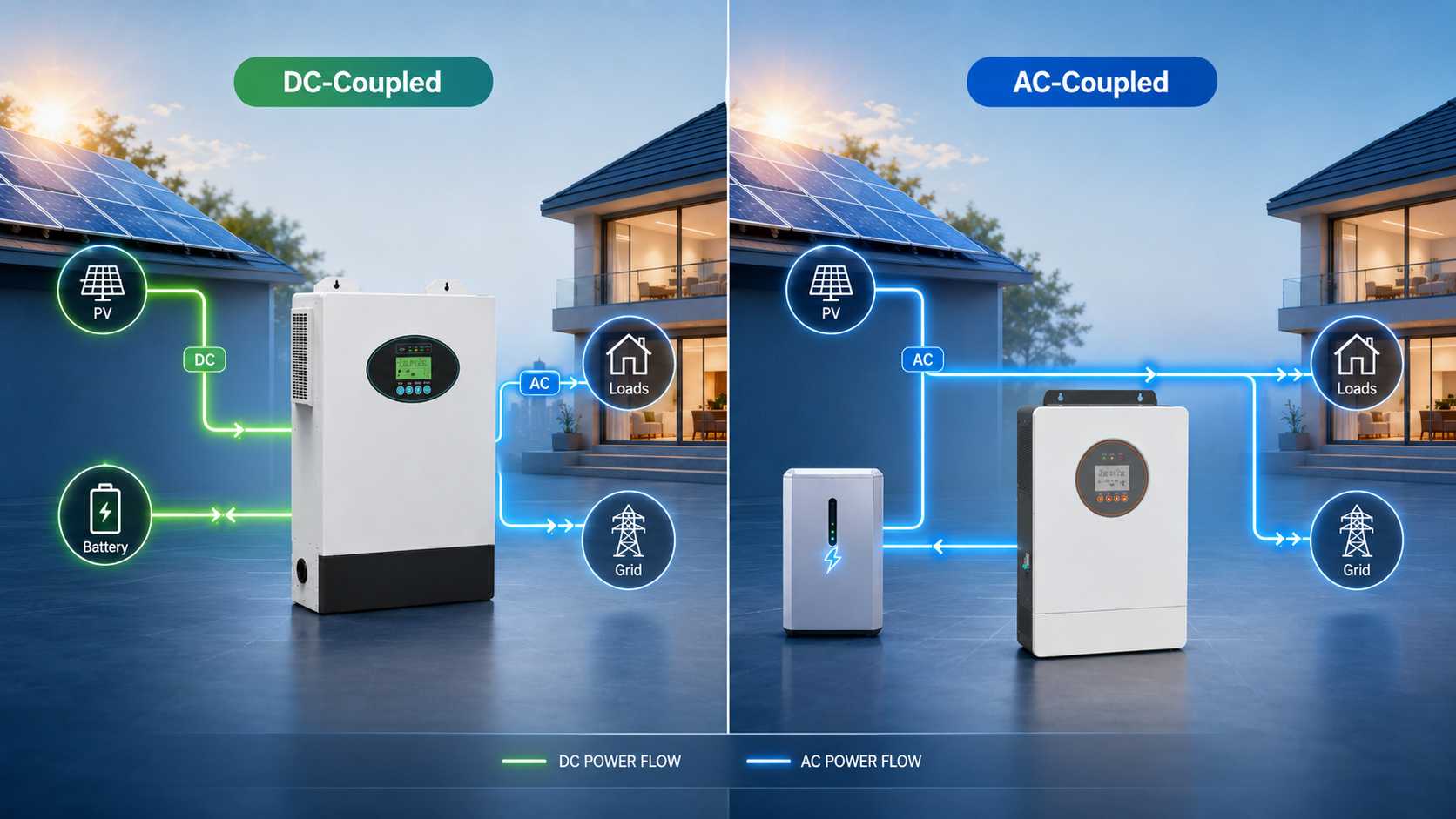
In a DC coupled solar and battery design, PV and battery circuits meet on the DC side of a hybrid inverter. Solar can support loads, charge the battery, or do both within the current and power limits of the system. When the battery supplies an AC load, the hybrid inverter creates the required AC output.
This path often makes sense for a new solar and storage project because one control platform coordinates several energy flows. Compatibility becomes more important, not less. PV voltage, battery voltage, battery communication, charge current, output power, transfer behavior, and protection settings must be checked as one operating system.
Conversion Before the Grid Connection
A grid connected inverter must create AC that can operate with the network and respond as required by the applicable connection rules. The IEC grid connection specification identifies configuration, protection, power control, grid support, fault response, and information exchange as relevant topics. A product family name alone does not prove local approval. The installer must confirm the required grid code, certification route, and export setting for the project location.
This point also explains why panels do not normally keep ordinary outlets alive during a grid outage. The system needs an inverter and switching arrangement designed to establish a stable local AC supply, isolate that supply from the grid, and limit backup loads to available power. Sunshine alone is not a backup specification.
Compare Architectures by the Conversion Point
A useful proposal shows where power changes between DC and AC. AC coupling and DC coupling are connection topologies, not quality grades. Neither label is automatically superior. The best choice depends on whether the project is new or existing, how storage will be used, where equipment can be installed, and which devices the owner is willing to maintain.
Architecture | Energy path to an AC load | Buyer value | Trade off to check |
String inverter | Panel DC to central inverter to AC board | One clear conversion and service point | String limits, shading interaction, and central dependency |
Microinverter | Module DC to module level AC to AC branch | Module level conversion and monitoring | Roof access, device count, and later battery integration |
DC coupled battery | Panel DC and battery DC through a hybrid inverter to AC loads | One coordinated solar and storage controller | Battery communication, shared power limits, and replacement compatibility |
AC coupled battery | Panel DC through a solar inverter to an AC bus, then through a battery inverter for storage | Often retains an existing solar inverter | Additional conversion, separate controls, and backup coordination |
A new installation with storage favor a DC coupled hybrid path because the inverter and battery are selected together. A retrofit may favor AC coupling because an existing solar inverter can remain in service. A shaded roof with several orientations may justify module level conversion. A simple uniform array may not benefit from the added device count. The architecture should answer a site condition, not follow a fashionable label.
Storage Changes the Power Path and the Commercial Trade Off
In a DC coupled design, PV energy can enter the battery before it becomes AC. In an AC coupled design, solar power first becomes AC. A battery inverter then converts available AC into DC for charging and converts battery DC back into AC during discharge.
Additional conversion stages can add energy loss, but conversion count should not decide the purchase on its own. Retaining a sound installed inverter can reduce construction work and avoid replacing useful equipment. A new hybrid system can reduce controller count and simplify the user interface, yet it can create tighter dependence on battery communication and future replacement compatibility.
Backup behavior deserves a separate line in every quotation. Identify the critical load panel, the largest motor starting demand, expected simultaneous load, target backup time, and generator requirement. Confirm whether solar can continue charging during an outage, how transfer occurs, which loads remain disconnected, and what happens when the battery reaches its reserve state of charge.
Our engineering advice is simple. Ask every bidder to draw one line from PV to battery, loads, and grid. Mark DC and AC on each segment and write the maximum power beside every conversion device. If the drawing cannot explain normal operation, outage operation, and battery charging in plain language, the quotation is not ready for approval.
SNADI/SNAT Solar Inverter Families
For an off grid site or a backup centered design, we use the SNADI/SNAT Solar NKH Off Grid Hybrid Solar Inverter as a practical starting point. The public family covers 1.2 kW to 12 kW and combines inverter operation, MPPT charging, AC charging, pure sine wave output, and configurable source priority. It suits a power path in which PV, battery, and an AC source are coordinated through one DC coupled control point.
Model selection still depends on the actual electrical inputs. We check PV open circuit voltage, MPPT range, battery voltage, maximum charging current, continuous output, surge demand, and transfer behavior. Cable size, polarity, DC protection, and terminal requirements must follow the selected manual.
For a grid interactive installation or a site that needs stronger enclosure protection, we use the SNADI/SNAT Solar ES IP54 On and Off Grid Solar Inverter EURO as the next comparison point. The public range includes 6.2 kW and 12 kW options, an IP54 enclosure, battery optional operation, and grid interaction functions. This family fits projects where PV, loads, grid, and optional storage must be coordinated while local connection requirements are confirmed.
The two families solve different operating problems. NKH is the clearer starting point for an off grid or backup centered route. ES IP54 is the stronger starting point when grid interaction and enclosure rating are part of the requirement. For either family, we verify battery communication against supported protocols and settings.
Use Five Inputs Before Requesting a Final Inverter Quotation
A supplier can size a solar DC to AC converter more accurately when the request begins with operating evidence instead of a preferred model number. Five input groups expose most conflicts before equipment is ordered.
Input to provide | What engineering needs | Purchase risk if omitted |
Load profile | Running power, starting power, operating hours, and critical circuits | Trips, poor backup priority, or unnecessary oversizing |
PV array | Module data, string layout, orientation, shading, and minimum temperature | PV voltage outside the allowed range or weak tracking |
Battery plan | Chemistry, voltage, usable energy, charge rate, and communication protocol | Charge limits, communication faults, or short backup time |
Grid and generator | Voltage, frequency, phase, export rule, and generator quality | Connection rejection or unstable source transfer |
Site conditions | Indoor or outdoor location, heat, dust, humidity, and service access | Thermal derating, enclosure mismatch, or difficult maintenance |
Financial value follows the same evidence. Oversizing raises CAPEX and may leave capacity unused. Undersizing can create trips, lost production, or excessive generator runtime. A retrofit that retains existing equipment may lower immediate CAPEX. A new integrated system may reduce controller count and simplify operation. Compare the purchase price with OPEX, service access, replacement options, monitoring, and expected operating modes.
Before choosing a system, confirm the array window, battery interface, output waveform, phase arrangement, protection plan, grid approval, backup switching, and local service process. Also ask which measurements remain visible when separate devices use different monitoring platforms. A design that cannot be diagnosed after commissioning carries an operating cost that the quotation may not show.
Conclusion
DC AC solar is easiest to understand as an energy route. Panels and batteries operate on DC. Loads and the grid usually operate on AC. The inverter marks the main conversion point, while the string, microinverter, DC coupled, or AC coupled architecture determines where that point sits and how storage changes the route.
For an engineering review, send us the load list, PV module data, battery goal, grid details, and site conditions. We can map the conversion points, define normal and outage operation, and check whether an NKH or ES IP54 configuration fits the intended loads, backup behavior, and installation environment. The next step is a clear one line power path supported by model level electrical checks.
✉️Email: marketing@snadi.com.cn
Website:
☎️WhatsApp / WeChat: +86 1803929353

FAQ
Not in a normal building system. Panel output is DC and changes with irradiance. AC appliances need a controlled supply, so an inverter and the required switching and protection equipment sit between the array and the load.
Does a battery store AC or DC electricity?
Is a hybrid inverter always more efficient?
Can one inverter power loads and charge a battery at the same time?
Why does inverter power differ from panel power?
What should a buyer verify before adding storage to existing solar?