

Two battery quotes can both show 10 kWh and still provide very different nights of backup, maintenance work and replacement risk. One may support a daily evening load and recharge before noon. The other may be suitable only for occasional use. The difference comes from permitted discharge, temperature, charger settings, peak demand, monitoring and the warranty conditions behind the battery.
A useful lithium ion vs lead acid comparison starts with delivered service. A daily solar system may need energy every evening, a refrigerator that must survive an outage and enough charge power to recover the next day. A cabin used a few weekends each month has a different duty. Chemistry matters, but it does not replace the project brief.
Define the Backup Service Before Comparing Chemistry
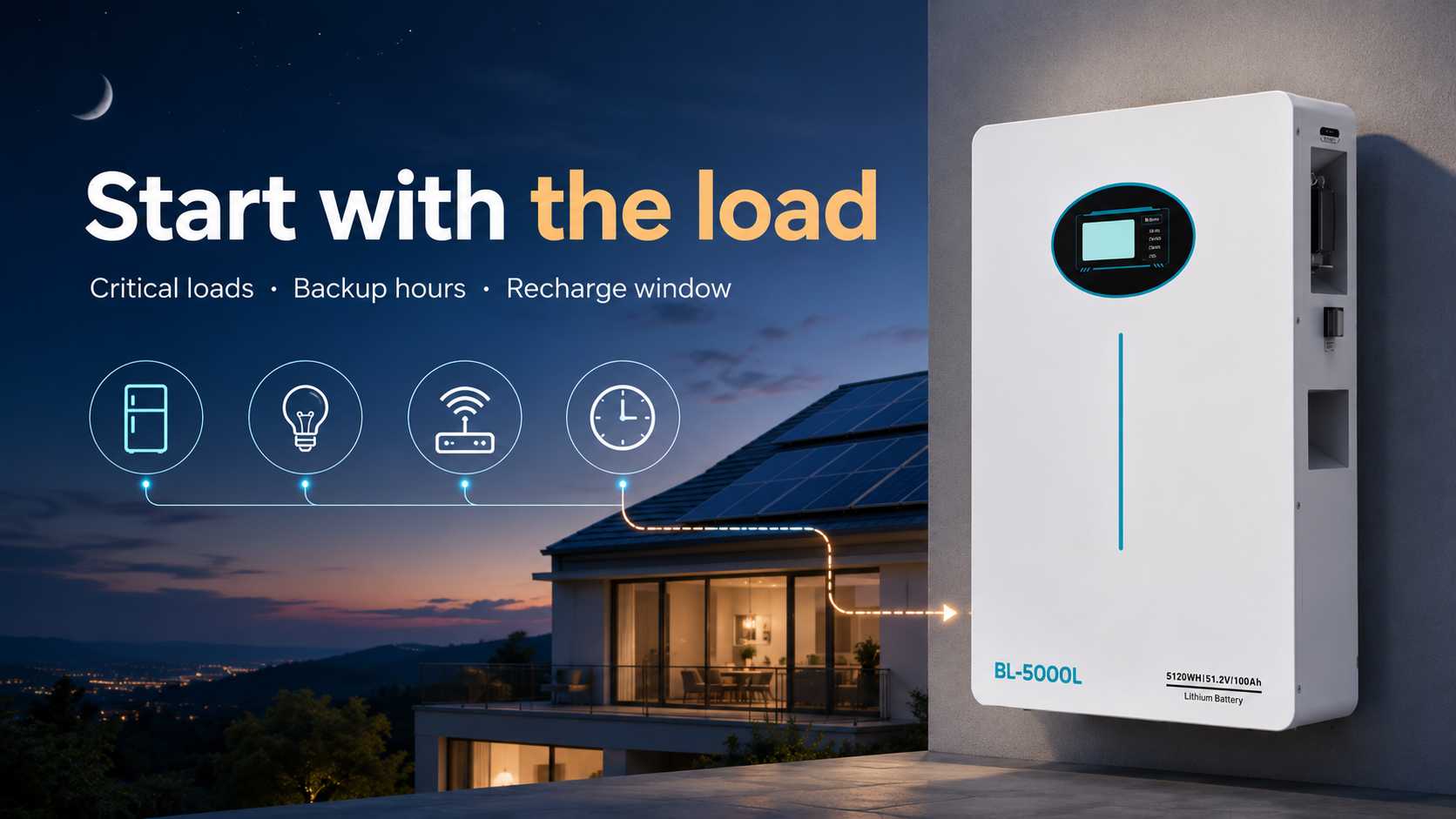
Before reviewing price, write down the critical loads, running power, surge demand, required backup hours, cycling frequency, PV array size, daily solar window, installation temperature and service access. Add the consequence of failure. Refrigeration, remote communications and a few lights are not the same operating duty.
The Energy Department distinguishes round trip efficiency, cycle life and calendar life in storage assessment, and notes that conventional battery cycle life varies with depth of discharge. A single cycle number or one percentage cannot rank every battery. The buyer needs the model documents and the conditions under which they apply.
Lithium ion is a family
Lithium ion covers more than one cell chemistry and more than one battery architecture. For stationary solar storage, ask for the actual cell chemistry, battery management system, permitted charge and discharge range, temperature limits, warranty definition and approved system partners. LiFePO4 is a lithium ion chemistry, but it is not a substitute for reading a model specific datasheet.
Lead acid is also a family
Flooded, AGM and gel batteries do not share the same maintenance, ventilation or charge requirements. A rule written for a flooded battery may not apply to a sealed product. Ask whether electrolyte inspection is required, what ventilation is needed and how the charger handles absorption, float and temperature compensation.
Nominal energy is not usable energy
Nominal kilowatt hours describe stored energy under a rating condition. Real load planning also depends on permitted discharge depth, discharge rate, temperature, inverter losses and an allowance for ageing. A conservative design reserves enough capacity for the end of life condition instead of promising every rated kilowatt hour to a critical load.
The recharge window is part of the design
If a battery supplies 6 kWh each evening, the next day must provide more than 6 kWh while serving daytime loads. Check PV production, inverter or charger power, battery current limit, weather margin and any utility charging rule. A large battery without enough recharge power becomes a reserve that never reaches the intended state of charge.
Match the Battery to the Duty Pattern
Daily solar shifting makes usable energy, recurring charge acceptance and delivered energy per cycle the main questions. A home that shifts solar into evening cooking, lighting and refrigeration needs a battery that can repeat the task inside the available solar window. For occasional standby use, calendar ageing, inspection interval and readiness can matter more than daily throughput.
Duty pattern | What to compare | Frequent mistake | Evidence to request |
Daily solar shifting | Usable energy, cycle warranty, recharge current | Choosing by nominal amp hours | Datasheet and warranty conditions |
Occasional backup | Storage behaviour, inspection task, replacement plan | Ignoring maintenance and float settings | Manual and service plan |
Remote off grid load | Monitoring, recovery after poor weather, spare parts | Underestimating service visit cost | Alarm method and service path |
Remote sites make each technician visit part of the business case. A battery with a lower purchase price can cost more to own when maintenance is hard to schedule or alarms do not identify a fault clearly. A monitoring and service plan belongs beside the battery quotation, not after the equipment is installed.
For a small system used rarely, a suitable lead acid design can remain a rational option when the owner accepts its servicing requirements and the charge profile is correct. For repeated daily solar shifting, a documented lithium battery and compatible hybrid inverter often offer a clearer route to usable energy and planned cycling. The deciding issue is the duty, not a generic winner chart.
Calculate Delivered Service Before You Compare Price
Start each candidate with a planning expression: planned usable energy equals rated energy multiplied by permitted discharge range, temperature allowance and end of life allowance. Every factor should come from a model document or a clearly marked design assumption. Do not copy a generic discharge percentage into a purchase order.
Consider a shop with 1.2 kW of critical load for four hours. The load energy is 4.8 kWh before inverter losses. A 10 kWh battery can appear sufficient, but the design still needs its permitted discharge range, temperature behaviour, inverter efficiency and ageing reserve. If a motor or pump must run, assess the starting demand separately. Kilowatt hours answer duration. Kilowatts and surge current answer whether the load can start.
The inverter is part of that answer. When we assess a lithium replacement, we check whether the existing inverter can receive battery limits through a supported communication method. Output power, output current and battery management interaction as selection factors for backup systems. A nominal voltage match alone does not establish a working system.
Check Climate, Space and Integration Together
Cold discharge capability does not automatically mean that charging is permitted in the same conditions. Hot enclosures can change capacity retention, charger behaviour and service life. Ask for charge limits and discharge limits separately, then review the actual indoor or outdoor location, sun exposure, humidity, airflow, enclosure needs and access for service.
At SNADI/SNAT Solar, we use the BL Power Storage Battery as one example of why an integration review matters. The public product page lists 51.2V options including 314Ah, a built in battery management system and CAN, RS485 and RS232 communications. Those details start the discussion, but they do not replace confirming the intended inverter protocol, current limit, temperature range and installation manual for the selected configuration.
Put the battery temperature reading on the commissioning checklist. If a cold morning prevents charging, the system should report that condition clearly. Without that visibility, an owner may assume the PV array has failed when the actual limit is a battery protection condition.
For a larger residential design, verify the inverter model, voltage range, communication method, charge current limit, cable size, fuse rating and parallel settings as one set of decisions. A battery with capable communications is useful only when the inverter follows a supported protocol and the installer proves the exchange during commissioning.
Treat a Lead Acid to Lithium Change as a Conversion
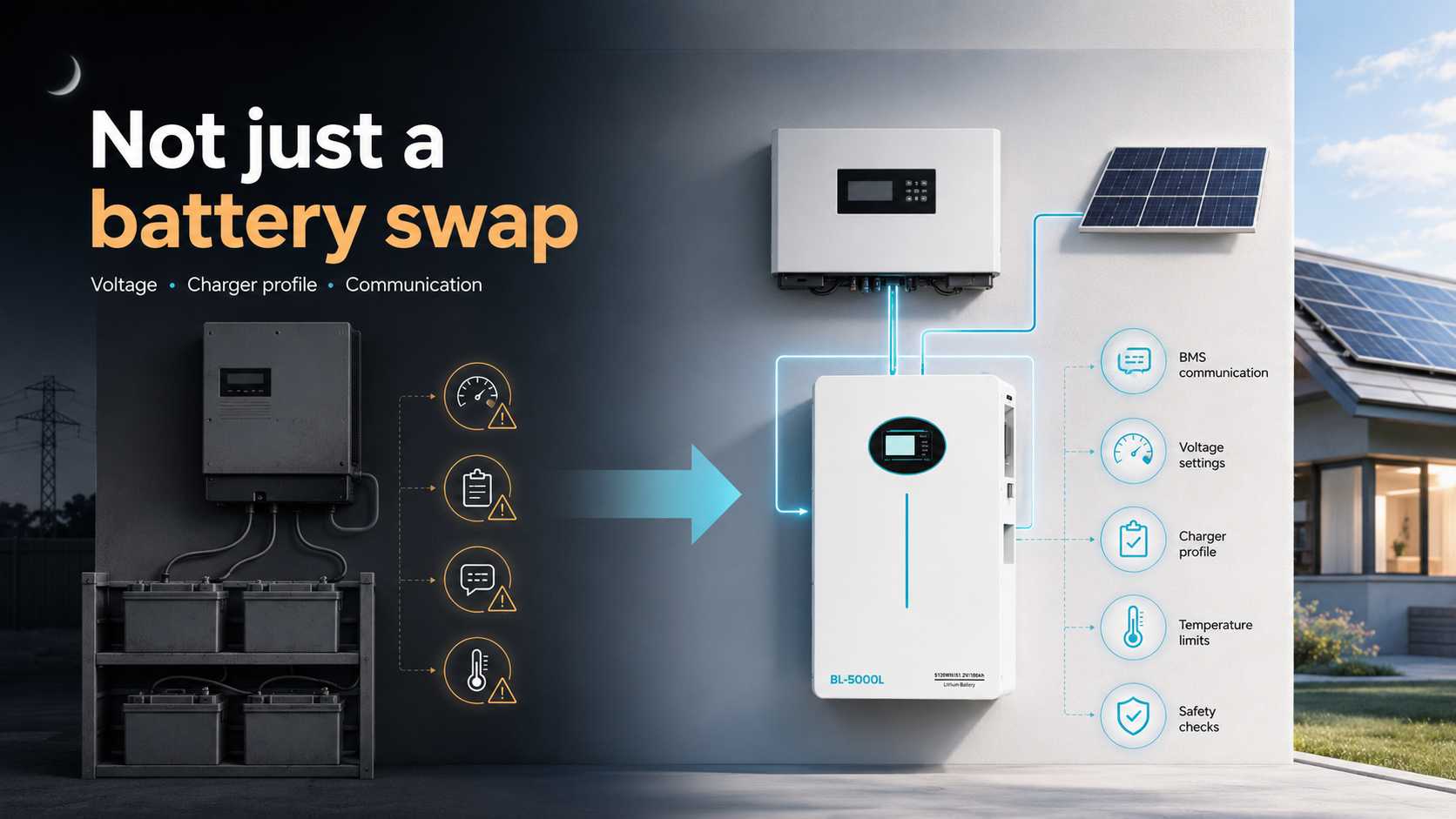
Changing chemistry is not a battery swap. Start with nominal system voltage, actual upper and lower limits, charger profiles, equalization behaviour, low voltage cutoff, cable size, fuse rating and inverter surge demand. Lead acid charging may use bulk, absorption, float and temperature compensation. A lithium battery may require a manufacturer approved profile and may require equalization to be disabled.
Then check communications. A battery management system can use CAN or RS485 to share state of charge, current limits and protection events. When the inverter and battery cannot exchange approved information, follow the published fallback method. Do not invent voltage settings, mix unmatched battery banks or parallel old and new chemistry unless the manufacturers approve the configuration.
The commissioning record should capture the selected battery profile, limits, protection settings, alarm contacts, battery serial information and the result of a controlled load test. This makes later service faster and gives the owner a reference when a new installer reviews the system.
Review Safety as a Complete System
Safety is not settled by a statement that one chemistry is safer. The enclosure, battery management, inverter, disconnects, cable protection, location, emergency information and local installation rules all shape the risk. For projects governed by United States requirements, UL describes UL 9540 as a system standard and UL 9540A as a method for evaluating thermal runaway fire propagation. The relevant certification and authority review must match the actual installation.
Lead acid planning should include product specific ventilation, electrolyte and maintenance instructions. Lithium planning should include listed equipment, grounding, protection settings, temperature controls and a response plan for alarms. Neither approach supports bypassing the battery management system, charging outside manual limits or placing combustible materials around the equipment.
Compare Lifetime Cost per Delivered Kilowatt Hour
Lead acid can have a lower first purchase price. Lithium can have higher initial equipment cost but a different service pattern. Neither fact settles the lifetime cost for solar storage. The comparison needs both a cost side and an energy service side.
Decision lens | Cost or risk to include | What can change the result |
Initial cost | Battery, charger changes, enclosure work, protection and installation | Existing equipment compatibility and site conditions |
Operating cost | Maintenance, monitoring, replacement labour and downtime | Service access and actual use frequency |
Delivered service | Usable energy, power capability and warranty conditions | Temperature, discharge depth and recharge availability |
End of life | Removal, replacement plan and handoff route | Local service capacity and ownership period |
Estimate the energy side from usable energy per cycle and the cycles or years supported by the warranty at the expected duty. Keep hot climate, shallow use, deep use and delayed recharge as separate sensitivity cases. A simple calculation with stated assumptions is more useful than a confident lifetime claim without an operating context.
Conclusion
Lithium ion vs lead acid is a useful search term, but it is not a system design. Start with the load and consequence of failure, calculate usable energy and recharge time, then verify climate limits, inverter compatibility, safety evidence and lifetime cost. The right option is the one that can repeatedly deliver the required service under documented conditions. Bring us the load profile, inverter model, installation location and required backup period. At SNADI/SNAT Solar, we can use those inputs to review battery compatibility and define a storage plan that is practical to commission, monitor and service.
✉️Email: marketing@snadi.com.cn
Website:
☎️WhatsApp / WeChat: +86 1803929353

FAQ
No. Daily cycling, limited space and high service visit cost can favour a well integrated lithium system. Occasional use with a strict initial budget can still support a suitable lead acid design. Compare the model, duty pattern and service plan.
Is LiFePO4 the same as lithium ion?
Can an old lead acid charger charge a lithium battery?
What should I compare instead of amp hours?
Why is the recharge window important?
What must be checked before a lead acid to lithium conversion?