
Solar monitoring devices are not just dashboards. They are the warning layer between a PV system that quietly loses yield and an owner who only notices the problem when the bill looks wrong, the battery is empty, or the installer receives a complaint.
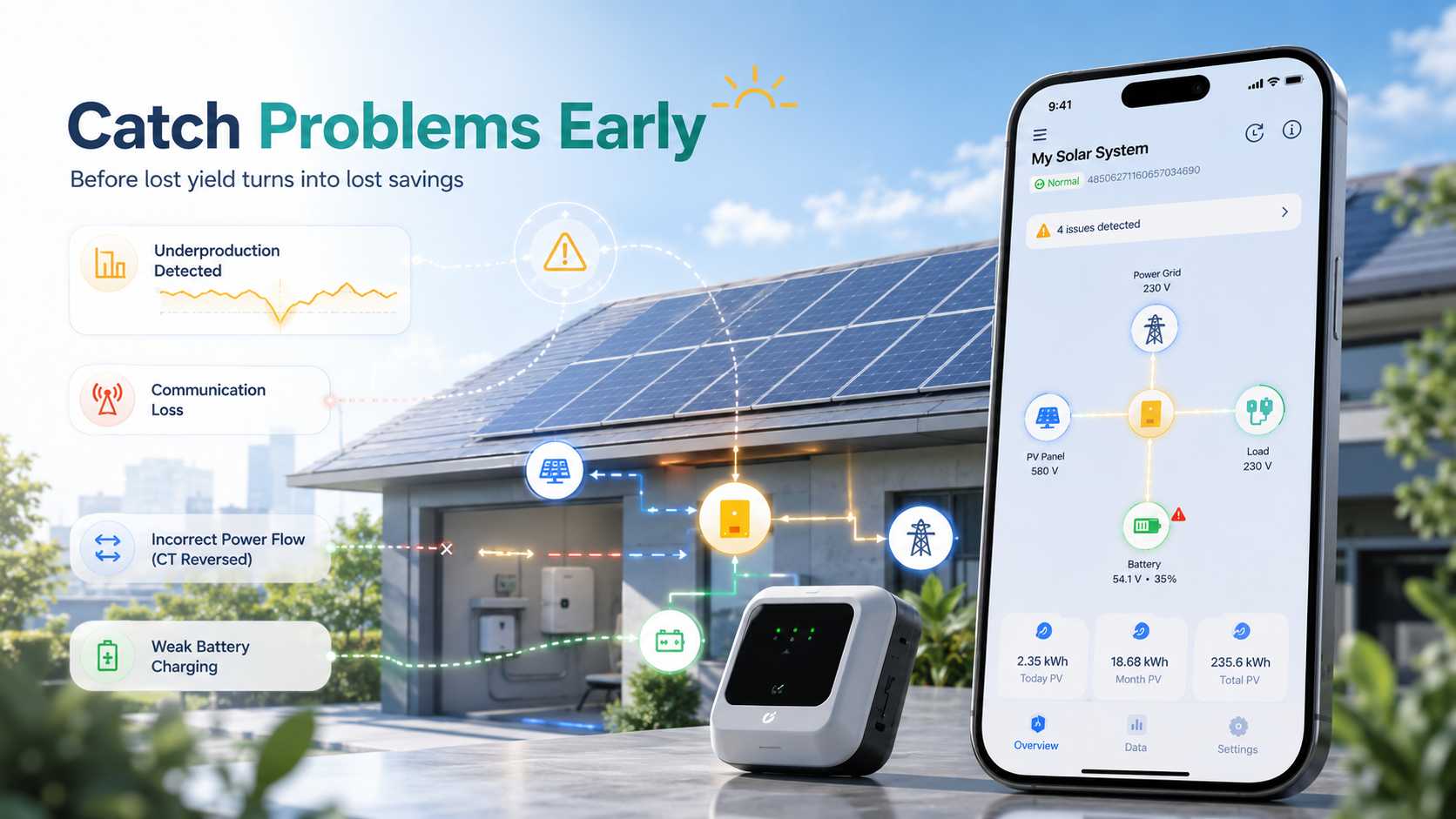
For a Chilean homeowner, small shop, school, clinic, or distributor portfolio, device choice affects how quickly someone can see underproduction, battery charging failure, grid export limits, communication loss, reversed CT direction, or a fault code that needs service.
The Hidden Cost of Silent PV Underperformance
A PV system can look normal from the ground and still lose money. One dirty string, one failed communication module, one meter wired in the wrong direction, one battery that never reaches the right state of charge, or one inverter fault that no one reads can reduce system value for weeks.
The financial loss is not only lower kWh. A small business may import more grid power during expensive hours. A cold room may lose backup readiness. A home may charge the battery from the grid at the wrong time. An installer may spend more on site visits because no one can diagnose the issue remotely.
Practical check: if the monitoring screen cannot tell the owner what action should happen next, it is only a display. A stronger setup connects data, alert, owner message, and service action.
What Solar Monitoring Devices Actually Do
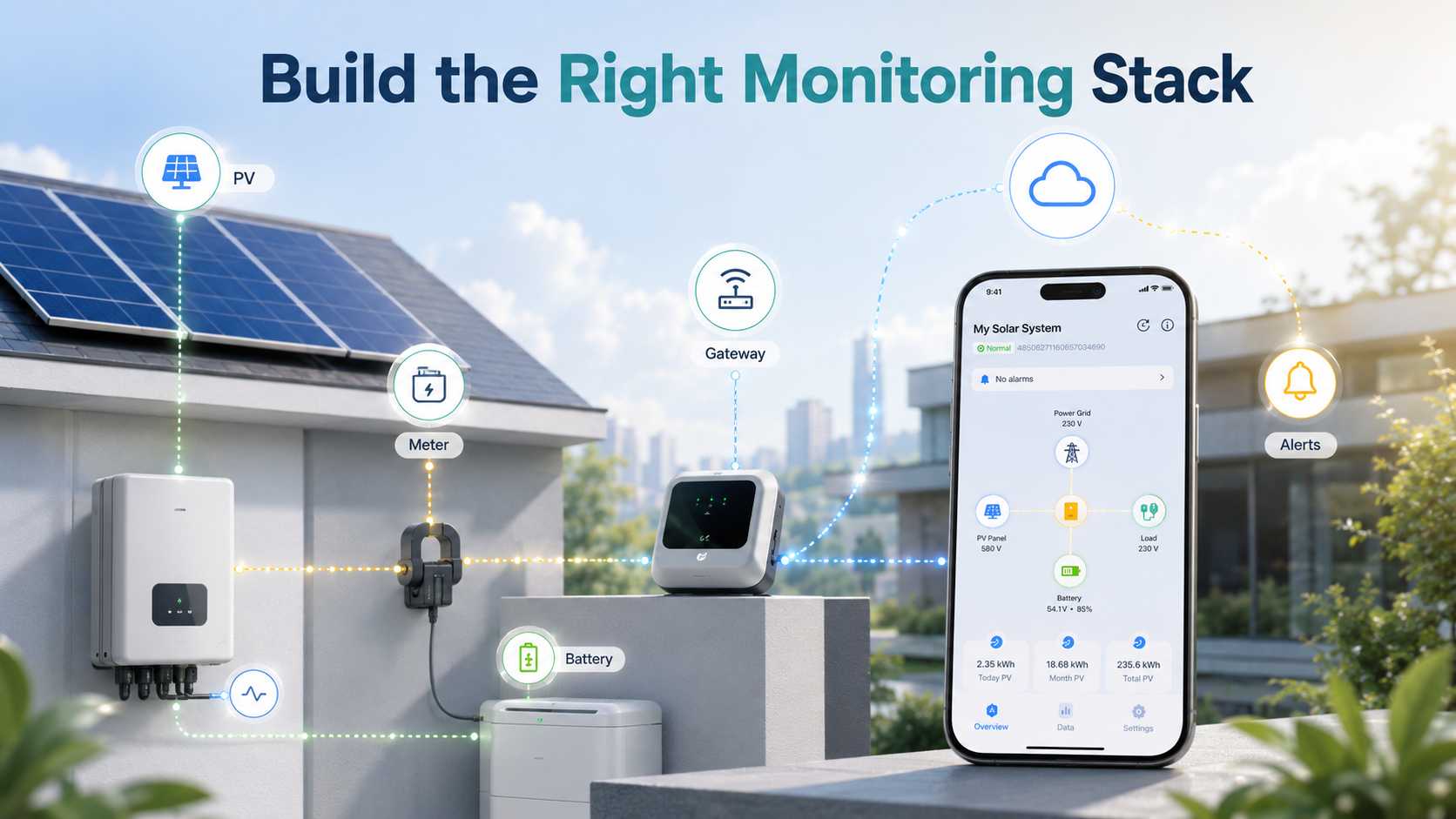
Solar monitoring devices collect, transmit, display, and interpret PV, load, inverter, and battery data. The device may be a communication module inside the inverter, a CT sensor, a smart meter, a data logger, a gateway, a battery communication link, or a cloud platform tied to a mobile app.
A buyer should not assume that having an app means having a complete monitoring system. An app may show inverter production, but not building consumption. A smart meter may show import and export, but not panel level issues. A battery page may show state of charge, but not why the battery failed to charge.
The Solar Monitoring Device Stack
Inverter communication module
The inverter communication module is usually the first layer. It can report PV production, inverter status, grid condition, fault code, and operating mode. It is often the most cost efficient starting point for homes and small systems.
Its blind spot is load behavior. If the owner wants to know whether solar is being used on site or exported, inverter only monitoring may not be enough.
CT sensors and smart meters
CT sensors and smart meters measure current flow and grid import or export. They help answer whether the site is using its own solar energy, sending it away, or buying power during peak periods.
They also create installation risk. If the CT direction is wrong, the app may report confusing consumption data. Commissioning should include a simple load test that confirms the data moves in the expected direction.
Solar data logger or gateway
A data logger or gateway collects data from one or more devices and sends it to a cloud platform or local dashboard. It can support installer fleets, mixed hardware, fault history, and data export.
For distributors and installers, the data logger is valuable because it supports remote diagnosis. It can reduce site visits when the issue is communication, settings, or a known inverter alarm.
Battery and hybrid inverter monitoring
Battery and hybrid inverter monitoring should show state of charge, charge power, discharge power, battery alarms, BMS communication, grid status, and backup mode. Without this layer, a battery system may look installed but fail to deliver useful backup when the grid fails.
Production, Consumption, and Battery Monitoring Compared
Industry monitoring guides separate production data, consumption data, system level data, panel visibility, and fault alerts because each device type answers a different owner question.
Monitoring layer | Hardware needed | Main question answered | Common blind spot |
Production monitoring | Inverter communication module | How much solar did the PV system produce | Does not explain load timing |
Consumption monitoring | CT sensor or smart meter | How much power did the site use or import | Does not diagnose panel faults |
Battery monitoring | BMS link and hybrid inverter data | Is the battery charging and discharging correctly | May miss building load details |
Panel level monitoring | Optimizer or module electronics | Which panel or string may underperform | Higher hardware and service cost |
Gateway or data logger | Logger or communication gateway | Can installers review multiple sites remotely | Needs stable network and account control |
A homeowner with a simple rooftop system may start with inverter and consumption monitoring. A hybrid solar buyer should add battery status and alarm visibility. An installer managing several sites should care about data export, remote alerts, account ownership, and event history.
Metrics That Should Trigger Action
The device should also make the next step clear. Production loss may trigger cleaning or string inspection. High grid import at noon may trigger load scheduling. Low battery state of charge may trigger settings review. Communication loss may trigger router, SIM card, or WiFi checks.
Metric | Why it matters | Action it should trigger |
Daily PV kWh | Shows generation trend | Compare with weather and prior days |
Real time kW | Shows current output | Check shading or inverter clipping |
Grid import and export | Shows self use quality | Shift loads or review storage |
Battery state of charge | Shows backup readiness | Review reserve and charge settings |
Fault code | Points to service issue | Assign remote or site service task |
Communication status | Protects data continuity | Check network and logger power |
Alert latency | Shows response speed | Tune alarm routing and owner notice |
SNADI/SNAT Solar Monitoring Guide and ES IP54 Hybrid Inverter
Our monitoring checklist starts with inverter compatibility, meter data, battery protocol, alarm receiver, account ownership, and whether the buyer can export records after commissioning. The SNADI/SNAT Solar monitoring device guide frames monitoring as an installation and service decision, not only an app decision.
Our ES IP54 On Off Grid Solar Inverter EURO is relevant when monitoring must include hybrid inverter status, battery communication, optional WiFi or GPRS access, RS485 data, and rugged installation needs. The official page lists 6.2 kW and 12 kW models, IP54 protection, MPPT, optional WiFi, USB and RS485 communication, GPRS option, dry node control, BMS communication, parallel support, and overload protection.
From our engineering view, ES IP54 should appear in a monitoring discussion when the buyer needs hybrid inverter visibility, battery behavior, remote fault review, or a small commercial backup setup that needs clear status. For a basic grid only PV system, a smart meter or data logger may be the first monitoring upgrade. For a hybrid system, inverter and battery visibility become central.
Buying Checklist for Solar Monitoring Devices
· Does the existing inverter support communication modules or a data logger
· Does the site need production monitoring only or consumption monitoring too
· Is battery state of charge visible when storage is installed
· Does the system support CT sensors or a smart meter
· Can alerts reach the owner and installer
· Can historical data be exported for service or warranty review
· Does the system keep data during network interruptions
· Who owns the monitoring account after commissioning
· Can the installer manage multiple customer sites
· Does the device support the required voltage current and communication protocol
· Can the buyer see fault codes and service history
· Is the device suitable for dust moisture and installation temperature
The trade off is simple. More monitoring layers increase CAPEX and commissioning work, but they can reduce operating risk. Less monitoring saves first cost, but it may leave the owner blind to underproduction, reversed sensors, battery charge failure, or repeated communication loss.
Buyers should also check what the monitoring device cannot do. A production app cannot prove self use. A CT meter cannot locate a bad module. A battery screen cannot diagnose PV string loss. A data logger cannot fix poor service workflow unless someone reviews alerts and acts.
Conclusion
Solar monitoring devices should be chosen around the problem the buyer needs to solve. For Chilean homes, hybrid solar users, small commercial PV owners, and installers, the best device is not always the most complex device. The right choice connects production data, consumption data, battery visibility, fault alerts, historical records, and service action. SNADI/SNAT Solar ES IP54 On Off Grid Solar Inverter EURO and our monitoring device guide fit projects where inverter communication, battery status, RS485 data, optional WiFi or GPRS access, and practical service workflow can improve uptime and buyer confidence.
✉️Email: marketing@snadi.com.cn
Website:
☎️WhatsApp / WeChat: +86 1803929353

FAQ
Solar monitoring devices are hardware and software tools that collect PV production, consumption, inverter, battery, fault, and communication data. They help owners and installers find performance problems and decide the next service action.
Is an inverter app enough for solar monitoring?
Why do CT sensors and smart meters matter?
What should hybrid solar monitoring include?
How do solar monitoring devices reduce service cost?
Where does SNADI/SNAT Solar ES IP54 inverter fit monitoring projects?