

Adding batteries to solar system projects changes how the electrical system works. The existing inverter, battery chemistry, backup load target, export rules, wiring, safety clearance, and monitoring plan all affect whether the retrofit is simple, expensive, or not worth doing.
For a Chilean home, clinic, small shop, security office, or rural property, the value is not only a lower electricity bill. It can also be avoided food loss, fewer generator hours, safer night operation, internet continuity, and less interruption during weak grid periods.
Quick Answer: Existing Hardware Decides the Retrofit Path
Many existing solar systems can add batteries, but the route depends on the inverter, battery protocol support, backup requirements, electrical panel layout, and installer capability. A buyer should not start with battery price before those checks are complete.
If the existing inverter already supports compatible batteries, the project may be a direct battery addition with settings, wiring, protection, and monitoring review. If the inverter is a standard grid inverter with no storage support, the buyer may need AC coupled storage, a hybrid inverter replacement, or a separate backup system.
Industry retrofit guides usually treat the battery upgrade as a system audit, not only a battery purchase.
Practical check: ask the installer to read the inverter nameplate, confirm battery protocol support, and define which loads must stay online during an outage before quoting battery capacity.
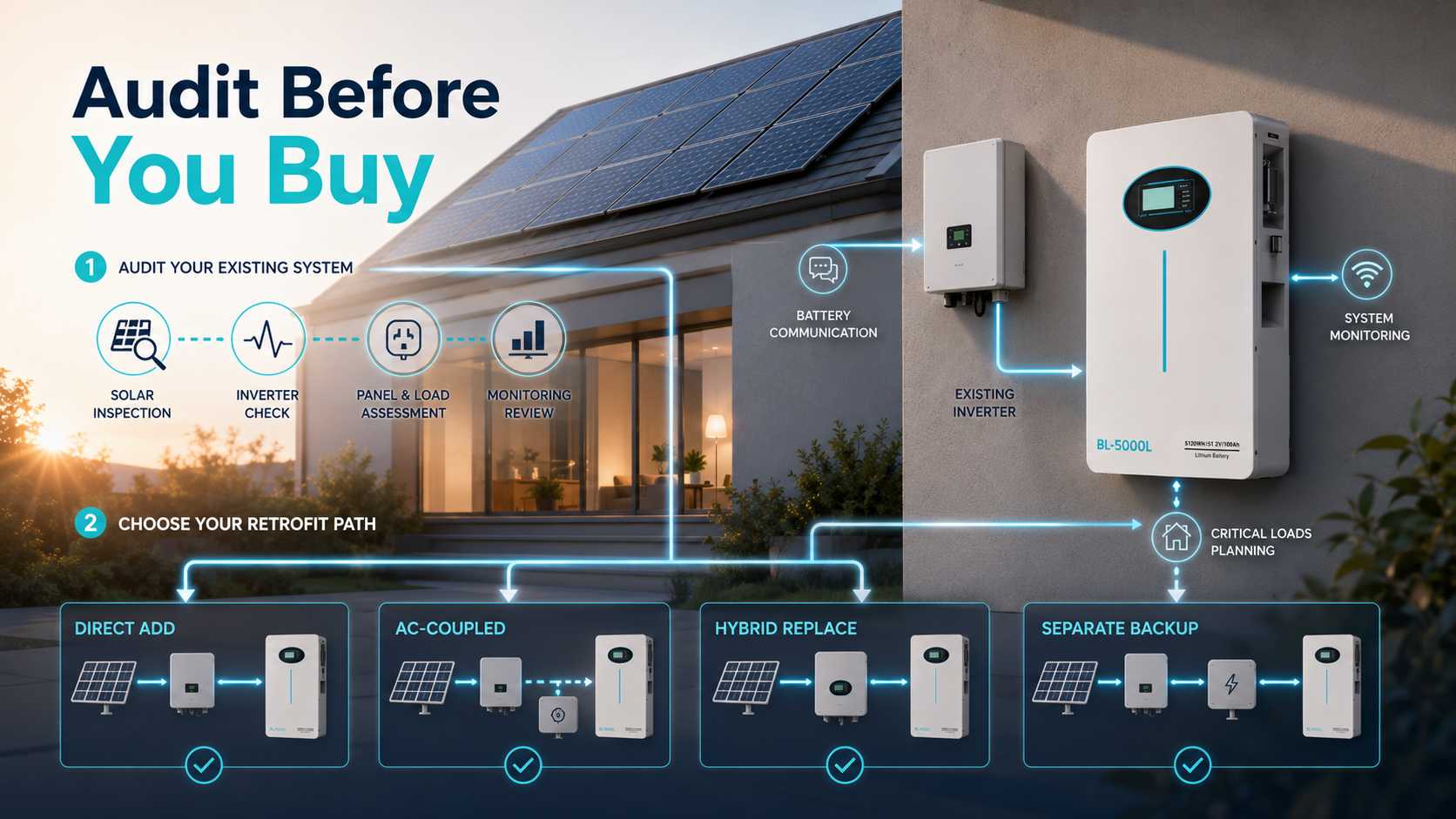
Step 1: Audit the Existing Solar System
Check the inverter type and age
The inverter is the first checkpoint. Some existing systems use a standard grid inverter that shuts down during an outage. Some use a hybrid inverter that can charge batteries and power selected loads. Older equipment may lack battery communication, warranty support, or firmware support for lithium storage.
Confirm battery communication and storage support
A lithium retrofit should check voltage range, BMS communication, charge profile, current limit, cable size, protection devices, and whether the inverter maker approves the battery model. A battery that looks correct on paper can still fail in operation if the BMS and inverter do not communicate properly.
Review roof PV size and energy bills
The PV array must generate enough surplus energy to charge the battery during useful hours. Electricity bills show when the buyer consumes power, whether peak periods exist, and whether storage should target bill control, backup, or both.
Define the backup goal before equipment selection
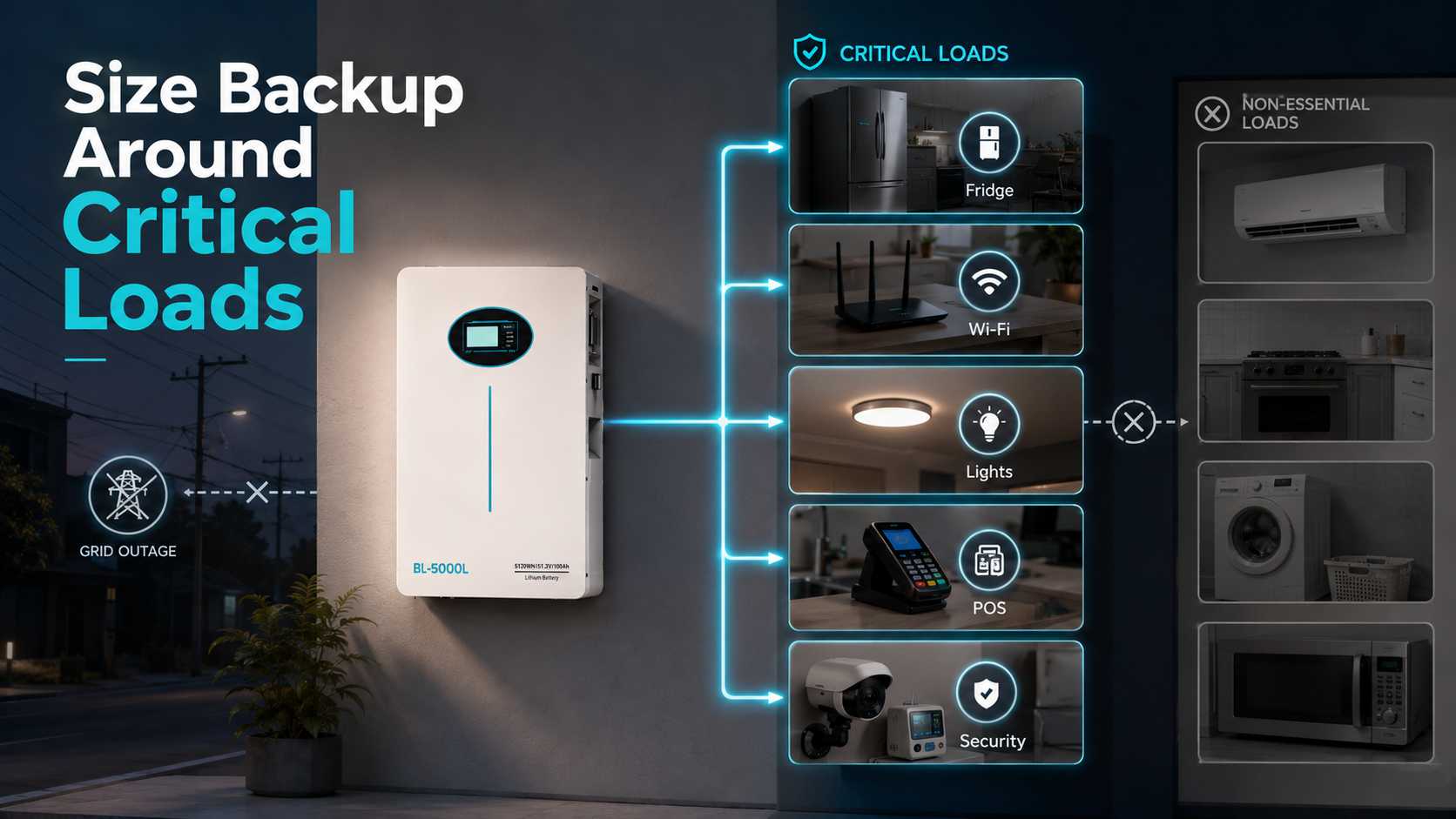
Backup should be sized around selected loads, not the whole building by default. A router, lighting circuit, refrigerator, payment terminal, and security system may need much less capacity than a whole home or whole shop plan.
Audit item | Why it matters | Buyer action |
Inverter model | Decides retrofit route | Photograph nameplate and manual page |
PV system size | Defines charging energy | Compare daily PV output with load |
Battery protocol | Affects BMS communication | Confirm supported protocol before purchase |
Load priority | Controls battery size | List critical loads first |
Existing wiring | Affects labor and safety | Ask for site inspection |
Monitoring access | Protects long term value | Confirm app and data ownership |
Step 2: Compare Retrofit Architecture Options
There are several retrofit paths. AC coupled battery storage can work with many existing grid solar systems because it adds storage on the AC side. DC coupled storage can be efficient when PV and battery charging are designed together on the DC side. Hybrid inverter replacement can be cleaner when the existing inverter is old, incompatible, or unable to support backup.
Retrofit path | Best fit | CAPEX pressure | Backup ability | Operating risk |
AC coupled battery | Existing grid solar with good inverter | Medium to high | Depends on gateway and load panel | More conversion steps and control settings |
DC coupled battery | Newer systems or planned inverter work | Medium | Strong when designed correctly | More wiring and compatibility review |
Hybrid inverter replacement | Old or incompatible inverter | Higher upfront | Strong for selected loads | More installation work but cleaner control |
Separate backup system | Small critical load need | Lower to medium | Limited but simple | May not use existing PV efficiently |
The right route is not universal. A home that only wants internet and lights may not need a full retrofit. A small shop with refrigeration may need a hybrid inverter, critical load panel, and battery sized for compressor surge and runtime.
Step 3: Size Battery Backup Around Critical Loads
A battery has two ratings that buyers often confuse. kWh describes stored energy. kW describes output power. A 10 kWh battery may store enough energy for several hours of light loads, but it still needs enough kW output to start a refrigerator, pump, or motor.
Start with the critical load list. Estimate running watts, starting watts, hours of use, and whether each load must work at the same time. Do not include air conditioning, electric heating, or large pumps unless the buyer accepts a larger system and higher cost.
Critical load | Example running watts | Example runtime | Energy need | Check before sizing |
Refrigerator | 150 W average | 8 hours | 1.2 kWh | Compressor surge |
Router and security | 60 W | 10 hours | 0.6 kWh | Always on need |
LED lighting | 120 W | 5 hours | 0.6 kWh | Circuit grouping |
Payment terminal | 40 W | 8 hours | 0.32 kWh | Business continuity |
Small medical device | Varies | Varies | Confirm device label | Pure sine wave and runtime |
Add inverter loss, battery reserve, temperature margin, and aging margin. If the result is close to the battery limit, the system is undersized. A practical design leaves reserve so the battery is not drained hard every outage.
Step 4: Safety, Permitting, and Installation Checks
A battery retrofit can involve DC wiring, AC backup circuits, battery cabinets, communication cables, disconnects, grounding, monitoring, and fire access. This work should be handled by qualified installers who can review local electrical rules and utility requirements.
Buyers should check where the battery will be installed, whether ventilation and access are suitable, whether the wall or floor can support the equipment, whether children or untrained staff can access the area, and whether the system has clear shutdown instructions.
SNADI/SNAT Solar BL Battery and ES IP54 Hybrid Inverter
Our BL Lithium Iron Phosphate Battery fits retrofit buyers who need modular LiFePO4 storage, inverter communication, and expandable capacity for selected backup loads. The official lithium battery page positions BL as wall mounted and rack mounted storage with RS485 communication for SNADI hybrid inverters and modular capacity expansion.
From our engineering view, BL is relevant when the buyer is upgrading from no storage or from older lead acid storage and needs safer lithium chemistry, BMS managed operation, and clearer battery status. Local battery documentation supports the same design logic: review LiFePO4 chemistry, BMS protection, communication, wiring, and charge discharge management before commissioning.
Our ES IP54 On Off Grid Solar Inverter EURO fits retrofit projects where the existing inverter is not suitable and the buyer needs hybrid charging, pure sine wave output, monitoring, and scalable backup power. The official page lists 6.2 kW and 12 kW models, IP54 protection, battery free operation, MPPT, parallel support, RS485, optional WiFi and GPRS, dry node control, and overload protection.
The product choice should come after the audit. If the existing inverter is compatible and the buyer only needs storage expansion, the battery route may be enough. If the existing inverter cannot support backup or communication, a hybrid inverter route may give cleaner control and monitoring.
Installer Quote Checklist
· Inverter brand model and nameplate photo
· PV system size and installation year
· Electricity bills or load profile if available
· Current monitoring app screenshots
· Desired backup loads and runtime target
· Photos of electrical panel and installation space
· Whether the buyer wants outage backup or bill control
· Existing battery details if any
· Any warranty or utility paperwork
Buyers should also ask what happens during an outage. Some systems store energy but do not power loads when the grid fails unless the backup gateway or critical load panel is designed for that job. This is a common retrofit misunderstanding.
AC coupled designs can reduce changes to the existing PV side but may add conversion steps. Hybrid replacement can improve control but raises first cost. More kWh gives longer backup but does not automatically solve high surge loads.
Conclusion
Adding batteries to solar system projects should begin with an audit, not a shopping cart. The buyer needs to know the existing inverter type, battery communication limits, PV surplus, backup load target, installation space, safety requirements, and budget. For Chilean residential backup and small commercial retrofit buyers, SNADI/SNAT Solar BL Lithium Iron Phosphate Battery and ES IP54 On Off Grid Solar Inverter EURO are relevant when the project needs modular lithium storage, inverter communication, hybrid charging, monitoring, and selected critical load backup.
✉️Email: marketing@snadi.com.cn
Website:
☎️WhatsApp / WeChat: +86 1803929353

FAQ
Yes, many existing systems can add batteries, but the route depends on inverter type, battery protocol support, wiring, electrical panel layout, backup requirements, and local installation rules.
What should be checked before adding battery storage?
Is AC coupled or DC coupled storage better for retrofit projects?
How should battery size be calculated?
When should a hybrid inverter be replaced during a retrofit?
How do SNADI/SNAT Solar BL Battery and ES IP54 inverter fit retrofit projects?