
A buyer usually asks about modified sine wave vs pure sine wave inverter after one load on the list changes the risk. The inverter looks affordable, the load list looks simple, and then a refrigerator, pump, microwave, laptop, router, CPAP machine, or payment terminal makes the choice more serious.
The safer question is not whether an appliance can turn on. The better question is whether it can run cleanly, quietly, efficiently, and repeatedly from that waveform without excess heat, buzzing, lower efficiency, support problems, or shorter service life.
For Chilean residential backup and small commercial buyers, this decision often appears when grid instability, cold storage loss, payment terminal downtime, or generator fuel cost makes solar backup worth reviewing. The waveform choice should follow the load list, not the cheapest catalog line.
Quick Answer: Choose by Load Risk, Not Price Alone
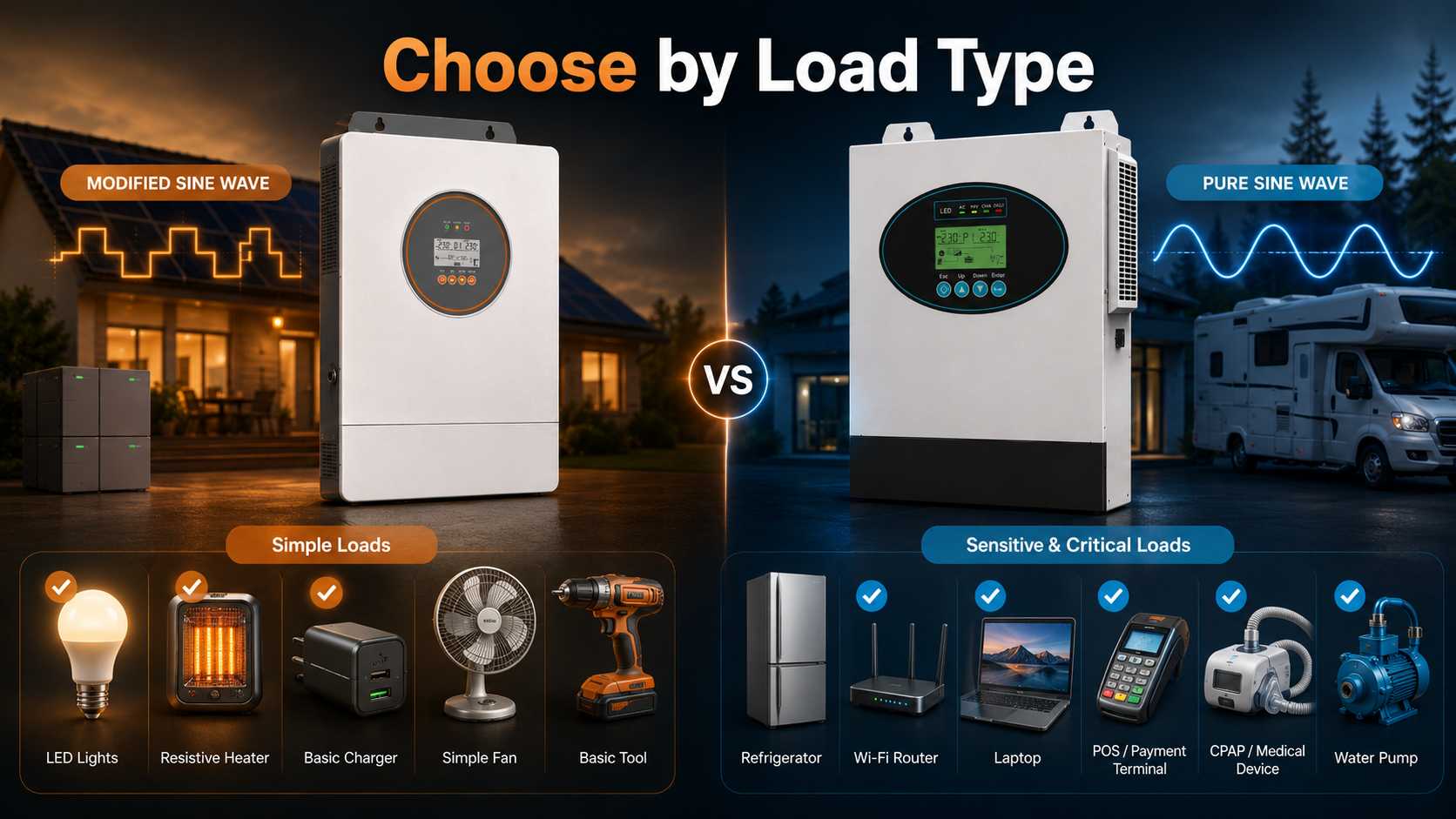
Choose a pure sine wave inverter if the system will power sensitive electronics, medical equipment, computers, routers, audio equipment, refrigerators, compressors, variable speed motors, microwave ovens, pumps, or a long running solar backup system. A modified sine wave inverter can still be reasonable for simple lights, resistive heating, basic tools, and short emergency use where the load is low value and easy to replace.
Industry inverter guides separate simple loads from sensitive electronics and motor loads because the risk is not the same for every appliance.
Practical check: before choosing waveform, write down each appliance, rated watts, starting watts, control type, run time, and whether failure creates a business loss. This short list prevents most wrong inverter choices.
Start With This Load Compatibility Checklist
Low risk loads for modified sine wave
Modified sine wave can be acceptable for basic LED lights, simple resistive heating, some phone chargers, and low value emergency loads. The key condition is short use time and low consequence if performance is imperfect. If a light flickers or a basic charger runs warmer, the cost of failure may be limited.
This does not mean every low risk load should use modified sine wave. It means the buyer can evaluate it when budget is tight, the load is simple, and the inverter will not carry critical equipment.
Loads that usually deserve pure sine wave
Refrigerators, freezers, pumps, air conditioners, microwave ovens, laptops, routers, camera systems, point of sale equipment, and audio devices usually deserve pure sine wave. These loads can be affected by harmonic content, motor heat, control board behavior, or buzzing noise.
For a small store, one freezer can be more financially important than the inverter price difference. The freezer may start on a rougher waveform, but higher heat, noise, or motor stress can create service risk.
Loads where pure sine wave should be the default
Medical devices, CPAP machines, lab equipment, servers, communication equipment, smart appliances, security systems, and warranty sensitive equipment should be treated as pure sine wave loads unless the device maker clearly allows another waveform. When a load is expensive, safety related, or business critical, the lower first price of modified sine wave is rarely the right anchor.
Load type | Modified sine wave fit | Pure sine wave fit | Buyer risk |
LED lighting | Possible | Good | Flicker or driver heat |
Phone charger | Possible | Good | Charger heat or noise |
Refrigerator | Risky | Better | Motor heat and food loss |
Router and payment terminal | Risky | Better | Business interruption |
Medical device | Avoid | Default | Safety and reliability risk |
Audio or lab equipment | Avoid | Default | Noise or measurement error |
What Changes Between Modified and Pure Sine Wave?
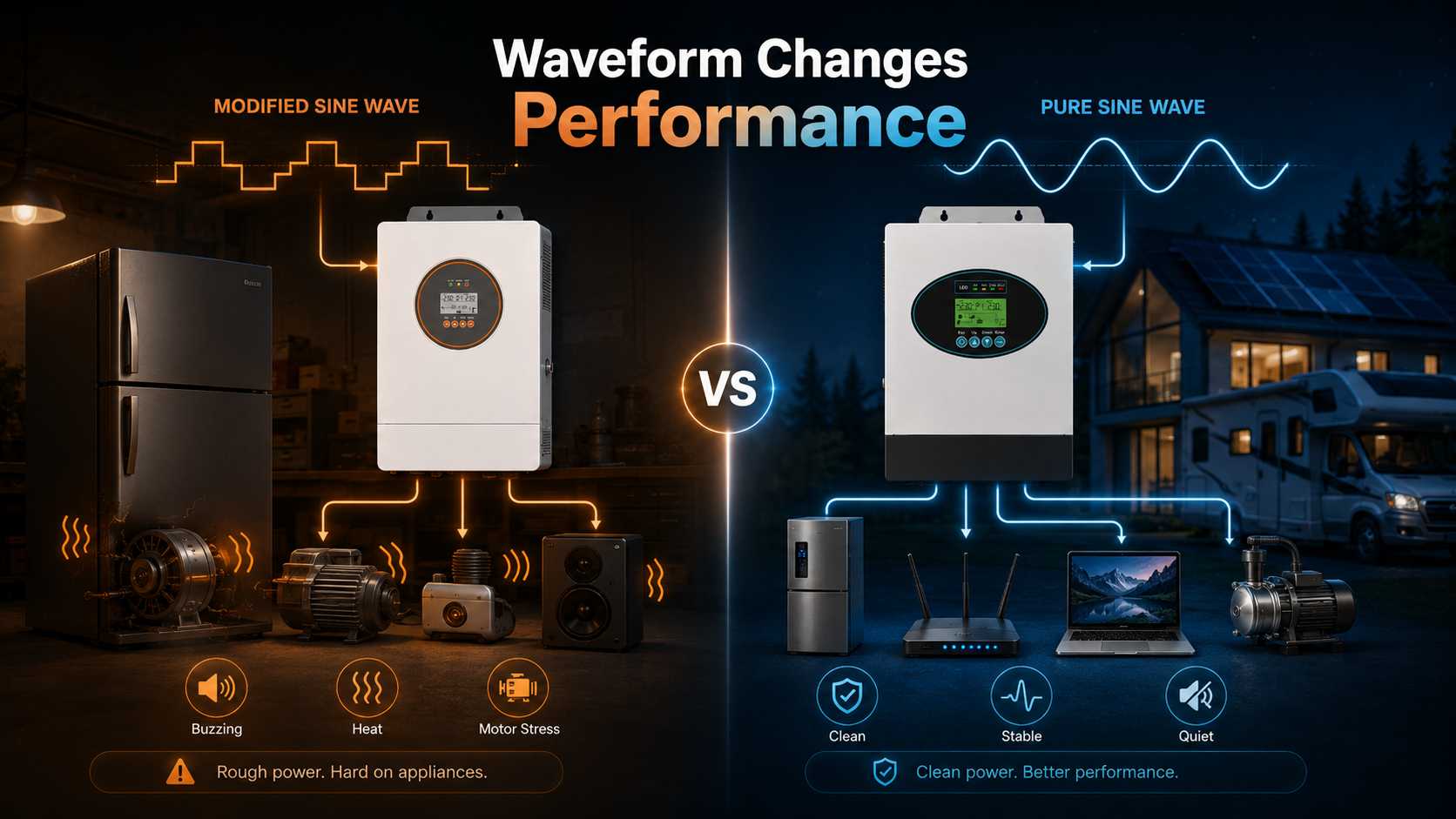
A modified sine wave inverter creates a stepped approximation of AC power. A pure sine wave inverter produces a smoother AC waveform closer to utility power. The difference affects total harmonic distortion, motor behavior, electrical noise, heat, and how control boards interpret incoming power.
A simple resistive load may not care much. A motor, compressor, transformer, power supply, or control board may care a lot. That is why modified sine wave vs pure sine wave inverter selection should be made by load type and operating consequence, not only by wattage.
Why Some Appliances Heat, Buzz, or Run Poorly
A motor load needs power that lets magnetic fields build and collapse in a predictable way. A rough waveform can increase heat or acoustic noise. An electronic power supply may work, but run hotter. An audio system may buzz. A microwave may heat less evenly. A refrigerator compressor may see more stress during start.
The practical issue is not always instant damage. The practical issue is silent stress. A buyer may think the inverter works because the load starts, but the owner may later see higher temperature, shorter service life, odd alarms, or nuisance shutdowns.
Cost, ROI, and Operating Risk
A modified sine wave inverter can reduce CAPEX for a simple emergency setup. That matters when the load is low value and occasional. A pure sine wave inverter raises first cost, but can protect expensive appliances, reduce service calls, and support a wider range of loads.
Decision factor | Modified sine wave | Pure sine wave | Financial meaning |
First price | Lower | Higher | Modified wave may fit strict budget |
Load compatibility | Narrower | Wider | Pure sine reduces wrong load risk |
Motor and compressor behavior | Higher risk | Lower risk | Pure sine can protect food and equipment |
Noise and heat | More likely | Less likely | Pure sine can reduce service complaints |
Future load changes | Limited | More flexible | Pure sine supports system growth |
Critical backup use | Weak fit | Stronger fit | Pure sine better supports business continuity |
For a home that only needs a few lights during rare outages, modified sine wave may be acceptable. For a store with refrigeration, a clinic with small medical devices, or a telecom cabinet with routers and monitoring equipment, pure sine wave is usually the better financial decision.
SNADI/SNAT Solar NKH and ES IP54 Inverters
Our NKH Off grid Hybrid Solar Inverter fits buyers who need pure sine wave output, solar charging, battery charging, and off grid backup in one compact inverter. The official page lists 1.2 kW, 3.6 kW, 6 kW, and 12 kW models, an integrated MPPT controller, optional WiFi and GPRS, and pure sine wave output for sensitive household appliances.
In engineering terms, NKH belongs in load lists that include home backup, cabins, small shops, routers, lighting, refrigerator support, and appliance protection where pure sine wave output reduces compatibility uncertainty. Installation still needs qualified work, correct cable sizing, battery connection checks, PV input checks, communication port review, and overload protection.
Our ES IP54 On Off Grid Solar Inverter EURO fits buyers who need pure sine wave output, outdoor rated enclosure, hybrid charging, remote monitoring, and scalable backup power. The official page lists 6.2 kW and 12 kW models, IP54 protection, battery free operation, optional WiFi, USB and RS485 communication, GPRS option, dry node control, MPPT ranges, and overload protection.
From our engineering view, ES IP54 is more relevant when the site has a tougher installation environment, higher load demand, parallel expansion needs, or buyer concern about remote monitoring. The product choice should come after the load list, surge demand, installation environment, and monitoring need are confirmed.
Buyer Checks Before Choosing an Inverter
· Appliance list and critical load priority
· Rated watts and surge watts for each motor load
· Output voltage and frequency required by the site
· Total harmonic distortion if the maker publishes it
· Battery voltage and battery chemistry
· PV input voltage and MPPT range
· Charger current and battery protection settings
· Cooling space and installation temperature
· Enclosure rating for dust, moisture, and outdoor exposure
· Communication ports for monitoring and BMS review
· Certification and local inspection requirements
· Service responsibility after installation
Do not size an inverter only from the running watts printed on appliances. Compressors, pumps, and some power tools can need much higher start power. If the surge is not checked, even a pure sine wave inverter can trip or overload.
Conclusion
Modified sine wave vs pure sine wave inverter is a load risk decision. Modified sine wave can be reasonable for simple, low value, short duration loads. Pure sine wave is the safer default for solar backup, lithium battery systems, refrigerators, medical equipment, routers, payment terminals, pumps, compressors, and most modern appliances. For Chilean residential backup and small commercial buyers, SNADI/SNAT Solar NKH and ES IP54 inverters fit different pure sine wave needs: NKH for compact off grid backup and ES IP54 for tougher hybrid installations with monitoring and scaling requirements.
✉️Email: marketing@snadi.com.cn
Website:
☎️WhatsApp / WeChat: +86 1803929353

FAQ
A modified sine wave inverter creates a stepped AC waveform, while a pure sine wave inverter produces smoother AC power closer to utility supply. The difference matters most for motors, compressors, sensitive electronics, medical devices, routers, and long running backup systems.
Can a modified sine wave inverter run a refrigerator?
When is modified sine wave acceptable?
Why is pure sine wave better for solar backup?
How should buyers size an inverter for motor loads?
Where do SNADI/SNAT Solar NKH and ES IP54 inverters fit?