
A solar system can look healthy from the ground while losing money on the roof. One shaded string, one reversed current sensor, one battery that never reaches the expected state of charge, or one inverter alarm that nobody sees can turn a good design into a slow operating loss.
Solar monitoring solutions should be chosen before installation, not after the first complaint. For a Chilean shop, school, clinic, installer portfolio, or small warehouse, monitoring is not only a screen that shows kWh. It tells the owner whether the PV array, inverter, battery, load, and service team are doing the job that was specified.
The Cost of Blind Solar Operation
Blind operation has three costs. The first is lost production. A dirty array, tripped string, or wrong inverter setting can reduce output for weeks. The second is slow service. If the installer has no event history, every fault visit starts from zero. The third is buyer distrust. A business owner who cannot see battery status, grid import, or alarm history may blame the wrong component.
Practical check: during commissioning, switch on a known load and confirm that the app or portal shows the correct change in consumption. Many monitoring disputes come from reversed CT direction, unverified meter settings, or missing communication cables.
What Solar Monitoring Solutions Should Track
Production and energy yield
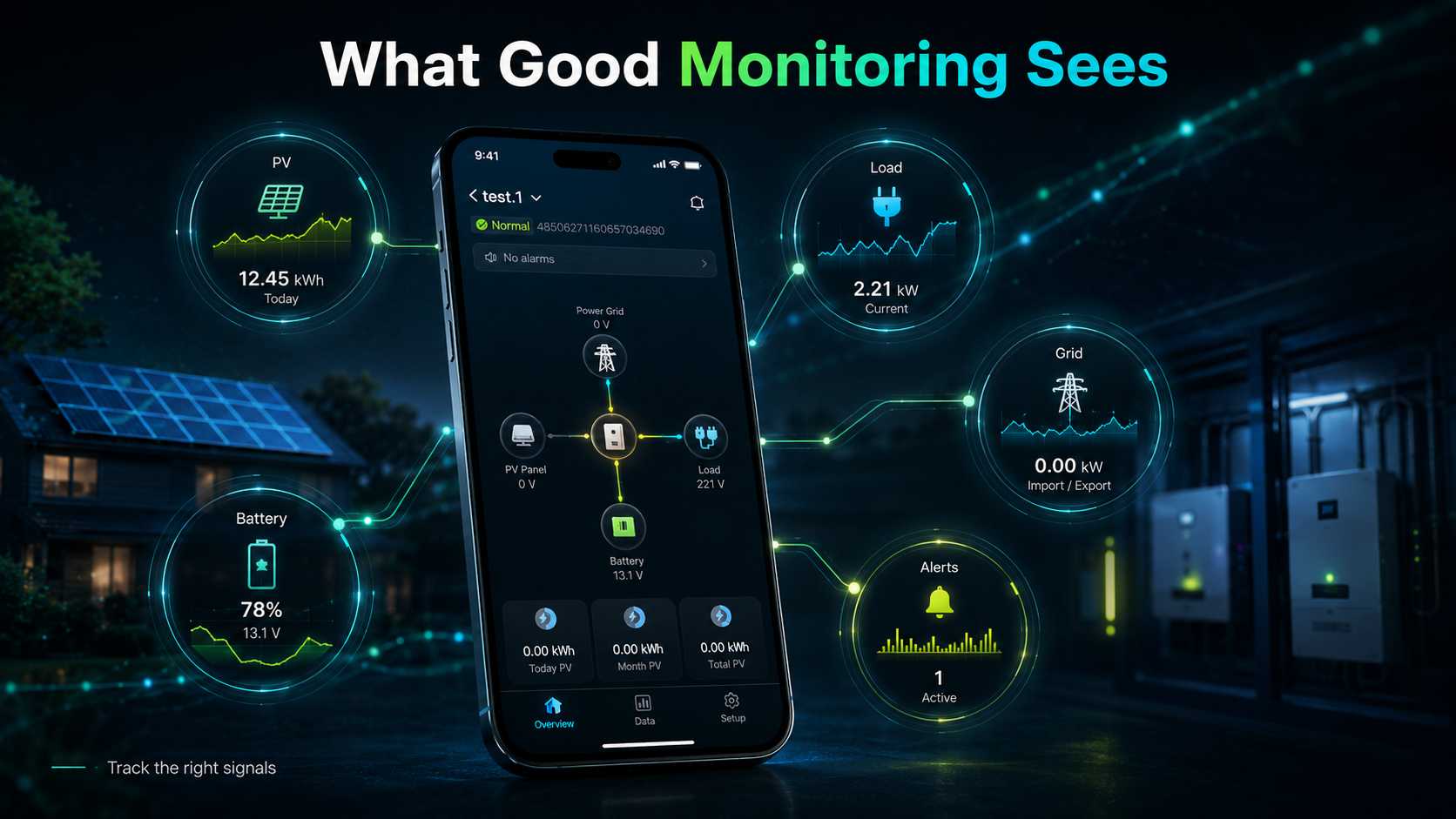
Production monitoring answers the basic question. How much energy did the PV array produce today, this month, and this year? For installers, production history also helps separate weather, shading, module issues, and inverter events.
Load and consumption behavior
Consumption monitoring asks where the solar energy went. A site can produce good PV energy and still import expensive grid power during the wrong hours. For shops and small factories, load data helps decide whether the buyer needs storage, load scheduling, or a tariff review.
Battery and hybrid inverter status
Hybrid systems need state of charge, charge power, discharge power, reserve setting, grid status, and fault history. Without battery visibility, backup promises are hard to verify. The buyer should know which loads the battery protects and how long those loads can run under real site conditions.
Panel level or string level faults
Panel level monitoring can help on shaded or complex roofs, while string level data may be enough for simple arrays. Industry monitoring guides usually separate production monitoring, consumption monitoring, panel level visibility, and fault alerts because each one answers a different buyer question.
Monitoring Options Compared by Use Case
Monitoring option | Best fit | ROI value | Risk to check |
Inverter app | Small home or simple shop | Low cost status view | May lack load and battery detail |
Smart meter or CT data | Sites with demand and self use goals | Better grid import and load decisions | Sensor direction and calibration |
Data logger | Installer fleet or mixed hardware | Central records and service reports | Compatibility and account access |
Panel level visibility | Shaded or complex roofs | Faster module fault location | Higher hardware and service cost |
EMS or SCADA layer | Commercial storage or multi building sites | Peak shaving and alarm workflow | More setup and data discipline |
The best option depends on operating risk. A small home may only need production and battery status. A clinic may need backup readiness, grid status, and alerts. A warehouse with refrigeration may need load trends, alarm routing, and a service response plan.
Data Quality and O and M Workflow
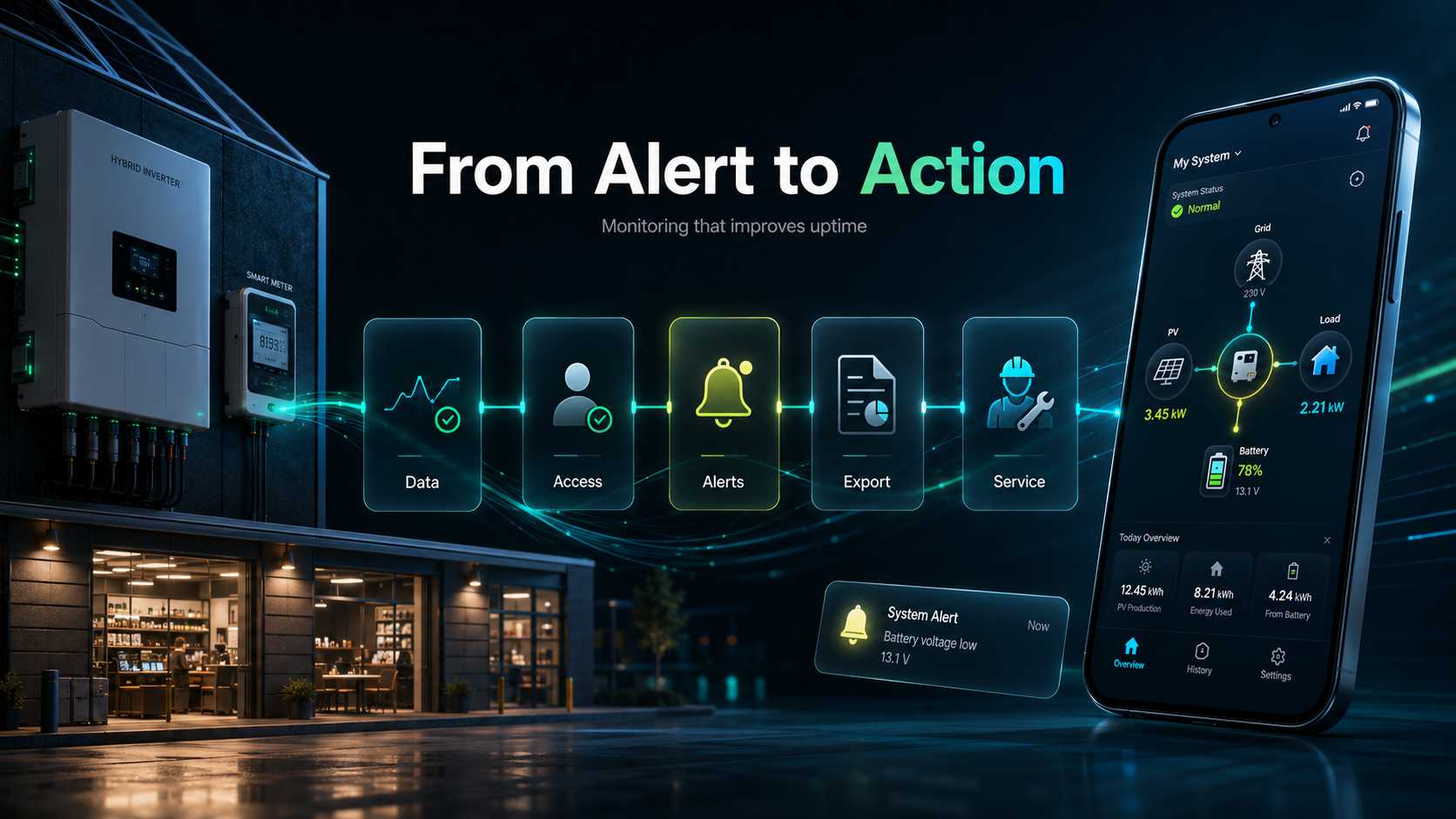
A dashboard is useful only when the data is reliable. Buyers should check sampling interval, missing data handling, sensor accuracy, time zone settings, permission levels, alert thresholds, and whether reports can be exported. If the owner loses access when the installer account changes, monitoring becomes a future service risk.
For installers, the workflow should be simple. Alarm received, fault code checked, remote data reviewed, site visit scheduled only when needed, service note recorded, and owner updated. A portal that shows a fault but gives no event history or export option is weaker than it looks.
SNADI/SNAT Solar Monitoring Guide and ES IP54 On Off Grid Solar Inverter EURO
Our monitoring recommendation starts with the inverter, battery, meter, data ownership, alarm receiver, and whether the owner can export records after commissioning. The SNADI/SNAT Solar monitoring guide places these checks before product selection so the system owner does not buy data that no one will use.
For hybrid inverter projects, our ES IP54 On Off Grid Solar Inverter EURO is relevant when the monitoring plan needs hybrid inverter status, optional WiFi or GPRS access, RS485 communication, and a rugged inverter enclosure. We have 6.2 kW and 12 kW models, IP54 protection, optional WiFi, USB and RS485 communication, dry node control, parallel support, and battery free operation.
From our engineering view, this product fits projects where the buyer needs inverter status, storage behavior, remote fault review, or a small commercial backup system that can be checked without waiting for a site visit.
Buying Checklist Before Installation
· Which data matters most, production, consumption, battery state, grid import, or alarm history?
· Who receives alerts, owner, installer, distributor, or service team?
· Can the owner export data for finance or warranty review?
· Does the inverter support the needed communication method?
· Does the battery BMS communicate with the inverter?
· Is a smart meter or CT needed to see import and export?
· Will monitoring stay active during an outage?
· Who owns the account if the installer changes?
· What service action follows each alarm?
Buyers should compare the cost of more data with the cost of real operating risk. A panel level platform may be worth it on a shaded roof. It may be unnecessary for a simple roof with easy access. A free inverter app may be enough for a small backup system, but not enough for a cold room where downtime has financial consequences.
Conclusion
Solar monitoring solutions should be selected around buyer risk, not app appearance. For Chilean small commercial buyers and installers, the useful system connects PV production, consumption, inverter status, battery behavior, alerts, data export, and service workflow. SNADI/SNAT Solar ES IP54 On Off Grid Solar Inverter EURO and our monitoring guide fit projects where hybrid inverter visibility, communication ports, remote review, and clear commissioning checks improve uptime and buyer confidence.
✉️Email: marketing@snadi.com.cn
Website:
☎️WhatsApp / WeChat: +86 1803929353

FAQ
They should track PV production, load behavior, grid import, battery state, inverter alarms, fault history, and service actions. The exact scope depends on the site risk and system design.
Is an inverter app enough for a small solar system?
Why does data quality matter in solar monitoring?
When is panel level monitoring worth the cost?
How does SNADI/SNAT Solar ES IP54 inverter support monitoring plans?
Who should own the monitoring account after installation?