

In the technical world of energy storage, we often discuss metrics like capacity and voltage, but for a business operator, the most critical number on the dashboard is the State of Charge. However, to truly master energy independence, one must go beyond the surface and understand exactly what does soc stand for in solar and why it is the ultimate indicator of your commercial asset's health.
In professional solar energy systems, SoC represents the level of charge of an electric battery relative to its capacity. Think of it as the fuel gauge of your hotel's energy heart. While it sounds simple, the precision of this measurement determines whether you are running a lean, profitable operation or a wasteful one plagued by power anxiety. For off grid hospitality, moving from a vague estimate of battery energy to a high precision SoC management strategy is the difference between a five years battery replacement cycle and a ten years one.
Why SoC is the Financial Dashboard of Your Off Grid System
In a typical off grid hotel environment, the battery bank represents the single largest recurring capital expenditure. Many owners, wary of unexpected blackouts, fall into the trap of blind expansion. Without accurate data on what does soc stand for in solar, they over size their battery banks by as much as 30% to 40% simply to create a safety buffer. This is dormant capital that yields no return.
Precision SoC monitoring allows an operator to release the hidden potential of their existing investment. When you know with 99% certainty that your batteries are at 22% SoC, you can confidently power through the last hour of the night. Without that precision, a system might trigger a low battery alarm at a perceived 30% due to voltage sag, forcing an unnecessary and expensive shutdown of guest services or the premature ignition of backup generators.
Minimizing Diesel Intervention
For many off grid resorts, diesel generators are a necessary evil. However, the cost of diesel in remote areas is not just the pump price; it includes the logistical nightmare of transport over water or rugged terrain and the maintenance of the engines. High precision SoC management optimizes energy scheduling. By accurately tracking how much energy is left, the system can ensure that every possible watt of solar energy is utilized before the sun sets, and precisely calculate if the stored energy will last until dawn. This minimizes diesel top ups which often occur because the system controller is guessing the remaining capacity and defaults to the generator for safety.
How SoC Inaccuracy Erodes ROI
Operating a hotel on a remote island or a high altitude mountain range presents environmental challenges that standard solar equipment often fails to meet. In these environments, SoC errors do not just cause inconveniences; they quietly steal your profits through accelerated equipment aging.
Protecting Your Most Expensive Asset
The longevity of Lithium Iron Phosphate (LiFePO4) batteries, the gold standard for high tier off grid solutions, is directly tied to the Depth of Discharge (DoD). If your system miscalculates what does soc stand for in solar, it might report a healthy 20% when the actual chemical state is closer to 5%. Repeatedly entering this deep discharge zone causes irreversible chemical degradation.
In a professional off grid setup, maintaining the SoC between 20% and 80% is a strategic move. It is not just about technical safety; it is about extending the equipment depreciation cycle. An accurately managed battery bank can provide 6,000 to 8,000 cycles. An inaccurately managed one, suffering from frequent deep discharges due to poor SoC reporting, might fail after 3,000 cycles. For a hotel owner, that is a 100% increase in the frequency of a massive capital outlay.
Environmental Distortion and False Prosperity
Temperature is the enemy of accurate energy measurement. In island environments where ambient temperatures frequently exceed 35°C, or in high altitude lodges where temperatures drop below freezing, the internal resistance of the battery changes. This often leads to SoC Drift or False Prosperity, where the dashboard shows a high charge level that collapses the moment a high load appliance, like a commercial laundry system or an industrial chiller, starts up. Understanding what does soc stand for in solar in these contexts requires advanced sensors that compensate for temperature, ensuring the number you see on the screen reflects the actual work the battery can perform.
Establishing a Sense of Energy Control
As we move into 2026, the technology behind energy storage has evolved from simple voltage checks to sophisticated algorithmic modeling. To provide the Energy Control required by a high stakes business like a resort, we employ methods that eliminate the guesswork.
Beyond Voltage: The Necessity of Coulomb Counting
In many entry level systems, SoC is estimated using Open Circuit Voltage (OCV). However, OCV is notoriously unreliable when the battery is under load. For a hotel, where power demand fluctuates wildly as guests turn on showers, kettles, and hair dryers, OCV measurements can swing erratically.
Professional ESS solutions utilize Coulomb Counting. This method measures the actual flow of current (Amperes) over time. If a battery is a water tank, OCV is like trying to guess the volume by looking at the water pressure, which changes as you open the tap. Coulomb counting is like having a high-precision flow meter on the pipe. You know exactly how many units of energy went in and how many came out.
| Feature | Voltage-Based Estimation (OCV) | Coulomb Counting (Professional Grade) |
| Accuracy | 5% - 15% Error Margin | < 1% Error Margin |
| Reliability under Load | Poor (fluctuates with demand) | Excellent (tracks actual flow) |
| Calibration | Requires frequent resting periods | Dynamic (auto-calibrates during cycles) |
| Impact on Battery Life | High risk of deep discharge | Maximum protection of cell chemistry |
| Application | Basic residential/backup | Commercial Off-grid / Hospitality |
Source: 2025 Global Energy Storage Technology Review
Dynamic Calibration and Aging Correction
A common issue in older off grid systems is that the sensors drift over time. A 50% SoC reading on a five year old battery does not represent the same amount of energy as it did on day one. Modern high tier inverters and BMS units use dynamic calibration algorithms. They monitor the full charge and discharge cycles to calculate the actual remaining health (State of Health) and adjust the SoC reporting accordingly. This ensures that even five years into your operation, the State of Charge remains a reliable business metric.
SNADI Solar's Energy Retrofit for the Mount Meru Hotel in Tanzania
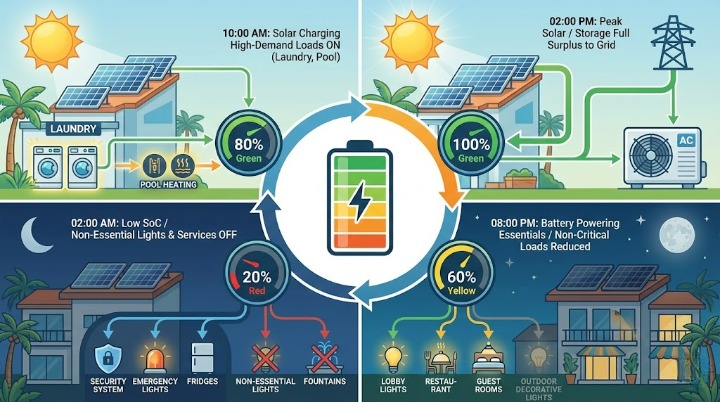
In June 2024 – March 2025, Mount Meru Hotel, a premier 178 rooms hospitality property. The hotel faced chronic power instability and relied heavily on two 500kVA diesel generators. During peak tourism seasons, monthly fuel costs exceeded $18,000. Additionally, frequent voltage spikes from the local grid caused repeated failures in the hotel's central chiller system and laundry equipment. A comprehensive off grid hybrid system was implemented, focusing on maximizing solar self consumption. The installation included a 450kWp solar array integrated into carports and rooftop spaces, paired with a 1.2MWh LiFePO4 Energy Storage System. The system was configured with a "Silent Night" logic. Between 11:00 PM and 7:00 AM, the generators were programmed to remain off, with the entire hotel load supported by the ESS. During the day, the laundry and pool heating systems were automated to trigger only when solar production exceeded the hotel's baseline demand.
The Results:
Fuel Reduction: Monthly diesel consumption dropped by 72%, saving the property approximately $13,000 per month.
Asset Protection: Zero reported compressor failures in the chiller system since commissioning due to the clean sine wave output of the high-frequency inverters.
Customer Satisfaction: Guest complaints regarding generator noise and vibration during the night were completely eliminated.
ROI: The projected payback period for the entire system was revised from 5.5 years to 4.2 years due to rising local fuel taxes.
A Guide to Optimizing Hotel ROI via SoC
For the property owner, managing SoC is not a task for the engineering room alone; it is a part of the Standard Operating Procedure (SOP).
Implementing Load Leveling SOPs
We recommend a tiered approach to energy consumption based on accurate SoC data. When your system reports that the SoC has dropped below 30%, the EMS should automatically disable noncore loads. This might include landscape lighting, water feature pumps, or secondary laundry units. By preserving the remaining 30% for guest room essentials (lighting, WiFi, and fans), you maintain the illusion of infinite power even when the sun hasn't shone for two days. This is the transition from selling batteries to managing energy.
Periodic Full Charge Calibration
Even the best Coulomb counting systems benefit from a reset. Once every two to four weeks, an off grid system should be allowed to reach 100% SoC and remain in a float stage for several hours. This allows the BMS to balance the individual cells and recalibrate the 100% reference point. In a hotel environment, this is best scheduled on days with low occupancy or high solar forecast.
Conclusion:
In the demanding world of off grid hospitality, a percentage point on a screen is more than a technicality; it is a promise of service. Understanding what does soc stand for in solar is the first step toward reclaiming control over your utility costs and asset longevity. Accurate SoC data removes the power anxiety that leads to over investment and operational waste. It allows you to run your resort with the confidence that the lights will stay on, the guests will stay happy, and your battery investment will stay protected for the next decade.
✉️Email: exportdept@snadi.com.cn
Website:
☎️WhatsApp / WeChat: +86 1803929353
FAQ
Q1: What does SoC stand for in solar energy systems?
SoC stands for State of Charge which indicates the level of energy remaining in a battery compared to its full capacity.
Q2: Why is precise SoC management important for off grid businesses?
Accurate monitoring prevents deep discharge cycles and helps avoid the premature replacement of expensive battery banks.
Q3: How does State of Charge help in reducing diesel fuel costs?
High precision tracking allows systems to maximize solar energy usage and start backup generators only when the stored power is truly depleted.
Q4: What is the most accurate way to measure solar battery SoC?
Professional grade systems use Coulomb Counting to track actual current flow because it is far more reliable than voltage based estimations.

FAQ
The energy consumption standards for household appliances are usually regulated by relevant national departments, and different products have different energy efficiency level standards. Consumers can choose energy-saving products based on their energy efficiency levels.
What are the precautions for repairing and maintaining household appliances?
What is the service life of household appliances?
What issues should be noted when purchasing household appliances?
What issues should be noted when purchasing household appliances?