

The fundamental difference between an off-grid inverter and a hybrid inverter lies in utility grid connectivity and energy management. An off-grid inverter operates entirely independently of the local utility grid, converting direct current (DC) from battery banks into alternating current (AC) for local loads. Conversely, a hybrid inverter integrates the functions of a traditional solar inverter, battery charger, and grid-tie bypass system, allowing bidirectional power flow to manage inputs from solar arrays, battery storage, and the utility grid simultaneously.
At a Glance
Section | Summary |
What is an Off-Grid Solar Inverter? | An in-depth analysis of off-grid inverters, their operating principles, physical hardware components, and core industrial applications in remote areas. |
What Is a Hybrid Inverter? | An examination of hybrid inverters, focusing on their bidirectional grid-interactive capabilities, dynamic power routing, and multi-source management. |
Off Grid Inverter vs Hybrid Inverter: Key Differences | A detailed comparative breakdown analyzing structural differences, hardware topologies, power routing logic, efficiency ratios, and installation capital expenditures. |
Off Grid vs Hybrid Inverter: Which One is Better for Your Solar Project? | An engineering decision-making matrix designed to help project managers choose the optimal system based on grid reliability, load profiles, and geographic regulations. |
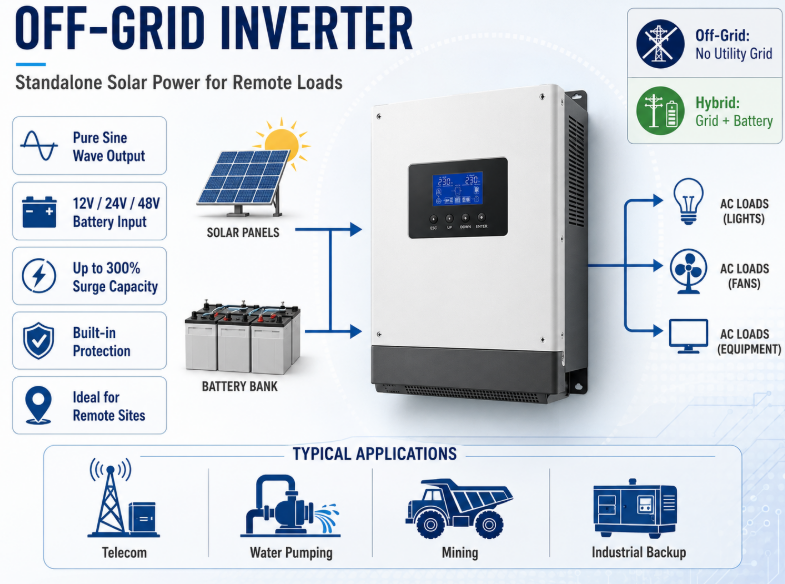
What is an Off-Grid Solar Inverter?
An off-grid solar inverter is a dedicated power electronic device designed to convert direct current ($DC$) stored in battery banks into regulated alternating current for standalone electrical loads, operating completely isolated from the utility grid.
Understanding Off-Grid Power Inversion Topologies
To comprehend the functionality of an off-grid inverter, one must look at the structural architecture of isolated power systems. Unlike grid-interactive systems, an off-grid unit does not synchronize its output frequency or phase with an external utility signal. Instead, it acts as a voltage source, utilizing internal crystal oscillators to generate a stable 50Hz or 60Hz sinusoidal wave. The system's primary dependency is on the chemical energy stored within a battery bank. When solar irradiance is low or unavailable, the inverter draws low-voltage DC energyand steps it up to high-voltage AC via internal solid-state switching circuits.
From an engineering perspective, modern off-grid inversion relies heavily on either high-frequency or low-frequency transformer topologies. High-frequency off-grid inverters utilize smaller, lightweight high-frequency transformers and intermediate DC-DC boost stages to convert DC to AC. While highly efficient at nominal loads and structurally compact, they exhibit lower surge capacities. Conversely, low-frequency off-grid inverters employ robust iron-core copper transformers. These heavy-duty components handle massive inductive load surges, such as those generated when starting air conditioners, water pumps, and industrial electric motors, making them the preferred choice for heavy industrial and high-reliability commercial setups.
In off-grid configurations, the system must balance generation, storage, and consumption in real time. Because there is no utility grid to absorb excess generation or supply deficit power, the design of the off-grid inverter must be highly robust. It must communicate with external solar charge controllers (MPPT or PWM) and battery management systems (BMS) to prevent over-discharging of the battery bank while ensuring that the critical loads receive a stable, low-distortion pure sine wave output.
Essential Components and Specifications of Off-Grid Inverters
To ensure sustained performance in harsh, isolated environments, the physical construction of an off-grid system must utilize heavy-duty components. The table below outlines the critical specifications and hardware components typical of high-quality industrial off-grid systems.
Component / Parameter | Specification / Material | Operational Purpose |
Power Stage Topology | Pure Sine Wave, Low Frequency (Transformer-based) | Delivers high inductive load surge capabilities and protects sensitive electronics. |
DC Input Voltage Range | 12VDC / 24VDC / 48VDC (nominal) | Standardizes integration with deep-cycle lead-acid or LiFePO4 battery storage banks. |
Output Voltage Regulation | 110V / 120V / 220V / 230V/ 240V± 1% | Maintains stable voltage levels despite rapid fluctuations in load demand. |
Surge Capacity | 300% of rated continuous power for up to 20 seconds | Accommodates inrush currents from electric motors and heavy inductive machinery. |
Cooling Mechanism | Intelligent variable-speed cooling fans with extruded aluminum heat sinks | Regulates internal temperature based on load demand to extend component lifespans. |
Protection Suites | Overload, short-circuit, over-temperature, under-voltage, over-voltage | Prevents catastrophic failure of internal IGBTs and external storage systems. |
Core Industrial Applications of Standalone Systems
1. Remote Telecommunication Infrastructure
Off-grid telecommunication towers located in remote mountain ranges or isolated valleys rely on continuous, uninterruptible power. High-efficiency off-grid power conversion systems convert DC power from solar-charged battery banks to supply standard AC power to cellular transceivers, microwave relays, and monitoring sensors. The reliance on heavy-duty low-frequency transformers prevents system shutdowns caused by lightning strikes or voltage transients.
2. Agricultural Irrigation and Water Pumping Systems
In large-scale agricultural projects far from the nearest municipal grid line, solar-powered water pumps are critical. These systems utilize dedicated off-grid high-surge inverters to handle the high inrush currents of three-phase AC induction motors. By coupling the inverter directly with variable frequency drive (VFD) technology, farmers can maximize water extraction during peak sunlight hours without requiring grid power.
3. Remote Industrial and Mining Facilities
Exploration camps, meteorological monitoring stations, and mining outposts operate in some of the most challenging environments on Earth. These facilities require extremely durable power solutions. Industrial-grade low-frequency off-grid inverters, such as the low frequency solar inverter, provide the mechanical and electrical resilience needed to run heavy power tools, ventilation fans, and scientific instrumentation under constant load, completely independent of local utility grids.
What Is a Hybrid Inverter?
A hybrid inverter, also referred to as a multi-mode or grid-interactive inverter, is an advanced power conversion unit capable of simultaneously managing energy inputs from photovoltaic (PV) solar panels, battery storage banks, and the utility grid.
The Bidirectional Mechanics of Hybrid Power Systems
The operational essence of a hybrid inverter centers on its intelligent, bidirectional power flow management. Unlike traditional grid-tie or standalone systems, a hybrid inverter features sophisticated integrated software algorithms and internal transfer switches that constantly monitor incoming PV power, household load demand, battery state-of-charge (SoC), and utility grid pricing structures. The system can route energy bidirectionally: charging batteries from either solar or the grid when rates are low, and discharging batteries to power local loads or feeding excess energy back into the municipal grid when rates peak.
At its core, the hybrid inverter replaces multiple individual components—such as a grid-tied inverter, a solar charge controller, and a battery charger—with a single, consolidated enclosure. This integration optimizes efficiency, as power does not need to undergo multiple DC-AC-DC conversions before reaching its destination. The internal switching network utilizes high-speed insulated-gate bipolar transistors (IGBTs) to seamlessly transition between grid-connected mode and islanded (backup) mode during a utility blackout.
For modern commercial and residential installations, especially in markets with complex net metering regulations or time-of-use (ToU) utility billing, hybrid inverters provide unmatched versatility. The internal control system can prioritize consumption. For example, during peak solar production, the inverter first satisfies immediate load demands. Any excess power is used to charge the energy storage system. Once the battery reaches its maximum charge capacity, the hybrid inverter can dynamically curtail solar production or export the remaining power to the utility grid, depending on grid conditions and local utility agreements.
Core Hybrid System Specifications and Hardware Interfaces
The dynamic nature of hybrid inverters requires precise engineering and interfaces that support multiple input and output channels. The table below highlights the structural and operational parameters essential for these multi-mode systems.
Interface / Parameter | Specification Type | Engineering Function |
Grid Interaction Mode | Bidirectional (Grid-tied & Off-grid) | Supports net metering export and grid-charging capabilities during low-tariff hours. |
Battery Compatibility | Lithium-Ion (LiFePO4) & Lead-Acid, with integrated BMS communication | Communicates via CAN/RS485 protocols to monitor cell health and state of charge. |
Transfer Time | ≤ 10 milliseconds (UPS-grade) | Guarantees uninterruptible power transition for sensitive IT and medical equipment during blackouts. |
MPPT Input Channels | Dual or Multiple independent MPPT trackers | Optimizes solar energy yield from PV arrays with varying orientations or shading. |
Grid Export Compliance | IEEE 1547, UL 1741, VDE-AR-N 4105 | Ensures adherence to local utility safety standards, including anti-islanding protection. |
Monitoring Interface | Wi-Fi / GPRS / Ethernet with cloud-based dashboard | Enables remote system tracking, firmware updates, and real-time parameter configuration. |
Advanced Operational Strategies of Hybrid Systems
1. Peak Shaving and Demand Charge Reduction
For commercial enterprises, utility bills are often determined not only by total energy consumption but also by peak demand spikes. Hybrid inverters can be programmed to monitor load consumption constantly. When the facility’s power draw approaches a pre-configured threshold, the hybrid inverter immediately discharges the battery bank to supply the excess load locally, effectively "shaving" the peak and significantly lowering utility demand charges.
2. Time-of-Use (ToU) Load Shifting
In regions where electricity tariffs vary throughout the day, hybrid inverters maximize economic efficiency. During off-peak night hours, the inverter can draw power from the utility grid to charge the battery bank at lower rates. When peak pricing begins during the day, the inverter shifts the entire local load to the solar array and the stored battery power, completely isolating the facility from expensive grid power without requiring structural changes to the electrical layout.
3. Uninterruptible Critical Load Backup
During utility blackouts, standard grid-tie inverters must shut down immediately to prevent hazardous power backfeeding into the utility grid (anti-islanding). Hybrid inverters, however, feature internal high-speed automatic transfer switches. During a grid failure, the inverter disconnects from the grid path and continues to supply power to dedicated critical load sub-panels using a combination of solar generation and battery reserves, functioning as a robust uninterruptible power supply (UPS).
Off Grid Inverter vs Hybrid Inverter: Key Differences
The primary structural difference is that an off-grid inverter cannot synchronize with the utility grid and relies entirely on battery storage for system stability, while a hybrid inverter is designed to connect to the utility grid and dynamically route power between solar panels, batteries, and the grid based on cost and availability.
Architectural and Functional Comparison
Evaluating an off-grid inverter against a hybrid inverter requires examining their electrical architectures, control logics, and system topologies. The table below compares these two technologies across critical engineering metrics.
Feature / Metric | Off-Grid Inverters | Hybrid Inverters |
Utility Grid Connection | No connection possible; completely isolated from the grid. | Dual connection; operates both grid-tied and isolated. |
Synchronization | Generates its own local voltage and frequency reference. | Synchronizes output voltage and frequency with the utility grid. |
Battery Requirement | Mandatory. The system cannot function without battery storage. | Optional for basic operation, but required for backup power functions. |
Energy Export Capability | Cannot export excess energy to external municipal lines. | Fully capable of exporting excess solar power to the grid. |
Surge Capacity | Very high (especially in low-frequency transformer models). | Moderate to high, depending on model and operating mode. |
System Complexity | Moderate; requires external charge controllers. | High; integrates charge controllers, bypasses, and communication interfaces. |
System Efficiency | Higher DC-AC conversion efficiency due to direct paths. | Slightly lower overall conversion efficiency due to bidirectional logic. |
Initial Capital Cost | Lower per-unit cost, but higher overall system cost (due to large batteries). | Higher per-unit cost, but offers flexible storage scaling options. |
Detailed Performance and Topology Analysis
1. Power Routing Logic and Circuit Topology
An off-grid system features a unidirectional power flow model from DC sources (batteries/solar) to AC loads. The inverter circuit lacks the synchronization bridges and phase-matching loops needed to feed power outward.
A hybrid inverter features a complex bidirectional topology. It utilizes bidirectional DC-DC converters to interface with the battery bank, allowing it to act as both a buck converter (charging the battery from PV or grid) and a boost converter (discharging the battery to power AC loads or export to the grid).
2. Battery Dependence and System Longevity
An off-grid system is entirely dependent on its battery bank. If the battery bank is depleted or disconnected, the inverter will shut down instantly, regardless of how much solar irradiance is hitting the PV array. This puts high cycling stress on the battery bank.
By contrast, a hybrid system can operate entirely without batteries in standard grid-tie mode, utilizing the grid as an infinite virtual battery. When batteries are integrated, they are cycled far less aggressively, as the utility grid can step in to support loads during extended periods of low solar output, extending the lifetime of the energy storage system.
3. Installation Complexity and Regulatory Approvals
Because off-grid systems do not connect to the utility infrastructure, they do not require utility grid approval, net metering agreements, or anti-islanding certification. This simplifies the planning and permitting process, especially in rural or remote jurisdictions.
Hybrid inverters must comply with stringent national and utility-specific grid connection standards (such as UL 1741 and IEEE 1547). They require formal grid-connection approval, bidirectional utility meter installations, and regular compliance audits, which can increase the administrative overhead and installation timeframe of a project. For high-performance installations requiring specialized standalone capabilities, choosing the correct off grid inverter can bypass these regulatory processes while ensuring robust power generation.
Off Grid vs Hybrid Inverter: Which One is Better for Your Solar Project?
The optimal choice depends on utility grid accessibility and local electricity tariffs: select an off-grid inverter for remote locations where grid expansion is cost-prohibitive, and choose a hybrid inverter for areas with an active grid to benefit from lower utility bills, battery backup, and grid-export opportunities.
Choosing the Right System for Your Application
Selecting the correct inverter topology is a critical decision that impacts both the long-term ROI and the operational reliability of a solar energy project. To help guide this decision, consider these key engineering criteria:
1. Evaluate Grid Availability and Infrastructure Quality
The first metric to analyze is the presence and stability of the utility grid. If the project site is located in a remote area where grid connection is physically unavailable or where the cost of extending grid lines is high, an off-grid system is the only logical choice.
If the grid is present but unstable, experiencing frequent daily outages, a hybrid system with UPS-grade switching speed is highly effective. If the grid is exceptionally stable and the goal is to reduce utility bills, a hybrid inverter provides the optimal combination of grid-tied economics and backup security.
2. Analyze Local Utility Policies and Net Metering Incentives
Local energy policies heavily influence project economics. In regions with favorable net metering policies, a hybrid inverter allows you to sell excess solar energy back to the utility, maximizing return on investment.
However, in areas where utilities prohibit energy export, feed-in tariffs are low, or grid connection permits are difficult to obtain, an off-grid inverter or a zero-export hybrid system is a more practical solution.
3. Define the Nature of the Electrical Loads
The type of machinery and appliances being powered plays an important role in inverter selection. Heavy inductive loads with high starting current spikes—such as deep-well pumps, industrial compressors, and workshop tools—are best served by heavy-duty, low-frequency off-grid inverters. These units utilize heavy copper transformers that can absorb high electrical surges without failing.
For standard residential loads, server racks, and light commercial buildings with sensitive digital electronics, hybrid inverters provide excellent, clean power with high-speed switching capabilities.
