

A rooftop PV system may reduce daytime grid purchases yet do nothing when the utility fails during a production shift. A battery may store enough energy for several hours but still be unable to start a pump or compressor. An inverter may carry an attractive efficiency figure while losing output every afternoon because it was installed in a hot, poorly ventilated room.
These are not minor specification issues. They affect production continuity, electricity costs, battery life, and the time required to recover the original investment.
For anyone researching how to choose a solar inverter, the starting point should be the job the system must perform. Panel capacity matters, but so do the load profile, grid condition, battery discharge power, tariff structure, ambient temperature, and plans for expansion.
That is particularly relevant in Latin America, where one project may be designed for rooftop self consumption in a stable urban grid while another must work with voltage fluctuations, regular outages, or diesel generation.
Why the Inverter Decision Matters in 2026
More solar capacity is being connected to electrical systems, but buyers are also asking solar equipment to perform more tasks.
The International Energy Agency reported that global solar PV electricity generation increased by about 620 TWh in 2025, compared with an increase of 450 TWh in 2024. Solar is not only being installed at greater scale; it is also being combined more frequently with batteries, load controls, and backup functions.
Brazil shows how far distributed generation has already moved into the mainstream. The country’s Energy Research Office reported that distributed photovoltaic microgeneration and minigeneration reached 35,892 MW of installed capacity in 2024.
Those figures do not mean every project needs storage. They do mean that inverter selection now involves more than finding a device with the same kilowatt number as the PV array.
A buyer may need the inverter to:
• Reduce daytime grid purchases.
• limit demand during expensive billing periods.
1• keep refrigeration, communications, lighting, or production controls online.
• coordinate solar, batteries, utility power, and a diesel generator.
• work with unstable voltage or frequency.
• allow more PV or battery capacity to be added later.
Each objective leads to a different system design.
How to Choose a Solar Inverter Based on the Job
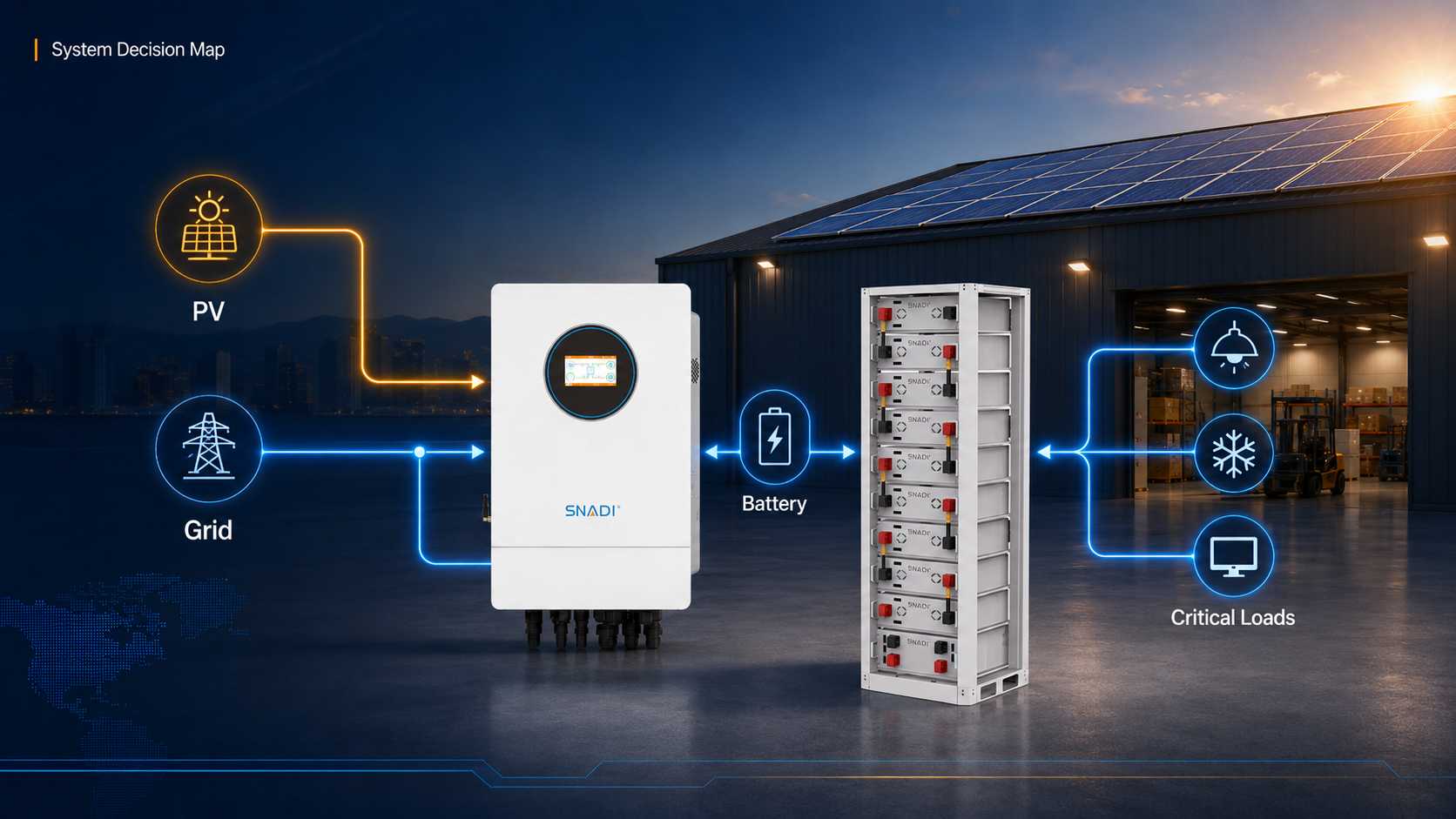
For reducing electricity purchases
Where the grid is reliable and most electricity is consumed during daylight hours, a grid connected inverter is usually the simplest option.
This design suits offices, retail buildings, workshops, and warehouses with steady daytime loads. Solar power is consumed on site, and surplus production may be exported where local regulations allow it.
The main advantage is lower capital expenditure. The trade-off is straightforward: a standard grid-tied inverter normally stops operating when the utility supply fails. Anti-islanding protection prevents the PV system from energizing a grid that technicians may be repairing.
A business that cannot tolerate an outage therefore needs more than a basic grid-connected installation.
For backup power and electricity-cost control
A hybrid inverter manages PV generation, battery charging, grid input, and backup loads. It can store solar energy for later use and may also charge the battery from the grid when operating rules permit.
This arrangement is worth considering when:
• outages interrupt business operations.
• the site has time of use tariffs.
• peak demand affects the electricity bill.
• evening consumption remains high after solar production falls.
• diesel backup is expensive to run or maintain.
A hybrid system has a higher initial cost because it includes batteries, protection equipment, and more complex controls. The financial case depends on how the battery will be used.
A battery installed only for rare outages may have a long payback period. The same battery may create more value when it also shifts solar energy into expensive tariff periods or limits short demand peaks.
For weak-grid or off-grid sites
An off-grid inverter is selected around the loads rather than around the solar array alone.
A rural home with lighting and electronics places modest demands on the inverter. A farm with a borehole pump, cold room, or workshop equipment may require much greater surge capacity even when daily energy consumption appears moderate.
An off-grid design must account for:
• continuous load.
• maximum simultaneous load.
• motor and compressor startup current.
• required backup time.
• seasonal solar production.
• battery charging power.
• generator capacity and control logic.
Undersizing may cause repeated overload trips. Excessive oversizing raises the purchase price and may increase no load consumption.
How to Choose a Solar Inverter Size
There are two related calculations: matching the inverter to the PV array and matching it to the AC loads.
Match the PV array to the inverter
For grid-connected and hybrid systems, designers commonly compare PV array capacity in DC kilowatts with inverter output in AC kilowatts.
The calculation is:
DC/AC ratio = PV array capacity ÷ inverter AC rating
A 12 kW array connected to a 10 kW inverter has a DC/AC ratio of 1.2.
A ratio above 1.0 is not automatically a design error. Solar modules rarely produce nameplate power throughout the day. A moderately larger PV array can keep the inverter working at a higher output during mornings, afternoons, cloudy conditions, and warmer operating temperatures.
The trade off is clipping. When available DC power exceeds the inverter’s AC output limit, some potential production cannot be converted.
The acceptable ratio depends on:
• local irradiance and temperature.
• roof orientation and tilt.
• module degradation assumptions.
• export limits.
• inverter warranty conditions.
• the manufacturer’s design rules.
Do not apply a standard 1.2 or 1.3 ratio to every project without checking the actual yield model and datasheet.
Match the inverter to the loads
Hybrid and off-grid inverters must also supply the required AC power.
Suppose a small commercial site has the following critical loads:
• Refrigeration: 1.5 kW
• Lighting and controls: 0.8 kW
• Computers and communications: 0.5 kW
• Water pump: 1.5 kW running power
The normal combined load is 4.3 kW if everything operates at once. However, the pump may draw substantially more power for a short period during startup.
A 5 kW inverter could appear adequate based on running power but still trip when the pump starts. The designer must compare the pump’s starting characteristics with the inverter’s overload rating and permitted overload duration.
SNADI/SNAT Solar Engineer’s Tip
Do not add an arbitrary safety margin before understanding the load. First identify which equipment can operate at the same time and which loads have high starting current. A carefully managed 8 kW critical-load panel may be more reliable and less expensive than connecting the entire building to a 15 kW backup output.
Load prioritization often saves more money than simply purchasing a larger inverter and battery.
Check the PV Input Before Approving the Model
Matching kilowatts is only the first step. The module strings must remain within the inverter’s electrical limits.
Check the following values:
Maximum DC voltage
Calculate the highest possible open-circuit string voltage under the site’s lowest expected temperature. Module voltage rises as temperature falls.
Exceeding the inverter’s maximum DC voltage can damage equipment and is not corrected by software settings.
MPPT operating range
The string’s working voltage should stay within the MPPT range during normal operation. A string that falls below the lower limit may start late, stop early, or fail to track correctly under hot conditions.
Input current per MPPT
High current and bifacial modules need careful review. A string may satisfy the voltage requirements but exceed the permitted operating or short circuit current of the MPPT input.
Number of MPPTs
Separate MPPT channels are useful when panels face different directions or when sections of the array experience different shading conditions.
Connecting east and west facing strings to one tracker can restrict production because the strings do not operate at the same electrical point.
Battery Capacity and Battery Power Are Not the Same
One of the most common storage mistakes is choosing a battery by kilowatt-hours without checking how many kilowatts it can deliver.
A 10 kWh battery describes stored energy. It does not automatically mean the battery can support a 10 kW load.
Before matching a lithium battery with a hybrid or off-grid inverter, check:
• nominal battery voltage.
• usable energy capacity.
• maximum continuous discharge current.
• short duration discharge limit.
• maximum charging current.
• battery management system communication.
• approved inverter compatibility.
• permitted depth of discharge.
• temperature restrictions.
Estimating backup capacity
Assume a site needs to support a 3 kW critical load for four hours.
The loads require:
3 kW × 4 hours = 12 kWh
If both the usable battery fraction and the conversion path are assumed to be 90%, the initial nominal capacity estimate is:
12 kWh ÷ 0.90 ÷ 0.90 = approximately 14.8 kWh
This is only a starting point. The final capacity may change after reviewing peak load, battery ageing, temperature, discharge limits, and whether solar production will be available during the outage.
Backup time should also be based on a realistic load schedule. A compressor, pump, or air conditioner does not necessarily run continuously for the full four hours.
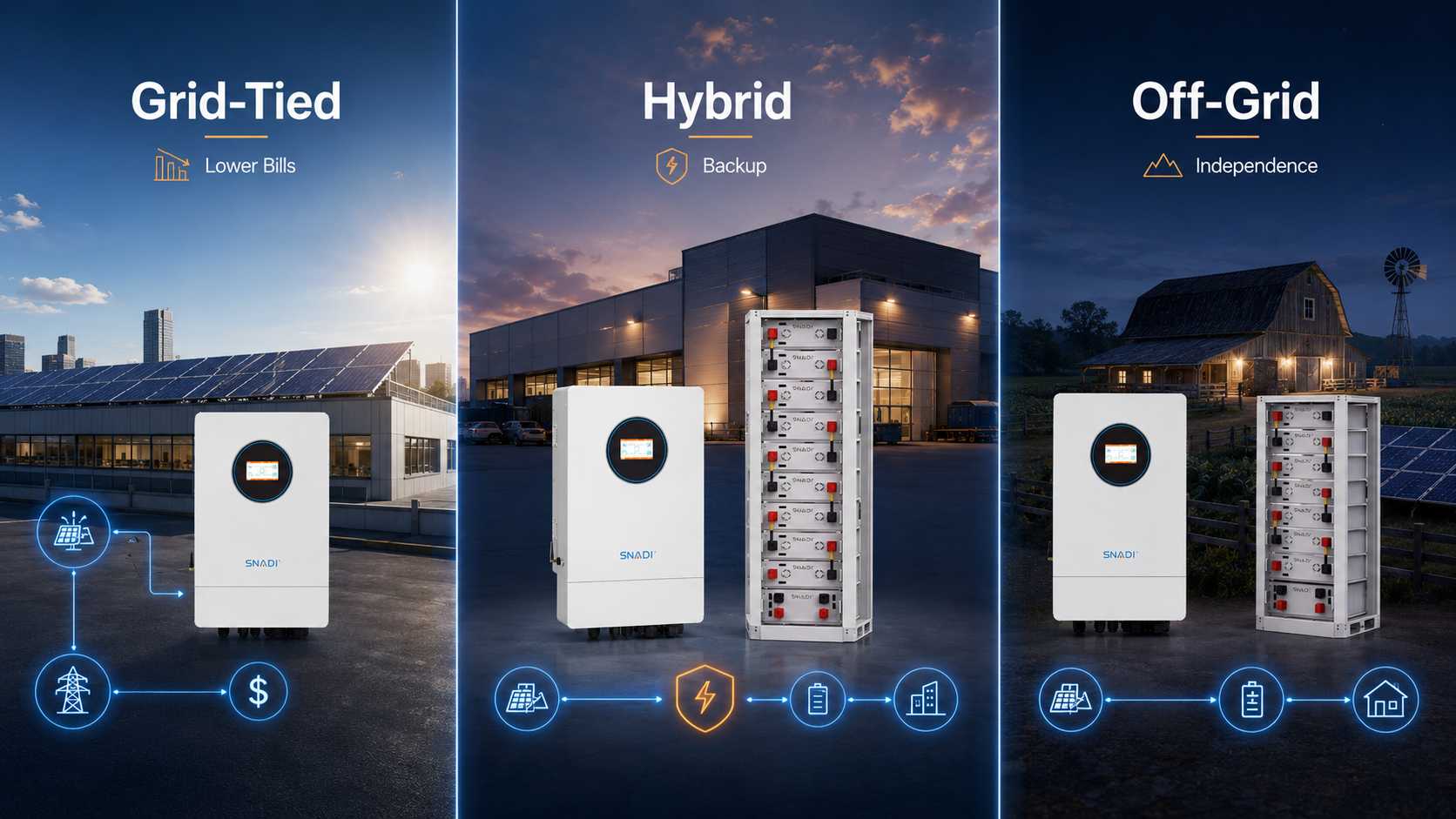
Compare the Financial Trade Offs
The lowest purchase price does not always produce the lowest operating cost. At the same time, adding batteries to every project does not guarantee a better return.
System Design | Relative CAPEX | Typical OPEX | Main Source of Value | Main Operating Risk |
|---|---|---|---|---|
Grid-tied PV inverter | Low | Low | Lower daytime grid purchases | No backup during a grid outage |
Hybrid inverter with battery | Medium to high | Low to medium | Backup, energy shifting, possible peak control | Battery may be underused or incorrectly sized |
Off-grid inverter, battery, and generator | High | Medium | Replaces grid extension or regular diesel operation | Load growth or poor seasonal design can cause energy shortages |
Oversized backup system | High | Low to medium | More spare power and longer runtime | Capital remains tied up in capacity that may rarely be used |
For a commercial buyer, downtime deserves its own calculation.
A battery system may be financially reasonable even when electricityprice savings alone do not justify it.
Conversely, a site with a reliable grid and low outage costs may receive a better return from a grid-tied inverter without storage.
Account for Latin American Site Conditions
Latin America is not one electrical market. Voltage, frequency, interconnection procedures, tariffs, and export rules vary between countries and sometimes between utilities.
Before placing an order, confirm the exact site requirements rather than selecting a “Latin America version” from a catalogue.
Grid configuration
Check:
• nominal grid voltage.
• single phase, split phase, or three phase connection.
• 50 Hz or 60 Hz operation.
• neutral and grounding arrangement.
• permitted export power.
• antiislanding and grid code requirements.
• local approval or certification requirements.
The voltage printed on the building’s main panel is more useful than a general country-level assumption.
Heat and ventilation
An inverter rated at 10 kW under laboratory conditions may reduce output when internal temperature rises.
Ask for the thermal derating curve, not only the maximum operating-temperature figure. Two products can list the same temperature range while delivering different continuous output in a hot equipment room.
Allow clearance around the unit and avoid locations exposed to direct afternoon sun.
Dust, humidity, and coastal air
Outdoor and semi outdoor installations require an appropriate enclosure rating. In coastal areas, corrosion resistance also matters.
An IP rating indicates protection against solid objects and water entry, but it does not by itself describe resistance to salt mist, chemical vapour, or long term corrosion.
Weak-grid behaviour
Where voltage changes frequently, ask how the inverter behaves near its permitted limits.
A unit that disconnects repeatedly may protect itself correctly but still leave the customer with poor system availability. The installer should review grid-voltage records and determine whether cable sizing, transformer conditions, export settings, or utility coordination also need attention.
What to Ask Before Issuing a Purchase Order
Do not approve an inverter from the sales brochure alone. Request the documents needed to check the complete configuration.
Ask the supplier for:
1. The full inverter datasheet.
2. MPPT voltage and current limits.
3. Overload power and permitted overload duration.
4. Battery compatibility list and communication protocol.
5. Thermal derating information.
6. Grid and safety certificates for the destination market.
7. Parallel operation limits.
8. Monitoring and firmware requirements.
9. Warranty coverage and exclusions.
10. Spare parts and after-sales procedures.
For a hybrid or off-grid project, provide the supplier with the proposed module strings, battery model,
load schedule, grid information, generator data, and required backup time.
A quotation that simply says “10 kW inverter with 20 kWh battery” is not a system design.
Where SNADI/SNAT Solar Products Fit
SNADI/SNAT Solar supplies hybrid and off-grid inverters, LiFePO4 batteries, residential storage systems, and commercial energy-storage equipment. The current inverter range includes single phase, split phase, three phase, on/off grid, off-grid hybrid, and low frequency models for residential, small commercial, and C&I applications.
For example, the product portfolio includes the BLD Hybrid Inverter, NKH off-grid hybrid inverter, ES on/off-grid solar inverter, split phase AS models, and inverter options that support parallel expansion. The suitability of any model still depends on the site voltage, PV string design, load characteristics, battery configuration, and required protection level.
Our sales support the solar engineering decision too.
How to Choose a Solar Inverter Without Overbuying
The final choice should reflect what happens at the site when solar production changes, the grid fails, or a large load starts.
A buyer focused on daytime bill reduction may be better served by a straightforward grid-connected inverter. A store protecting refrigeration and payment systems may need a hybrid inverter with a carefully defined critical load panel. A remote farm may need an off-grid inverter with strong surge capability, sufficient battery reserve, and generator support.
Learning how to choose a solar inverter comes down to five questions:
• What financial or operating problem must the system solve?
• Which loads must run, and for how long?
• Are the PV strings electrically compatible with the inverter?
• Can the battery deliver the required power as well as the required energy?
• Will the equipment operate reliably under the site’s grid and environmental conditions?
Answer those questions before comparing quotations. The result is usually a smaller set of suitable products, fewer assumptions, and a system that performs closer to what the buyer expected.
✉️Email: marketing@snadi.com.cn
Website:
☎️WhatsApp / WeChat: +86 1803929353

FAQ
To size a solar inverter accurately, you must calculate both the total PV array capacity and the peak AC load demands. For grid-tied systems, a typical DC/AC ratio might exceed 1.0 to maximize daytime yield, though this can cause clipping. For hybrid or off-grid setups, you must ensure the inverter can handle the continuous running power as well as the high startup surge currents of devices like pumps and compressors to prevent unexpected system shutdowns.
What is the difference between battery capacity and battery power in solar storage?
Why do Latin American site conditions affect solar inverter selection?