

Two batteries can both carry a 51.2V label and still behave very differently when a solar inverter starts a pump, receives a full charge signal or loses communication with the battery management system. The difference sits in usable energy, continuous current, voltage range, firmware, protection logic and installation evidence. A chemistry label cannot answer those questions.
Lithium iron phosphate batteries for solar are rechargeable lithium ion batteries that can suit home, small commercial and off grid storage when the complete system is verified. The right purchase starts with documents and acceptance criteria, not with a promise of long life. IEA notes that battery deployment includes behind the meter systems, mini grids and solar home systems, so the operating context matters as much as the cell chemistry.
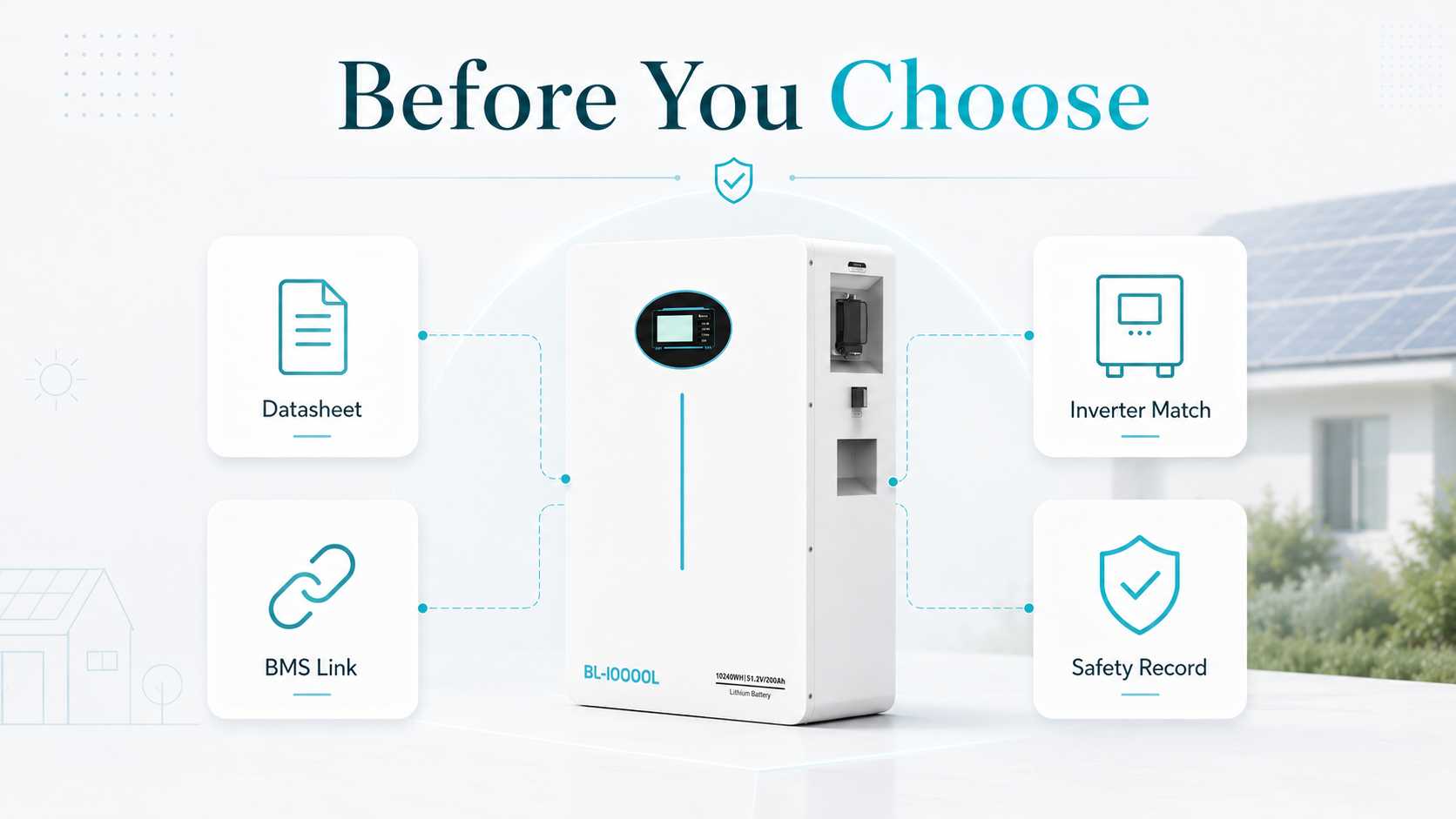
Ask for the Procurement Packet First
Before comparing capacity or price, request the battery datasheet, battery manual, inverter compatibility or firmware list, and certification or test evidence. The datasheet explains ratings. The manual explains installation and control conditions. The compatibility list shows whether the inverter profile is approved. Safety evidence shows what product or system scope was evaluated.
Document | Buyer question | Reject condition |
Battery datasheet | What energy, current and temperature limits apply | No test condition or model identifier |
Battery manual | How is the unit installed and protected | Generic instructions with no configuration limits |
Compatibility evidence | Is the exact inverter and firmware pair supported | A matching connector is the only evidence |
Safety evidence | What is the standard or test scope | One mark is said to cover the whole installation |
Keep the model name and revision visible on every document. A product family name is not enough when voltage limits, firmware, parallel operation or communication behaviour differ between configurations. The first useful question is not whether a battery is lithium iron phosphate. It is which exact battery and which exact system are being reviewed.
Decode the Datasheet Before Choosing Capacity
Convert voltage and amp hours into usable energy
Nominal energy in kilowatt hours equals nominal voltage multiplied by amp hours divided by one thousand. A 51.2V 314Ah battery is about 16 kWh nominal. Planned usable energy must then use the documented permitted state of charge range and an end of life reserve. Do not promise a critical load every nominal kilowatt hour. If a buyer needs a defined backup period, write the load list beside the battery rating. Refrigeration, lighting, communications and a pump may have different running and starting demands. Capacity answers how long a load may run. It does not by itself answer whether the inverter and battery can start that load.
Calculate current at the minimum voltage
Approximate battery current equals inverter AC output divided by battery voltage and inverter efficiency. Use the lowest permitted battery operating voltage for a conservative review. Compare the result with the battery and BMS continuous discharge current, not only a short peak rating. Motors, pumps and compressors need a separate surge check.
The current path includes terminals, cables, fuses, disconnects and the inverter. A battery with high nominal energy can still stop under load if the BMS limit, cable path or inverter surge setting is too low. Energy and power are separate procurement checks.
Read peak power as a timed event
Ask for maximum current, permitted duration, recovery condition and repetition limit. A peak value without a time condition is difficult to use in a design. Record the hardest motor start and the number of starts expected during a backup period. That evidence is more useful than comparing a single peak number between brochures.
Treat cycle life as a conditional result
Cycle count needs depth of discharge, temperature, charge and discharge rate and end of life capacity. Separate cycle life from calendar life and warranty throughput. A long laboratory cycle claim does not define the energy service promised by a particular warranty under a hot room, deep daily use or a slow recharge window.
Write the Battery and Inverter Interface Contract
Match the full voltage window
Compare charge limit, operating range and low voltage protection with the inverter and every approved charger. Nominal 48V or 51.2V matching is not enough. The controlled response when the BMS blocks charging or discharging must be documented by both manufacturers.
Match charge and discharge limits
Inventory solar charging, utility charging, generator charging and any other permitted source. Their combined current must remain inside the battery charge limit. On discharge, confirm that normal loads and surge loads remain inside the protected current envelope. Write the limits into the design record instead of leaving them hidden in separate manuals.
Prove the communication protocol
CAN and RS485 name a communication path, not a shared battery protocol. Verify the selected inverter profile, cable pinout, termination, firmware and expected display values. A working system should show plausible state of charge, voltage, current and alarms without undocumented settings.
Define the response to lost communication
The design record should state what the inverter and charger do when battery data disappears. BMS logic can control charger and load disconnect behaviour to protect the battery. The comparable behaviour for another system must come from its own manuals and approved configuration.
Use a Model Specific SNADI Example
At SNADI/SNAT Solar, we may review the BL Power Storage Battery after the load profile and inverter are known. Its public page lists 51.2V options including 314Ah, a built in battery management system and CAN, RS485 and RS232 communications. The local product documentation also describes a 16 kWh class LiFePO4 unit, parallel address settings, indoor installation and inverter communication steps.
Those details make the battery a candidate for a documented hybrid storage system. They do not prove that it will work with every inverter. Confirm the selected protocol, current limit, temperature range, installation manual and warranty configuration before the equipment scope is final.
SNADI/SNAT Solar Engineer Tip:
Put the selected battery protocol, inverter firmware and initial state of charge on the commissioning form. A photo of the nameplate is useful, but it does not record the interface settings that decide whether the BMS can manage charging and loads.
Build the Safety Evidence Stack
LiFePO4 is not a fireproof claim. A cell chemistry, battery pack, complete energy storage system and installed project are different boundaries. IEC 62619 2022 specifies safety requirements and tests for secondary lithium cells and batteries used in industrial applications including stationary applications. It does not replace a check of the complete installation.
For relevant North American projects, UL Solutions describes UL 9540A as a fire test method referenced by the 2026 NFPA 855 edition in specified situations. Buyers should ask which standard, edition, model and installation decision the supplied evidence supports. Local rules and authority approval still govern the project.
Evidence | Scope to verify | Buyer action |
Battery evaluation | Exact battery model and stationary use | Match model and manual revision |
ESS evidence | Battery, inverter and controls boundary | Check the supplied system configuration |
Fire test evidence | Test method and representative assembly | Do not generalize a cell result to a building |
Installation approval | Local rules, location and protection design | Use qualified professionals |
Lead acid and lithium projects both need product specific installation instructions. The design should cover enclosure location, grounding, cable protection, disconnects, ventilation where required, temperature control, emergency information and an alarm response plan. Neither path supports bypassing the BMS or charging outside the manual limits.
Commission the System Before Handover
Record identity and configuration
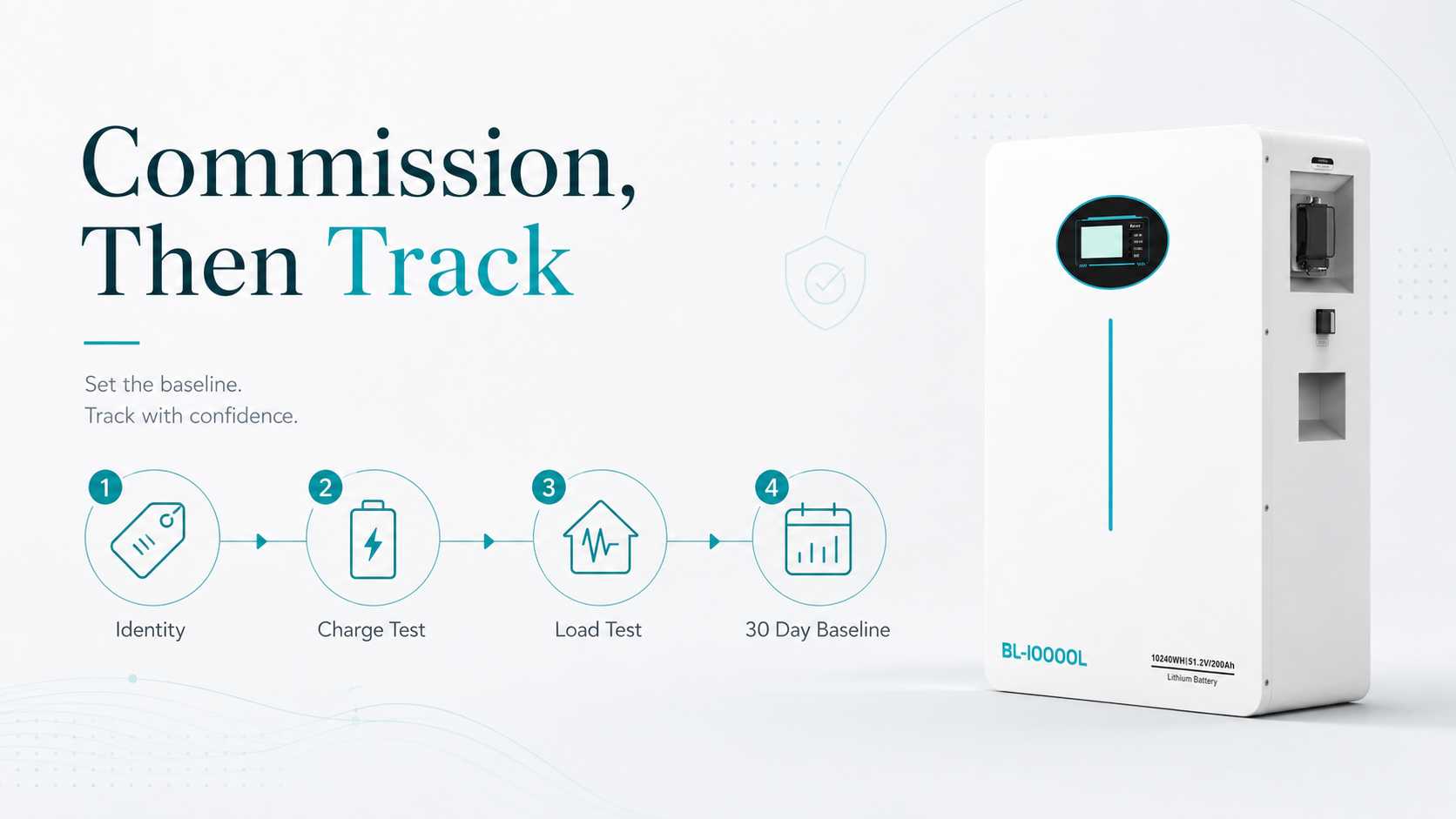
Record model, serial number, manufacturing date where available, firmware, protocol profile, parallel topology and opening state of charge. Keep photos of labels, protection settings and manual revisions with the project dossier. This information prevents a later service team from guessing which configuration was installed.
Verify charging and dynamic limits
Under approved conditions, observe solar and other permitted charging sources. Confirm that current limits, state of charge direction, battery temperature and charge termination behave as specified. Do not create unsafe conditions merely to trigger a protection event. Use the manufacturers commissioning procedure for controlled tests.
Verify load and shutdown behaviour
Use an approved test load within the system design limits. Observe voltage stability, current, temperature and alarm reporting. The installer should use approved procedures to prove low state of charge handling and communication loss response. A system that turns on is not necessarily a system that has passed its acceptance test.
Sign an acceptance record
The acceptance record should show the expected result, measured result, evidence file, responsible person and corrective action. Include the owner account, service contact, monitoring access and the next scheduled review. This gives the owner a clear handover instead of a folder of disconnected screenshots.
Test | Expected result | Evidence |
Inverter battery handshake | Plausible data and approved profile | Screenshot and configuration record |
Charge limit | Current stays within documented limit | Commissioning log |
Critical load test | Stable operation inside design limit | Test record |
Monitoring alarm path | Alarm reaches responsible person | Notification record |
Establish a Thirty Day Baseline
Track daily charge and discharge energy, minimum and maximum state of charge, peak current, battery temperature and alarms. Compare observed solar recharge with the project expectation. Repeated shutdowns, state of charge jumps or uneven current sharing need a log review before any setting change. The first thirty days should confirm how the system behaves under the real load pattern. It is a chance to find a monitoring boundary error, a missing alert recipient or a battery reserve that does not match the owner priority. It is not a reason to change several variables at once.
Before purchase, ask who provides firmware support, how replacement batteries are matched, what the warranty excludes and who owns end of life removal. EPA guidance says owners should contact the manufacturer, dealer or installer for management options and should not place used lithium ion batteries in trash or municipal recycling bins. Document that service responsibility with the rest of the handover record.
A thirty day baseline does not prove the full service life of a battery. It proves whether the installed controls, load priorities, charging sources and alarm path behave as expected during the first operating period. Keep the baseline with the warranty record so a later capacity or communication concern can be compared with the original configuration.
When a system is expanded, repeat the identity and configuration checks for every added battery. Confirm matching state of charge, approved parallel settings, current sharing and monitoring visibility before the larger bank is placed into normal service. The acceptance record should name the person who approved the change and retain the updated single line diagram.
Conclusion
Lithium iron phosphate batteries for solar should be selected as part of a proven system. Start with the procurement packet, calculate energy and current separately, verify the BMS and inverter contract, then test the installed system before handover. At SNADI/SNAT Solar, we use this evidence path to review a BL battery and hybrid inverter configuration around real loads, installation limits and service ownership.
Bring us the load profile, inverter model, installation location and required backup period. The result should be a purchase record that can be commissioned, monitored and maintained with fewer surprises.
✉️Email: marketing@snadi.com.cn
Website:
☎️WhatsApp / WeChat: +86 1803929353

FAQ
LiFePO4 is one rechargeable lithium ion chemistry. It does not give every battery the same current limit, temperature range, warranty or communication method.
Can any LiFePO4 battery work with any inverter?
Does every battery need CAN or RS485?
Can I add batteries later?
What should be recorded at handover?
How do I compare battery life claims?