

The primary difference between on-grid and off-grid solar systems lies in their electrical grid connection and energy independence: on-grid systems operate directly synchronized with the public utility grid to import or export electricity without mandatory battery storage, shutting down automatically during utility outages for anti-islanding protection; whereas off-grid systems function as completely autonomous microgrids using an off-grid inverter and battery energy storage to supply continuous electricity without reliance on public infrastructure.
At a Glance
Section | Summary |
What Are the Differences Between On-Grid and Off-Grid Solar? | Compares the architectural, physical, economic, and operational distinctions between grid-connected and utility-independent solar systems across key technical metrics. |
Main features of off-grid inverters | Examines the internal topology, pure sine wave output, wide PV input range, high surge capacity, and independent frequency-forming mechanisms of the modern off-grid inverter. |
Main features of on-grid inverters | Details phase synchronization, Maximum Power Point Tracking efficiency, anti-islanding algorithms, grid-feeding dynamics, and transformerless design topologies. |
System Architecture Comparison: On-Grid vs. Off-Grid vs. Hybrid | Analyzes hardware topologies, balance-of-system requirements, and operational behavior across pure utility-tied, off-grid inverter-driven, and multi-mode energy storage configurations. |
Engineering Guidance for Global System Selection | Provides technical decision criteria based on utility stability, regional grid standards, environmental operating ranges, and total cost of ownership. |
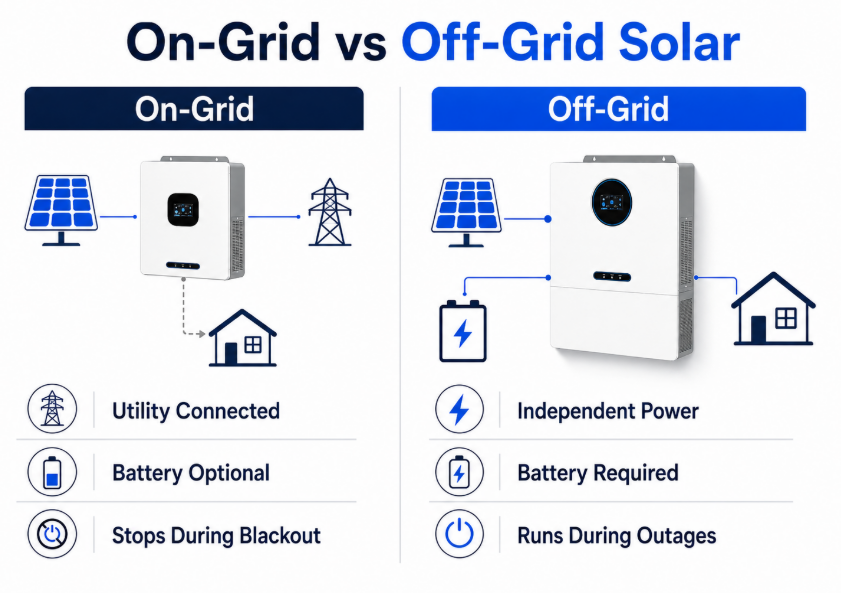
What Are the Differences Between On-Grid and Off-Grid Solar?
The essential difference between on-grid and off-grid solar systems revolves around system synchronization with the public utility network, hardware topology requirements, and operational autonomy under utility power disruptions.
From an electrical engineering standpoint, solar energy systems are categorized by their relationship to the electrical distribution network. An on-grid (or grid-tied) system is directly connected to the local utility grid. It utilizes grid frequency and voltage as reference waveforms to lock into phase using Phase-Locked Loop (PLL) algorithms. When solar arrays generate excess power, electricity flows directly into the public grid through net metering or feed-in tariff arrangements. Conversely, when solar generation is insufficient, power is instantly drawn from the grid to meet load demand seamlessly.
In contrast, an off-grid system functions as a self-sustaining islanded microgrid. It does not rely on a utility grid reference signal. Instead, the central power unit—specifically a robust off-grid inverter—generates its own AC voltage and frequency reference to supply downstream connected loads. Because utility power is absent, off-grid systems must incorporate dedicated energy storage mechanisms, primarily lithium iron phosphate (LiFePO4) or heavy-duty lead-acid battery banks, to store daytime solar energy for usage during night cycles or low-irradiance conditions.
Understanding these fundamental divergences requires analyzing critical operational parameters, including grid connectivity, autonomy, energy storage requirements, capital expenditure, lifecycle maintenance, and environmental adaptation factors. Industrial client requirements heavily dictate whether an installation utilizes pure grid feed-in or robust autonomous power units such as an off-grid solar inverter for remote power systems designed to maintain steady AC power under harsh, grid-deficient environments.
1. Connection to the Grid
On-grid systems maintain continuous two-way electrical synchronization with the municipal distribution grid, whereas off-grid systems operate in absolute electrical isolation from public utility lines.
On-grid installations require a bidirectional utility connection point equipped with grid-compliant protection devices, net metering meters, and rapid shutdown control gear. The grid serves as an infinite virtual battery: surplus solar energy generated during peak noon hours is exported back to the utility, yielding feed-in credits or reducing net consumption metrics. However, strict safety regulations mandate that on-grid inverters incorporate anti-islanding mechanisms. If the main grid experiences a blackout, the on-grid inverter must immediately shut down within milliseconds to prevent back-feeding electricity onto dead power lines, which would endanger utility line workers.
Off-grid systems are completely physically disconnected from public utility infrastructure. They require no approval from local utility operators, nor are they bound by utility interconnect agreements or anti-islanding shutdown mandates. The system relies entirely on internal power generation from photovoltaic modules, managed by a specialized high-performance off-grid inverter that converts direct current (DC) into precise alternating current (AC). Because there is no external grid buffer, off-grid systems must be engineered with precise load calculations, peak surge tolerances, and secondary backup power sources such as diesel generators for extended low-irradiance periods.
For installations situated in regions with frequent utility dropouts or non-existent electrical infrastructure, relying on grid synchronization is impossible. In such scenarios, deployments utilize high-efficiency units like an energy storage on off-grid solar inverter capable of handling variable solar input while maintaining strict voltage regulation for connected loads.
2. Energy Independence
Off-grid systems deliver complete 100% power autonomy from utility infrastructure and grid outages, while on-grid systems remain entirely dependent on utility grid availability to function.
Energy independence is a decisive factor for commercial, industrial, and agricultural project planners. On-grid solar systems offer financial offset benefits by reducing monthly electricity bills, but they offer zero energy security during a grid outage unless augmented with complex energy storage retrofits. When the grid fails, a standard grid-tied system halts production immediately, leaving the facility without power despite full sunshine shining on the PV arrays.
Off-grid systems deliver total energy sovereignty. Because the system creates its own localized AC grid voltage, it remains entirely immune to municipal grid blackouts, load shedding, line frequency instability, or rolling brownouts. The facility owner controls power production, storage reserves, and load distribution independently. This autonomy is vital for telecommunications towers, remote mining operations, agricultural pumping stations, and rural electrification projects where utility grid access is either non-existent or financially prohibitive to extend.
In modern industrial applications, achieving energy independence does not always require living in remote wilderness. In suburban or industrial zones with unstable power grids, engineering teams deploy flexible off-grid architecture using an advanced IP54 outdoor on off-grid solar inverter that seamlessly toggles between grid-assist mode and isolated battery mode to guarantee continuous uptime for critical operations.
3. Battery Storage
Battery energy storage is an absolute technical requirement for off-grid systems to balance energy supply and demand, whereas on-grid systems can operate entirely without batteries.
In an off-grid system, solar panels generate electricity only during daylight hours, but power consumption occurs continuously over 24-hour cycles. Without an integrated battery energy storage system (BESS), an off-grid installation would experience instant system collapse whenever cloud cover passes or when sun sets. The battery bank acts as the operational buffer, storing excess daytime DC generation and feeding the DC input of the off-grid inverter during demand surges and night hours. Modern off-grid designs utilize lithium iron phosphate (LiFePO4) battery chemistries due to their high depth of discharge (DoD up to 90%), long cycle life (over 6000 cycles), and superior thermal stability.
On-grid systems, by contrast, utilize the public grid as their energy buffer. When PV generation exceeds site loads, excess power feeds the grid; when loads exceed generation, grid power flows in. This eliminates the necessity of capital-intensive battery banks, significantly reducing initial equipment costs. However, modern commercial trends are moving toward hybrid grid-tied systems that incorporate battery banks to capture peak-shaving benefits and provide critical load backup during blackouts, blurring the line between traditional on-grid and off-grid topologies.
System Component / Spec | On-Grid System | Off-Grid System |
Battery Requirement | Optional (Not required for standard operation) | Mandatory (Essential for continuous 24/7 power) |
Grid Synchronization | Mandatory (Requires PLL phase lock) | None (Functions as independent AC source) |
Anti-Islanding Protection | Required by international standards (IEEE 1547 / IEC 62116) | Not applicable (Naturally isolated) |
Surge Capacity Handling | Buffered by public grid infrastructure | Must be absorbed entirely by the off-grid inverter (200%–300% rating) |
Energy Balancing Mechanism | Net metering / Feed-in export to utility | Battery Charge Controller / BESS management |
4. Cost Considerations
On-grid solar systems feature lower initial capital expenditure due to minimal equipment requirements, whereas off-grid systems carry higher initial costs driven by battery storage and specialized inverters.
The total cost of ownership (TCO) structure differs fundamentally between the two architectures. On-grid systems represent the most cost-effective initial investment for solar adoption. The equipment stack is streamlined: PV modules, string or central grid-tied inverters, mounting structures, and basic AC/DC distribution protection. Because no battery bank is required, initial capital outlay is minimized, yielding shorter payback periods (typically 3 to 6 years depending on local feed-in tariffs and utility rates).
Off-grid systems require a higher initial capital investment. Beyond the solar array and mounting hardware, the project budget must account for a high-capacity battery bank, charge controllers, diesel generator integration interfaces, and a heavy-duty off-grid inverter capable of handling severe motor-starting surge currents. The battery system alone can account for 40% to 50% of the total system equipment cost. Furthermore, because batteries have finite cycle lives, replacement reserves must be factored into long-term Levelized Cost of Energy (LCOE) calculations.
However, when evaluating off-grid costs in remote areas, the financial comparison must include the exorbitant capital expense of extending utility power lines (which can range from $20,000 to $100,000 per mile). In such scenarios, installing a self-contained solar microgrid powered by a robust off-grid inverter is vastly more economical than paying for utility infrastructure expansion.
5. Maintenance and Complexity
Off-grid systems exhibit higher maintenance requirements and engineering design complexity compared to low-maintenance, plug-and-play on-grid systems.
On-grid systems are structurally simple and highly automated. With fewer active mechanical or chemical components, maintenance is primarily limited to periodic visual inspections, thermal imaging of solar panels, cleaning PV glass surfaces, and monitoring inverter error logs via cloud telematics. Because the electrical grid acts as a massive stabilizing buffer, system sizing requires less stringent tolerance margins.
Off-grid systems demand precise engineering calculation, careful load profile auditing, and regular ongoing system maintenance. Engineers must accurately calculate daily watt-hour consumption, peak surge wattage, days of autonomy (cloudy day buffer), and battery State of Charge (SoC) management profiles. Improperly sized off-grid systems risk frequent low-voltage disconnects, premature battery capacity degradation, or blackouts during high-demand cycles. System owners must monitor battery health parameters, clean air intake filters on high-power inverters, verify terminal torque tightness, and maintain secondary backup generators.
System Maintenance Protocol: Regular operational checks for off-grid installations must include monthly terminal thermal scanning, quarterly battery state-of-health (SoH) diagnostics, biannual dust filter cleaning on inverter intake fans, and annual verification of protective circuit breaker trip curves to maintain system reliability across a 15-year operational lifespan.
6. Environmental Considerations
Both architectures deliver substantial environmental carbon offset benefits, but off-grid systems require careful battery lifecycle management and recycling protocols.
From a direct carbon mitigation standpoint, both on-grid and off-grid solar systems displace fossil-fuel electricity generation. On-grid systems maximize environmental benefits by continually harvesting 100% of available solar energy; any energy not consumed locally is exported to the grid to clean up the broader municipal power mix. No solar power is wasted or throttled due to full energy storage reserves.
Off-grid systems provide critical environmental protection in ecologically sensitive off-grid zones, replacing dirty, noisy diesel generators that emit particulate matter, nitrogen oxides (NOx), and high CO2 levels. However, off-grid deployments introduce environmental management responsibilities regarding battery chemical lifecycles. System operators must ensure end-of-life battery recycling pathways for lithium-ion or lead-acid chemistries to prevent hazardous material waste, ensuring a truly sustainable green footprint.
Main features of off-grid inverters
An off-grid inverter is a specialized power conversion unit designed to transform direct current (DC) stored in batteries or generated by solar panels into stable, frequency-regulated alternating current (AC) without requiring an external utility reference signal.
Unlike standard grid-tied inverters that rely on the municipal power grid to set voltage and frequency timing, an off-grid inverter functions as a primary voltage source. It incorporates internal pulse-width modulation (PWM) logic controlled by high-speed digital signal processors (DSPs) to establish a clean 50Hz or 60Hz pure sine wave output. This clean sinusoidal output is critical for operating sensitive industrial equipment, medical devices, refrigeration compressors, and microprocessor-controlled electronics without causing harmonic distortion, overheating, or electrical noise.
A central feature of modern industrial off-grid inverters is their exceptionally high surge power capacity. When inductive loads such as water pumps, air conditioners, or industrial motor drives start up, they draw inrush currents 2 to 3 times higher than their rated continuous running power. High-performance off-grid units are built with heavy-duty toroidal transformers or robust MOSFET/IGBT bridge circuits designed to sustain 200% to 300% overload surges for several seconds without tripping power protection alarms.
Furthermore, modern off-grid inverters integrate advanced multi-stage battery charging logic (Bulk, Absorption, Float, and Equalization) alongside built-in Maximum Power Point Tracking (MPPT) solar charge controllers. This integrated approach optimizes energy harvesting efficiency from solar arrays across wide DC voltage ranges while protecting connected battery banks against overcharging, deep discharge, and thermal runaway. Flexible operating modes allow users to prioritize AC output sources between PV power, battery storage, and auxiliary generator inputs based on real-time energy conditions.
Technical Parameter | Industrial Off-Grid Inverter Specification Standard |
Output Waveform | Pure Sine Wave (Total Harmonic Distortion THD < 3%) |
Surge Power Rating | 200% to 300% of nominal rating (10 seconds duration) |
Nominal DC Input Voltage | 24VDC / 48VDC / 96VDC / High Voltage DC (200V–500V) |
Inverter Peak Efficiency | 93% – 96% |
Transfer Time (Grid/Generator to Inverter) | < 10 milliseconds (UPS-class seamless transfer) |
Integrated Charge Controller Type | High-efficiency MPPT (Tracking Efficiency > 99.5%) |
Main features of on-grid inverters
An on-grid inverter is a grid-synchronized power conversion device engineered to feed DC electricity from solar arrays into the public electrical grid with maximum energy conversion efficiency and strict power quality compliance.
The primary engineering mandate of an on-grid inverter is high-efficiency power harvesting and precise synchronization. The device continuously monitors utility grid voltage and frequency via advanced Phase-Locked Loop (PLL) hardware. It injects alternating current into the grid slightly above ambient utility voltage levels, ensuring seamless power flow out to the distribution network. Because these inverters do not manage battery charging dynamics or off-grid voltage regulation, internal design topologies prioritize ultralight transformerless conversion architectures that achieve peak operating efficiencies reaching 98.5% or higher.
Maximum Power Point Tracking (MPPT) technology is particularly sophisticated in on-grid inverters. Multi-MPPT tracking channels allow the inverter to handle solar panel arrays installed across different roof orientations, tilt angles, or partial shading profiles. Each MPPT channel independently adjusts impedance to lock onto the precise current-voltage curve maximum, extracting the maximum possible kilowatt-hours from the sun throughout the day.
Grid compliance and safety represent another defining feature set. On-grid inverters feature comprehensive grid protection suites mandated by international standards (such as IEEE 1547, UL 1741, and IEC 62116). These include active and passive anti-islanding detection, over/under-voltage protection, over/under-frequency response, low-voltage ride-through (LVRT) capability, and reactive power control (VAR support) to help grid operators stabilize local line voltage fluctuations.
Technical Parameter | Industrial On-Grid Inverter Specification Standard |
Grid Synchronization | Automatic PLL Phase-Locking (50Hz/60Hz Auto-Sensing) |
Peak Conversion Efficiency | 98.0% – 98.8% (Transformerless Topology) |
Anti-Islanding Protection | Active Frequency Shift / ROP < 100ms disconnection |
MPPT Channels | Multiple Independent MPPT Trackers (Dual to 6-Tracker designs) |
Power Factor Adjustment Range | 0.8 leading to 0.8 lagging (Grid-stabilizing VAR control) |
System Architecture Comparison: On-Grid vs. Off-Grid vs. Hybrid
Selecting between pure on-grid, isolated off-grid, and multi-mode hybrid architectures requires evaluating grid reliability, energy storage costs, and critical operational uptime demands.
To assist system integrators and commercial procurement teams, the table below provides a comprehensive comparison across system topologies:
Evaluation Criterion | On-Grid Architecture | Off-Grid Architecture | Hybrid Architecture |
Grid Connection | Directly Synchronized | Completely Isolated | Interactive with Bypass Switch |
Energy Storage | None | Mandatory (LiFePO4 / Lead-Acid) | Integrated BESS |
Operation During Blackout | System Shuts Down (Anti-Islanding) | Uninterrupted Continuous Power | Seamless Backup Transfer (< 10ms) |
CAPEX (Initial Cost) | Lowest | Highest (Includes battery bank) | Moderate to High |
Design Complexity | Low / Standardized | High / Precision Sizing Required | Moderate / Multi-mode Programming |
Ideal Application | Urban / Suburban Net-Metering | Remote / Rural / Microgrid | Commercial Unstable Grid Areas |
Why do commercial engineering firms favor modular inverter designs? In real-world industrial installations, client demands vary widely by geographic region and grid reliability. For instance, European buyers prioritize ultra-quiet, aesthetically clean outdoor units with IP54 ingress protection ratings, high efficiency during low-irradiance winter days, and full compliance with stringent grid feed-in codes. Conversely, customers in emerging markets or island communities prioritize heavy-duty overload tolerance, wide input voltage windows, generator auto-start contacts, and robust lightning protection features in their off-grid inverter selections.
Engineering Guidance for Global System Selection
System engineers must weigh four key variables when specifying system topologies: utility grid stability index, daily kilowatt-hour load profile, ambient environmental conditions, and long-term total cost of ownership.
When engineering energy installations for global markets, a single system configuration rarely fits all scenarios. In regions with stable municipal power networks and favorable feed-in tariffs, on-grid inverters deliver maximum return on investment. Where utility infrastructure is absent, deploying an off-grid inverter paired with high-density lithium storage offers the only path to reliable electrification.
Furthermore, in environments subject to severe weather, dust, or moisture exposure, system reliability relies heavily on structural enclosure ratings. Utilizing units engineered to IP54 or higher standards prevents dust ingress and water splashing from compromising high-voltage switching electronics, extending system operational lifespan significantly in agricultural or coastal environments.
Summary Conclusion: Navigating the technical differences between on-grid and off-grid solar architectures allows project managers to select the optimal power conversion topology. By matching site grid conditions with high-performance inverter technology—whether pure grid-tied, hybrid, or robust off-grid inverter units—engineers can build resilient, cost-effective green energy systems tailored precisely to client operational needs.
