

Cadmium telluride solar panels, often called CdTe solar panels, use a thin CdTe semiconductor layer to convert light into electricity. The active material is part of a manufactured module assembly rather than loose cadmium metal placed on a site. That distinction matters, but it does not erase the need for product and lifecycle evidence.
The United States Environmental Protection Agency explains that CdTe cells are sealed between glass layers in a module. Its guidance also shows that end of life classification can differ between panels and circumstances. Some discarded panels may exhibit a hazardous waste characteristic and some may not. This is a United States regulatory example, not a global legal rule.
· An intact module should be assessed through its certified construction, installation limits and current manufacturer documents.
· A damaged module should trigger the approved isolation, handling, storage and reporting procedure.
· A retired module should follow the waste classification, transport and recovery route that applies to its product, condition and location.
The material name alone cannot prove that an operating module is releasing a substance. It also cannot prove that a damaged or discarded module may enter an ordinary waste stream. Buyers need evidence matched to the condition.
Separate Material Hazard From the Exposure Path
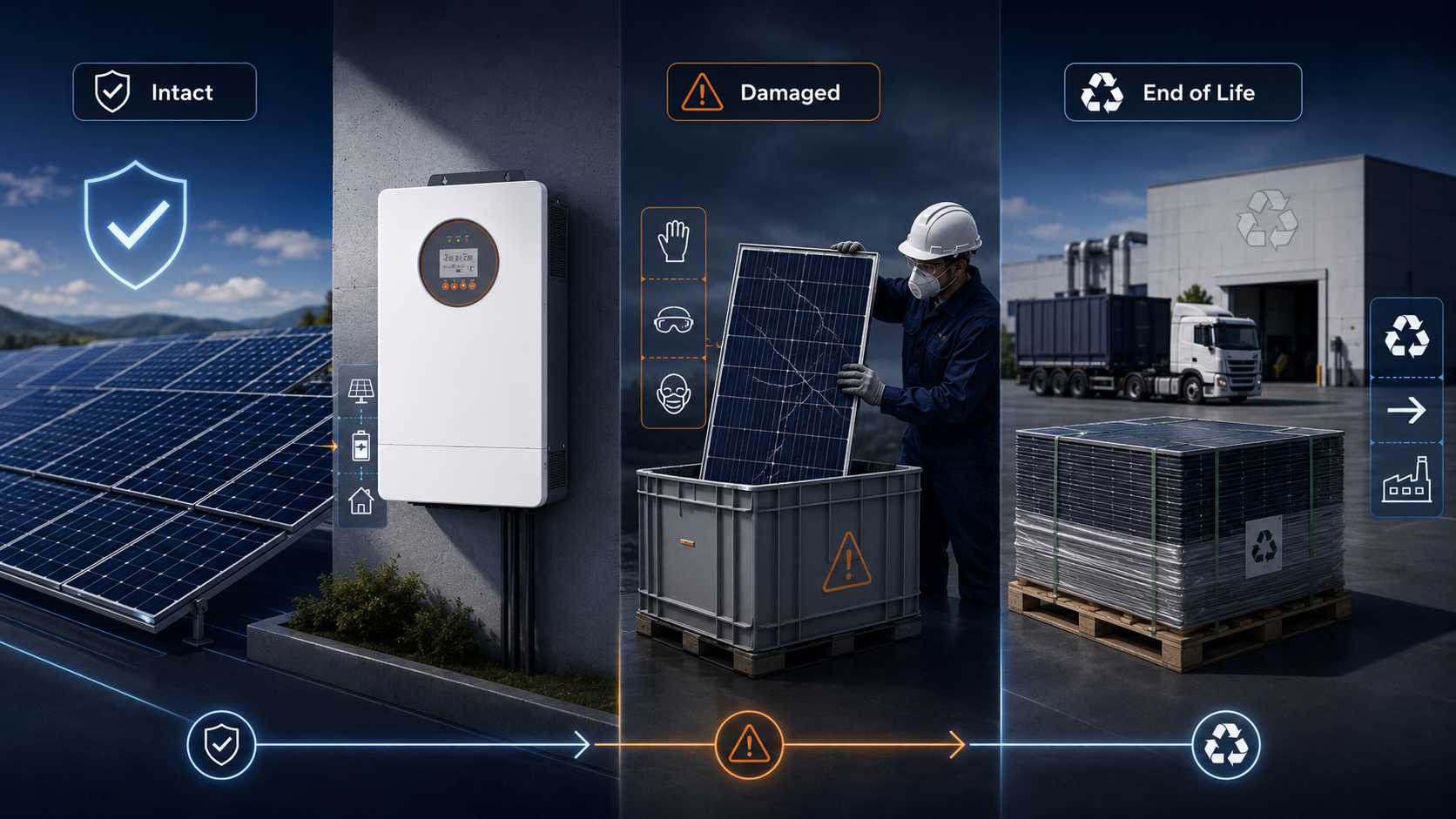
Intact Modules During Normal Operation
For an installed module, begin with the exact model rather than a general article about CdTe. Request the current data sheet, installation manual, safety documentation, applicable certifications, bill of materials declaration where available and warranty terms. Confirm that the supplied revision matches the purchased batch.
IEC 61730 Part 1 and Part 2 cover construction and testing requirements for photovoltaic module safety, including thin film technologies. They also acknowledge that national and regional requirements may add obligations. Certification can support the review of electrical, mechanical and fire related module safety, but it does not determine the waste route for every future location.
Site design still matters. Clamps, edge clearance, cable routing, grounding, wind load, roof access and maintenance practices can affect the likelihood of damage. A certificate does not excuse installation outside the manual.
Broken Modules During Removal and Storage
Broken CdTe solar panel handling should be written before the first module arrives. The site procedure should identify who can stop work, how an affected area is controlled, how the module is moved without further breakage, what protective equipment is required, which container is approved and who receives the incident record.
The response should cover less dramatic damage as well. A failed junction box, cracked edge seal or transport impact may not look like a shattered panel, yet it can change whether the unit is suitable for reuse. A documented inspection threshold prevents a warehouse team from making an improvised decision.
End of Life and Recycling
Cadmium solar panel recycling becomes a project issue long before decommissioning. CdTe recycling must be translated into an accessible route, acceptable module conditions, packaging instructions, shipment responsibility, cost terms and a named receiving facility. The same contract discipline applies when thin film solar panels move across regions.
The question are CdTe panels hazardous waste cannot be answered globally by a blog or supplier brochure. Ask the responsible authority or a qualified waste professional for the rule that applies to the actual site, module condition and intended route.
Module condition | Unsafe assumption | Evidence to request | First owner of the action |
Intact and operating | The material name proves exposure or proves zero risk | Current module documents, certification, installation record and inspection history | Asset operator |
Damaged on site | Visual appearance is enough to approve reuse or ordinary disposal | Incident procedure, qualified inspection, product identification and local handling instruction | Site safety lead |
Removed and stored | A warehouse can hold modules indefinitely without special controls | Storage limit, packaging method, inventory record and approved destination | Asset owner |
End of life | A recovery percentage guarantees collection at this location | Written acceptance, logistics duty, price mechanism and local waste classification | Contract owner |
SNADI/SNAT Solar Engineer tip:
Put the module model, serial range, document revision and disposal contact in the asset register on delivery day. Waiting until a damaged pallet appears turns a document check into an urgent site decision.
Compare CdTe With Silicon Only After the Risk Boundary Is Clear
The search for cadmium telluride vs silicon solar panels often collapses several metrics into one. Cell efficiency, module efficiency, module area, temperature response, annual energy, balance of system cost and end of life obligation are not interchangeable.
The United States Department of Energy reported that CdTe represented about 34 percent of the United States utility scale photovoltaic market in 2022, while its global share was about 3 percent. DOE also notes that current CdTe deployment is concentrated in utility scale applications and that crystalline silicon retains an efficiency advantage at cell and module level. These facts describe market and technical context, not a recommendation for every project.
A project with tight roof area may value higher power density differently from a ground mounted project with ample land. A buyer with a mature take back contract may view lifecycle risk differently from an owner in a region without a practical collection route. The correct comparison uses the same site assumptions, service period, energy model and exit plan for both technologies.
Financial review should include more than module purchase price. Add the effect of area, support structure, cabling, inverter loading, monitoring, spares, inspection, damaged module storage, transport and final treatment. A cheaper module offer can create a higher operating burden if the responsibility map is vague.
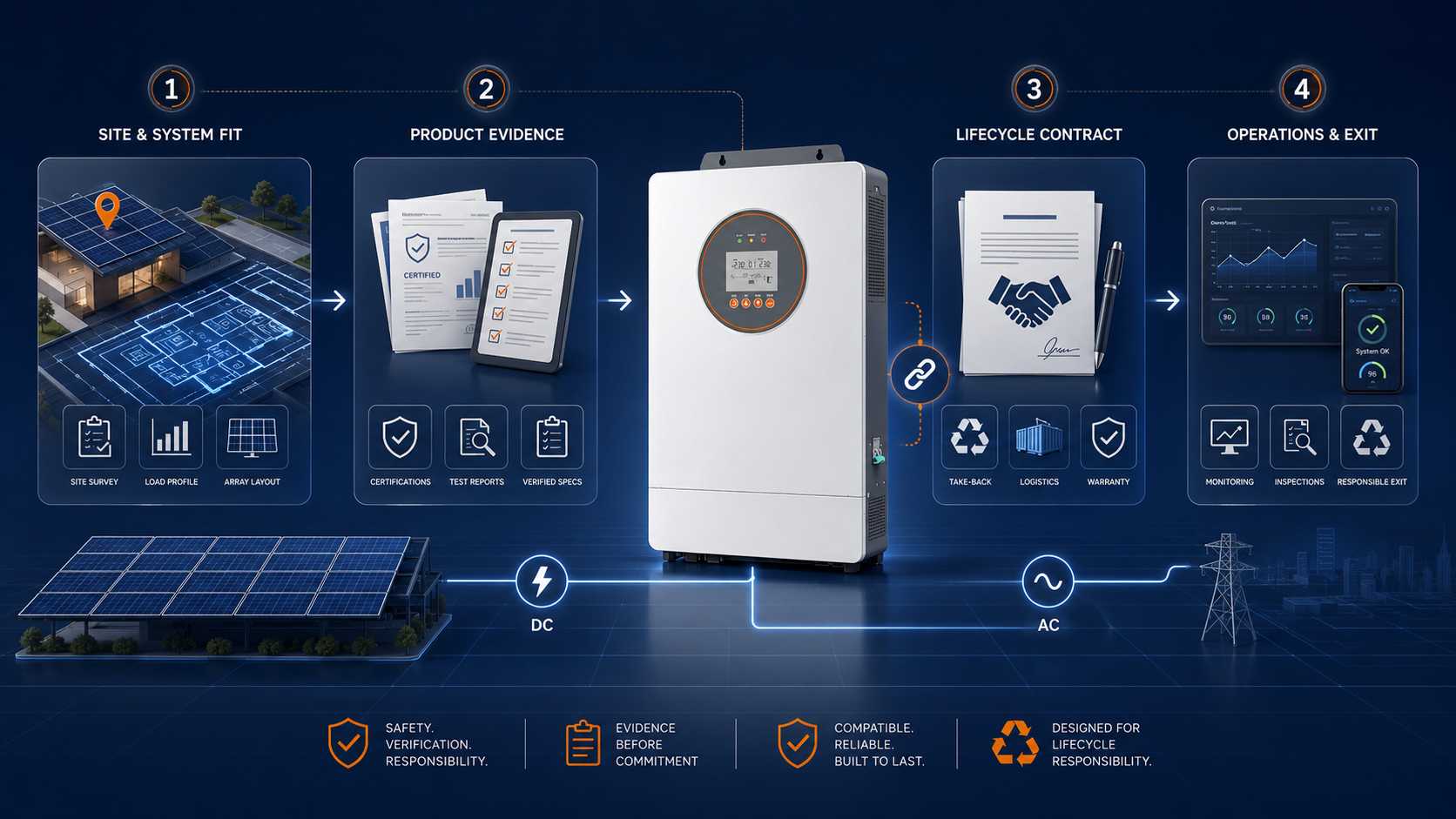
Use Four Gates Before Approving Cadmium Solar Panels
Gate One: Site and System Fit
Define the job before comparing products. Record usable area, structural and mechanical constraints, climate, soiling, access, electrical architecture, expected energy profile and project life. Decide whether the project is constrained by area, capital, annual energy, service access or another factor.
Use the same assumptions when comparing CdTe and silicon. Do not compare a CdTe energy model from one layout with a silicon quotation based on another. Request calculation files and loss assumptions, not only the final annual production number.
Gate Two: Product Evidence
The bid should identify the exact module, data sheet revision, certification scope, warranty version, installation manual and traceability method. Check whether the named manufacturing site and supplied batch are covered by the presented evidence.
Ask what condition voids warranty coverage and how a buyer proves a claim. Mechanical damage, installation outside clamp zones, unsupported cleaning methods and undocumented storage can change the commercial outcome even when the module technology is sound.
Gate Three: Lifecycle and Contract Evidence
A CdTe module end of life plan should name the owner of removal, inspection, packaging, temporary storage, transport, receiving acceptance and payment. It should define what happens if the original service provider changes ownership, closes a facility or stops accepting the model.
The plan also needs an update trigger. Review it when the project changes owner, the waste rule changes, the receiving facility changes or the service agreement is renewed. A promise made at procurement can become unusable if nobody tracks those events.
Gate Four: Operations and Exit Evidence
Build an operations file that joins monitoring, physical inspection and incident management. The operator should know which performance alert requests an electrical investigation and which physical condition requests a module safety review.
At SNADI/SNAT Solar, we treat module chemistry and inverter compatibility as separate evidence questions. For a small commercial system, the ES IP54 On/Off Grid Solar Inverter EURO offers published 6.2 kW and 12 kW options, a 90 V to 450 V MPPT range and a 500 V maximum photovoltaic open circuit voltage. These figures do not establish automatic compatibility with a CdTe array. Designers must verify string voltage across the site temperature range, operating current, array power, grounding, local code and the exact module instructions before selection.
We focus on inverter and energy storage solutions for residential, small commercial and commercial and industrial applications. We do not present a CdTe module supply or disposal service. The project team must obtain module and waste evidence from the responsible parties.
Conclusion
Cadmium solar panels should not be approved or rejected from the word cadmium alone. The defensible decision separates the material from the exposure path, then tests the exact product across intact operation, damage response and end of life management.
For a buyer, the next step is concrete: assemble the current module file, ask for the local handling and disposal route, place recycling duties in the contract and verify the electrical interface with the chosen inverter. When those records agree, cadmium solar panel safety becomes a documented project judgment rather than an unsupported assurance.
SNADI/SNAT Solar can review the inverter and energy storage side of a residential, small commercial or commercial and industrial design once the module electrical data and site conditions are available.
✉️Email: marketing@snadi.com.cn
Website:
☎️WhatsApp / WeChat: +86 1803929353

FAQ
Safety should be assessed from the exact module construction, condition, installation and applicable requirements. Evidence that the CdTe layer is enclosed within the module supports the normal operation review, but it does not replace damaged module or end of life procedures.
Is CdTe the Same as Loose Cadmium Metal?
What Should an Owner Do With a Broken CdTe Module?
Are CdTe Panels Hazardous Waste After Retirement?
Can a Buyer Compare CdTe and Silicon by Efficiency Alone?
What Belongs in a Recycling Agreement?