
A DC to AC inverter for house use converts direct current from a battery or solar power system into alternating current for household appliances. Choosing the right inverter, however, involves more than comparing its rated kilowatts with the wattage printed on appliance labels.
You also need to account for simultaneous loads, motor startup current, battery voltage, PV input limits, waveform, required backup time and the AC standard used in the installation location.
These considerations are especially relevant in markets where homeowners use solar both to reduce grid consumption and to maintain power during outages. The IEA has noted that relatively high retail electricity prices are supporting further growth of distributed solar PV in Latin America.
What Is a DC to AC Inverter for a House?
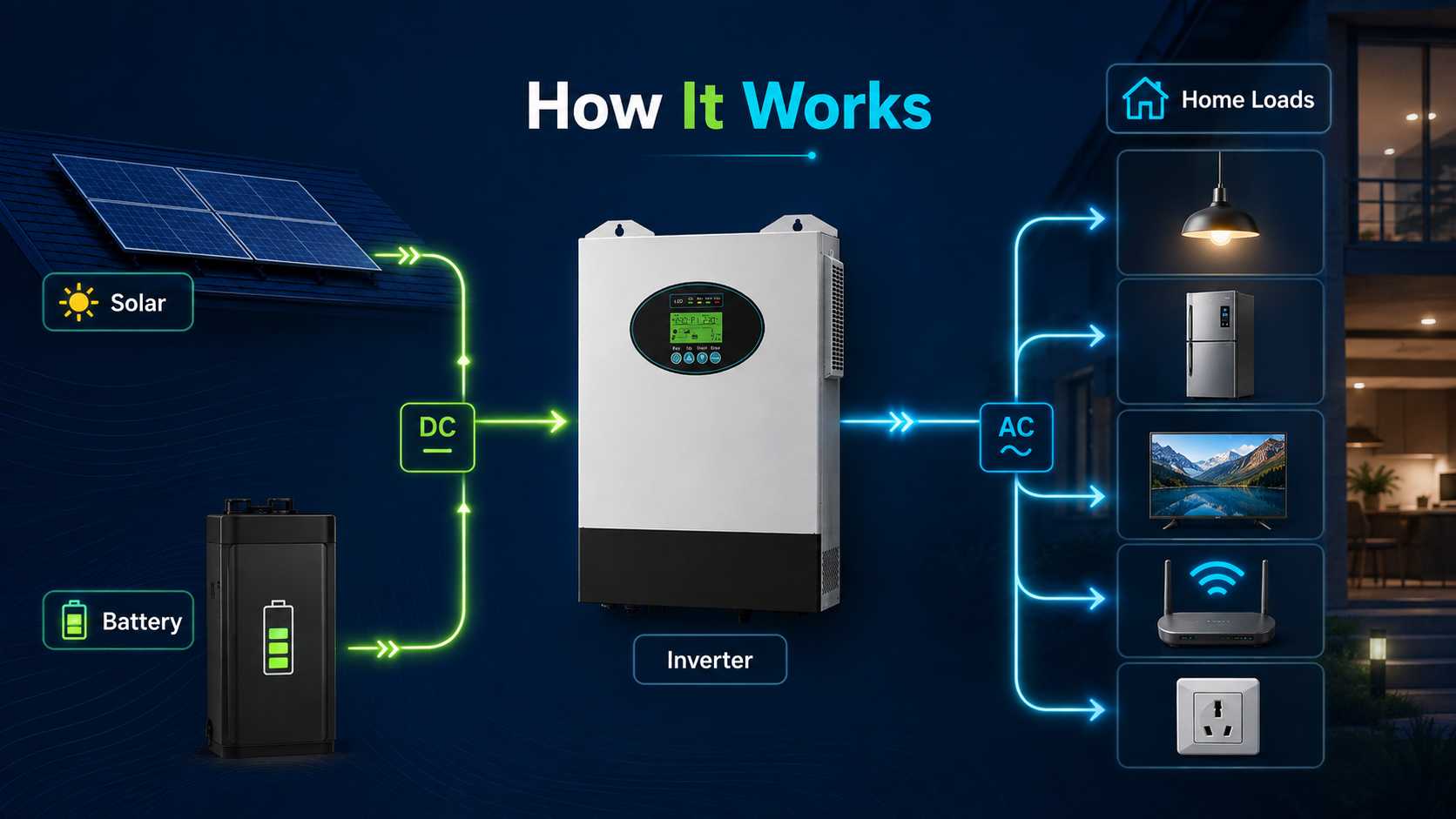
Solar panels generate direct current, or DC, and batteries store energy as DC. Most household electrical systems and appliances operate on alternating current, or AC.
The inverter connects these two sides of the system.
A basic battery backup system may follow this path:
Battery → DC Input → Inverter → AC Distribution → Household Loads
A solar storage system may instead use:
Solar Panels → MPPT / Hybrid Inverter → Battery → Inverter Stage → AC Loads
The actual layout depends on the inverter type, whether the solar charge controller is built in, whether the system is DC-coupled or AC-coupled, and whether utility power is available.
DC vs AC Electricity
DC maintains one polarity. Solar modules naturally produce DC electricity, and batteries charge and discharge on the DC side of the system.
AC changes polarity periodically and is used by most residential electrical networks.
An inverter therefore does more than change one voltage into another. Its power electronics switch, regulate and filter the incoming DC power to produce AC at the voltage and frequency required by the connected loads.
Why Homes Need AC Power
Most refrigerators, televisions, air conditioners, pumps, computers and wall outlets are designed for the local AC supply standard.
A battery cannot normally power these appliances directly. The battery voltage must first be converted into the correct AC output by an inverter.
The required output also depends on the installation market. Residential electrical standards across Latin America are not identical. Before specifying equipment, installers should confirm AC voltage, frequency, phase arrangement, grounding requirements and applicable local electrical rules.
Is a DC to AC Converter the Same as an Inverter?
The terms are often used interchangeably in online searches, but technically they describe different equipment.
An inverter converts DC power into AC power.
A DC-to-DC converter changes one DC voltage into another DC voltage.
When someone searches for a DC to AC converter for solar panel use, they are usually looking for a solar inverter, hybrid inverter or off-grid inverter rather than a conventional DC converter.
How Does a DC to AC Inverter Work?
For residential applications, the conversion process can be broken down into three main stages.
DC Power Comes From Solar Panels or Batteries
A battery supplies DC power at a specified voltage, commonly 12 V, 24 V or 48 V in residential and small backup systems.
Solar panels also produce DC, but their voltage changes with module configuration, temperature, irradiance and operating conditions. PV input therefore has to be checked against the inverter's solar input specifications rather than treated like a fixed battery voltage.
The Inverter Regulates and Switches DC Power
Inside the inverter, semiconductor switching devices control the DC input at high speed.
The conversion stage creates an alternating waveform and regulates it to the required AC voltage and frequency.
If the inverter includes MPPT, it also adjusts the operating point of the PV array so the system can make better use of available solar power as sunlight and module temperature change.
AC Power Is Supplied to Household Loads
After conversion and filtering, the inverter supplies AC power to the house or to selected backup circuits.
For most modern homes, a pure sine wave inverter is the more practical option because it provides wider compatibility with electronics, appliances and motor-driven equipment.
SNADI/SNAT Solar Engineer's Tip:
Do not choose an inverter from its AC power rating alone. Check battery input voltage, MPPT operating range, maximum PV open-circuit voltage, surge capacity, battery communication requirements and the required AC output before finalizing the model.
How Does a Solar Panel DC to AC System Work?
Adding solar panels introduces another design variable because PV voltage is not fixed.
Solar Panels Produce DC Electricity
PV modules are wired in series and parallel to produce the voltage and current required by the inverter.
The complete string must stay within the permitted PV operating range under the expected site conditions.
Cold weather is particularly important when checking maximum voltage because module open-circuit voltage rises as temperature falls. A string that appears acceptable from nominal module values can still exceed the inverter's maximum PV voltage under colder conditions.
What the Solar Inverter Does
A solar panel DC to AC inverter may perform several functions depending on the model:
convert DC electricity into household AC;
track solar generation through MPPT;
charge a battery;
accept utility input;
manage solar, battery and utility priority;
supply backup loads during outages.
A basic power inverter may only convert battery DC into AC.
For this reason, buyers should first determine whether they need simple DC-to-AC conversion or a complete solar energy management platform.
Where the Battery and MPPT Controller Fit
In a conventional off-grid system, PV power must be regulated before it can charge the battery.
This can be handled by a separate MPPT charge controller or by an off-grid or hybrid inverter with an integrated MPPT controller.
A hybrid inverter combines more of these functions in one unit and may coordinate PV generation, battery charging and discharging, grid input and household loads.
Checking this architecture before purchasing equipment can prevent several common problems. For example, buying a basic battery inverter for a solar project may require an additional charge controller later. Mismatched battery or PV voltage ranges can also make otherwise suitable components unusable together.
Can Solar Panels Connect Directly to a DC to AC Inverter?
Only if the inverter has a dedicated PV input and the solar array stays within its specified voltage, current and power limits.
A standard battery inverter should not be connected directly to a solar string unless the manufacturer specifically supports that configuration.
For example, SNADI's NKH off-grid hybrid inverter range includes integrated MPPT functionality. It is designed to work as part of a solar and battery system rather than only converting battery DC into AC.
What Size DC to AC Inverter Do I Need for My House?
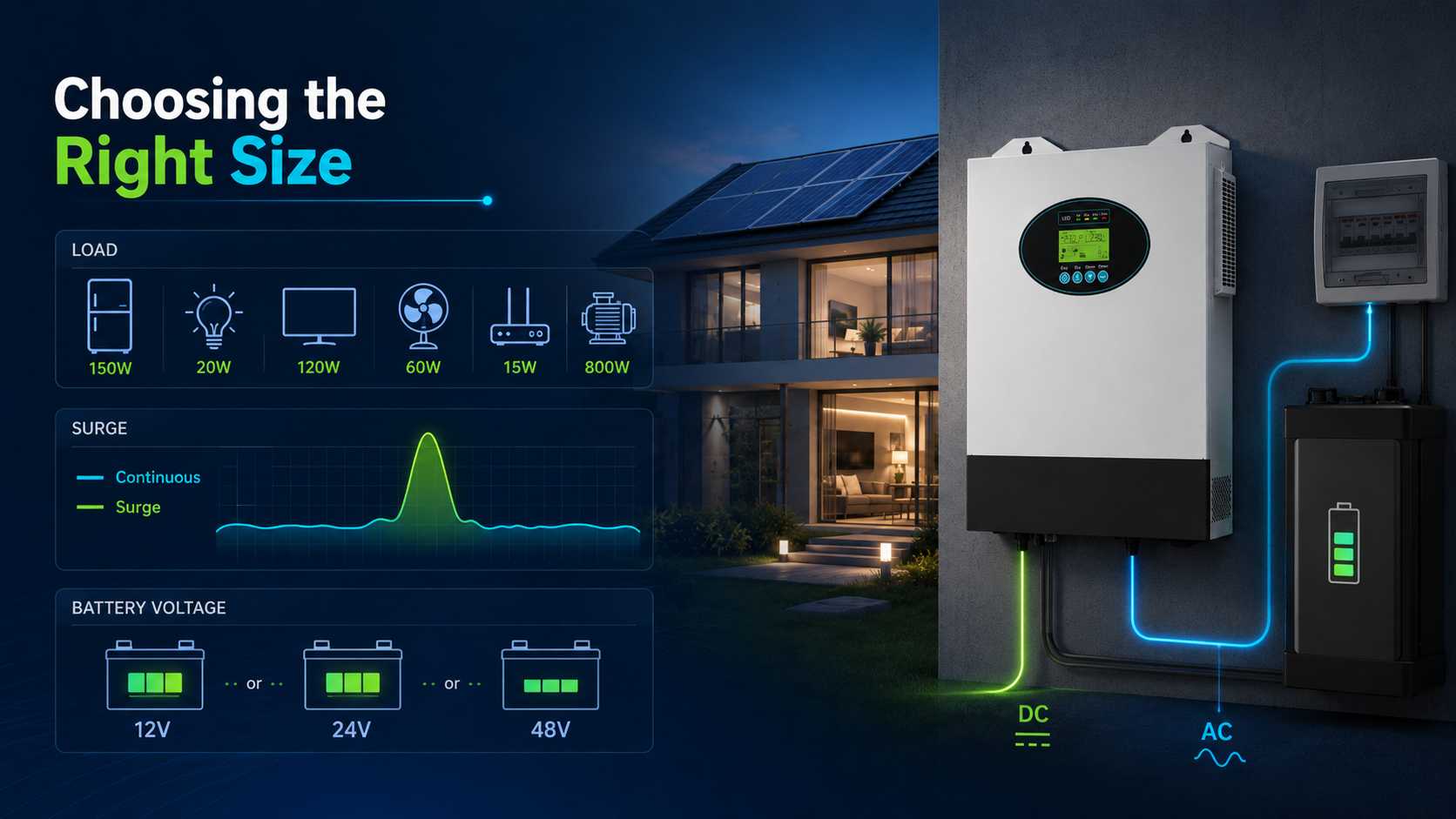
Residential inverter sizing starts with the loads the customer actually expects to run.
Three figures are especially important:
the appliances likely to operate at the same time;
the highest startup demand from motors or compressors;
the additional capacity required for normal load variation and future use.
Calculate Continuous Load
List the appliances that may realistically run together.
Use:
Continuous Load = Sum of Simultaneous Running Watts
There is usually no need to add every appliance in the house if many of them will never operate at the same time.
The opposite mistake is also common. Sizing an inverter around an unrealistically low average load can leave too little capacity when several normal household loads operate together.
Check Startup and Surge Loads
Refrigerators, pumps, compressors and other motor-driven appliances can draw considerably more power during startup than during normal operation.
That startup requirement can determine whether an inverter that looks large enough on paper actually works in the installation.
Appliance | Typical Load Character | Main Inverter Concern |
LED lighting | Low, steady | Continuous output |
TV | Low, steady | Power quality |
Router | Very low, steady | Backup continuity |
Refrigerator | Motor/compressor load | Startup surge |
Freezer | Compressor load | Startup surge |
Water pump | Motor load | Startup current |
Air conditioner | High compressor load | Surge and battery discharge |
Power tools | Intermittent motor load | Short-duration surge |
Computer | Electronic load | Pure sine wave output |
Where possible, use startup data from the appliance manufacturer or measured values rather than applying the same surge multiplier to every motor.
Leave a Practical Capacity Margin
An inverter should not be operating at its maximum continuous rating during normal household use.
Some spare capacity helps accommodate temporary load changes, operating temperature and reasonable future additions.
Too much spare capacity is not necessarily useful either.
A much larger inverter can increase equipment cost and may require heavier DC cables, larger protection devices and a battery capable of supplying higher current. Standby consumption may also be higher depending on the inverter design.
Sizing should therefore follow the expected load profile rather than simply choosing the largest available model.
House Inverter Sizing Example
Consider a backup circuit with the following appliances:
refrigerator: 180 W running;
lighting: 120 W;
television: 120 W;
router: 20 W;
fans: 160 W;
water pump: 750 W.
The total running load is:
180 + 120 + 120 + 20 + 160 + 750 = 1,350 W
Selecting a 1.5 kW inverter solely from this calculation would leave very little room for startup demand.
Both the refrigerator and water pump contain motors. If either requires a much higher current during startup, the inverter may overload even though the normal running load is only 1.35 kW.
A more useful sizing approach is:
Required Inverter Capacity = Simultaneous Running Load + Relevant Startup Requirement + Design Margin
12V vs 24V vs 48V DC to AC Inverter for Home
Battery voltage directly affects the current flowing on the DC side of the inverter.
For a simplified comparison that ignores conversion losses:
Current = Power ÷ Voltage
At a 3,000 W load:
12 V requires about 250 A;
24 V requires about 125 A;
48 V requires about 62.5 A.
Actual battery current will be somewhat higher because an inverter is not 100% efficient.
This is one reason higher power residential systems commonly use higher DC voltages. Raising the battery voltage reduces the current required to deliver the same amount of power.
When a 12V Inverter Makes Sense
A 12 V system can work well for smaller loads, compact backup systems and installations where 12 V batteries or other DC equipment are already in use.
As inverter power increases, however, DC current rises quickly.
High current systems require appropriate cable cross-section, short cable runs, low-resistance connections and correctly rated protection devices.
When to Choose 24V
A 24 V battery system halves the theoretical current of a comparable 12 V system at the same power level.
It can be a practical option for medium size backup installations where 12 V would result in unnecessarily high current but the project does not require a 48 V architecture.
Why Larger Home Systems Often Use 48V
At several kilowatts of inverter output, a 48 V battery system can make the DC side easier to manage because current is significantly lower than in a 12 V or 24 V configuration.
But battery voltage still has to match the inverter input range, battery or BMS design, required output power and overall system architecture.
Never connect a battery bank whose voltage falls outside the inverter manufacturer's specified range.
Pure Sine Wave vs Modified Sine Wave for Household Appliances
Pure sine wave output is generally the better choice for a residential inverter.
Modified sine wave models can cost less, but appliance compatibility is less predictable in a modern home containing refrigerators, computers, variable-speed equipment, electronically controlled appliances, audio equipment and sensitive power supplies.
The lower purchase price can quickly lose its advantage if appliances operate noisily, motors run hotter than expected or the inverter has to be replaced because of compatibility problems.
For mixed household loads, choosing a pure sine wave inverter usually gives the installer fewer compatibility issues to manage.
SNADI's pure sine wave inverter guide provides more detail on appliance behavior and motor startup requirements, including why running wattage alone is not enough for sizing compressor and motor loads.
Off-Grid vs Hybrid DC to AC Inverters for a House
Once the load and battery requirements are clear, the next step is deciding how the house will use solar, storage and utility power.
Design | CAPEX Tendency | Grid Dependence | Backup Capability | Main Trade-Off |
Grid-tied solar | Lower | High | Usually limited without storage | Lower storage cost but limited outage protection |
Off-grid inverter + battery | Higher | None | Strong | Requires sufficient PV and battery capacity |
Hybrid inverter + battery | Medium to high | Flexible | Strong when configured for backup | More control functions but greater system complexity |
Basic battery inverter | Lower | Application-dependent | Basic | Separate solar charging equipment may be required |
Off-Grid Inverter
An off-grid inverter is designed for a system that does not depend on the utility network as its main power source.
Battery storage normally plays a central role because household loads still need power at night, during poor weather or whenever PV generation is below demand.
For remote installations, system cost should also be compared with alternatives such as utility-grid extension or generator operation rather than looking at inverter CAPEX in isolation.
Hybrid Solar Inverter
A hybrid solar inverter can manage several energy sources in one system.
Depending on the model and installation, it may control PV generation, battery charging and discharging, utility input and household loads.
This type of architecture is particularly useful when the grid is available but the customer also wants solar self-consumption, battery storage or backup during outages.
The IEA has noted that distributed PV can reduce reliance on grid electricity and that pairing solar with energy storage can improve resilience during power interruptions.
Grid-Tied Solar Inverter
A conventional grid-tied inverter operates together with the utility network.
Solar generation can reduce the amount of electricity imported from the grid, but a standard grid-connected PV system does not necessarily continue supplying the house during a blackout.
If backup is required, buyers should confirm that the selected inverter and system architecture specifically support backup operation or battery storage.
How to Choose the Right DC to AC Inverter for Your House
Before comparing inverter brands or prices, confirm these eight parameters:
Continuous AC power: Calculate the loads that are realistically expected to operate at the same time.
Surge capability: Check startup requirements for refrigerators, pumps, air conditioners and other motor loads.
Battery voltage: Confirm whether the system operates at 12 V, 24 V, 48 V or another supported voltage.
AC output: Match voltage, frequency and phase configuration to the installation.
Waveform: Choose pure sine wave output when the system needs to support a wide range of household appliances.
PV input: For solar inverters, verify the MPPT voltage range, maximum PV open-circuit voltage, input current and supported PV power.
Battery compatibility: Check battery chemistry, charging and discharging limits and BMS communication where required.
Protection and monitoring: Review overload, short-circuit, over-temperature and DC protection requirements together with available monitoring functions.
Once these specifications are clear, product comparison becomes much easier and less dependent on headline power ratings.
Which SNADI DC to AC Inverter Fits Different Home Applications?
The inverter should be selected after the load and system architecture are defined, not before.
Small and Medium Off-Grid Home Systems
For residential off-grid projects, SNADI's NKH series combines pure sine wave AC output with integrated MPPT functionality for solar-and-battery applications.
An integrated design like this can reduce the number of separate components required compared with a battery inverter and standalone solar charge controller.
Homes Requiring Grid + Solar + Battery Management
When utility power is available but the homeowner also wants solar self-consumption and battery backup, a hybrid inverter is generally the more relevant architecture.
SNADI's hybrid inverter range includes single-phase, three-phase and region-specific options for residential and small commercial energy-storage applications.
The correct model still depends on the required AC standard, load power, PV configuration and battery system.
Complete Home Solar and Battery Storage
Some projects require a complete system rather than a standalone inverter.
In these cases, sizing should start with household loads, required backup duration, usable battery capacity, available PV area and installation conditions.
SNADI's residential ESS range combines solar, hybrid inverter and LiFePO4 battery options for backup, self-consumption and off-grid applications.
For projects that need an inverter, battery and solar configuration together, the company's off-grid solar solution range provides another starting point for system selection.
Why Inverter Selection Is Also a Financial Decision
Inverter cost is only one part of the total system budget.
A cheaper inverter can increase overall project cost if it requires a separate MPPT controller, cannot handle the required startup loads, restricts battery options or needs to be replaced when household demand increases.
Oversizing also adds cost.
Paying for inverter capacity that is unlikely to be used can raise initial CAPEX and may lead to larger cables, protection devices or battery requirements without improving the amount of solar energy available to the house.
For most residential projects, the practical target is enough continuous and surge capacity for the expected load profile, with reasonable room for operating variation and planned future loads.
The economics of solar generation provide useful background for that decision. IRENA reported a global weighted-average utility-scale solar PV LCOE of about USD 44/MWh in 2025.
That figure is a global utility-scale benchmark rather than a residential electricity tariff, so it should not be used to estimate household payback directly.
In Latin America, the IEA reported clean energy investment of around USD 70 billion in 2025 and has also identified high retail electricity prices as one factor supporting distributed solar PV deployment.
Actual residential returns still need to be calculated project by project.
Local electricity tariffs, solar irradiation, system cost, financing, export compensation, usable battery capacity, battery replacement assumptions and the value placed on backup power can all change the final economics.
Conclusion
Choosing a DC to AC inverter for house use should begin with a realistic load calculation.
List the appliances that may run together and identify pumps, refrigerators, air conditioners and other equipment with significant startup demand. From there, match the battery voltage, PV operating range, AC output standard and inverter architecture to the installation.
Smaller systems may work well with 12 V or 24 V batteries. As inverter power increases, a 48 V architecture can reduce DC current and make the high power battery connection easier to manage.
For homes with a mix of electronics and motor-driven appliances, pure sine wave output is generally the more practical option.
The final choice should also account for how the homeowner plans to use the system. A simple backup inverter, an off-grid solar system and a hybrid solar plus storage system solve different problems.
A properly selected inverter will not increase the amount of sunlight available to the solar array. What it does determine is whether the available energy can be converted and delivered reliably to the household loads the system was designed to support.
✉️Email: marketing@snadi.com.cn
Website:
☎️WhatsApp / WeChat: +86 1803929353

FAQ
It converts DC electricity from a battery or compatible solar system into AC electricity that household appliances can use. Solar and hybrid models may also manage MPPT charging, batteries, grid input and backup loads.
What size DC to AC inverter do I need for my house?
Can I connect a solar panel directly to a DC to AC inverter?
Is a 12V, 24V or 48V inverter better for a home?
Do I need a pure sine wave inverter for household appliances?
Can a DC to AC inverter run a refrigerator or air conditioner?
What is the difference between a solar inverter and a power inverter?
Does a home solar inverter need a battery?