

A supermarket loses refrigeration during a long outage. A small factory stops a production line because the grid voltage disappears. A house with rooftop solar still goes dark at night when the utility fails. Another business keeps a diesel generator running for hours even though solar panels are producing power during the day.
These are not simply solar generation problems. They are power management problems.
That is why buyers increasingly ask what is hybrid inverter, and whether paying more for one makes financial sense.
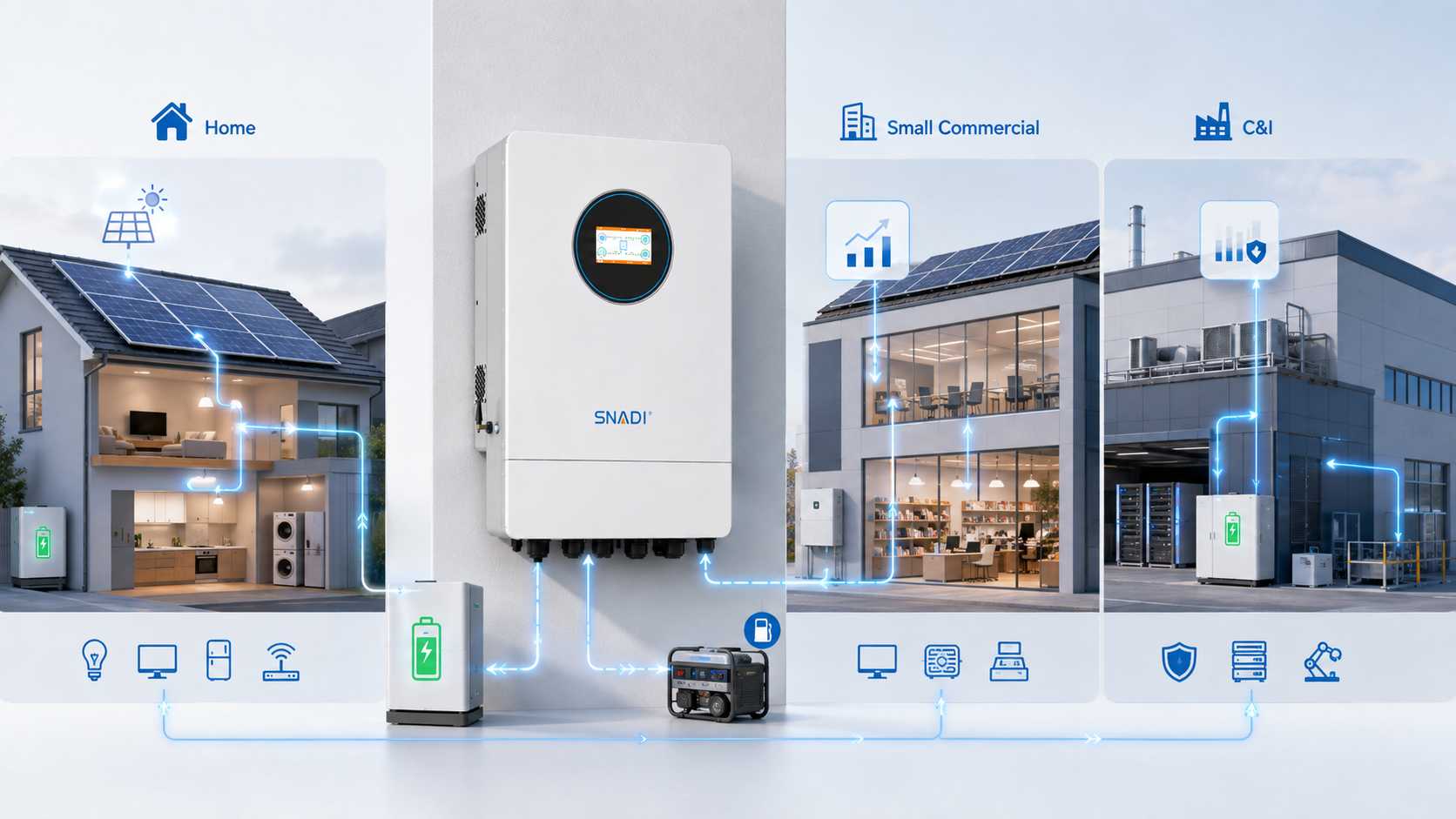
A hybrid inverter sits between solar panels, batteries, electrical loads and, depending on the system, the utility grid or generator. Instead of only converting solar DC power into AC electricity, it can coordinate where electricity comes from, where excess energy goes and which source should supply the load at a given time.
For a homeowner, that may mean keeping refrigeration, lighting and communications running during an outage. For a commercial site, it may mean using stored solar energy during expensive tariff periods, limiting demand from the grid or reducing generator operating hours.
What Is a Hybrid Inverter?
A hybrid inverter is a power conversion and energy management device designed to work with more than one energy source.
In a typical solar plus storage system, the inverter may manage:
PV modules
battery storage
utility grid supply
electrical loads
a standby generator
A conventional grid-tied solar inverter mainly converts DC power from solar panels into AC electricity for on site consumption or grid export. A hybrid solar inverter adds battery charging and discharging functions and usually includes operating modes that decide whether solar, battery or grid power should be used first.
This is the practical answer to what is a hybrid solar inverter: it is not simply a solar inverter with a battery terminal. Its value comes from controlling energy flow between multiple sources.
How Does a Hybrid Inverter Work?
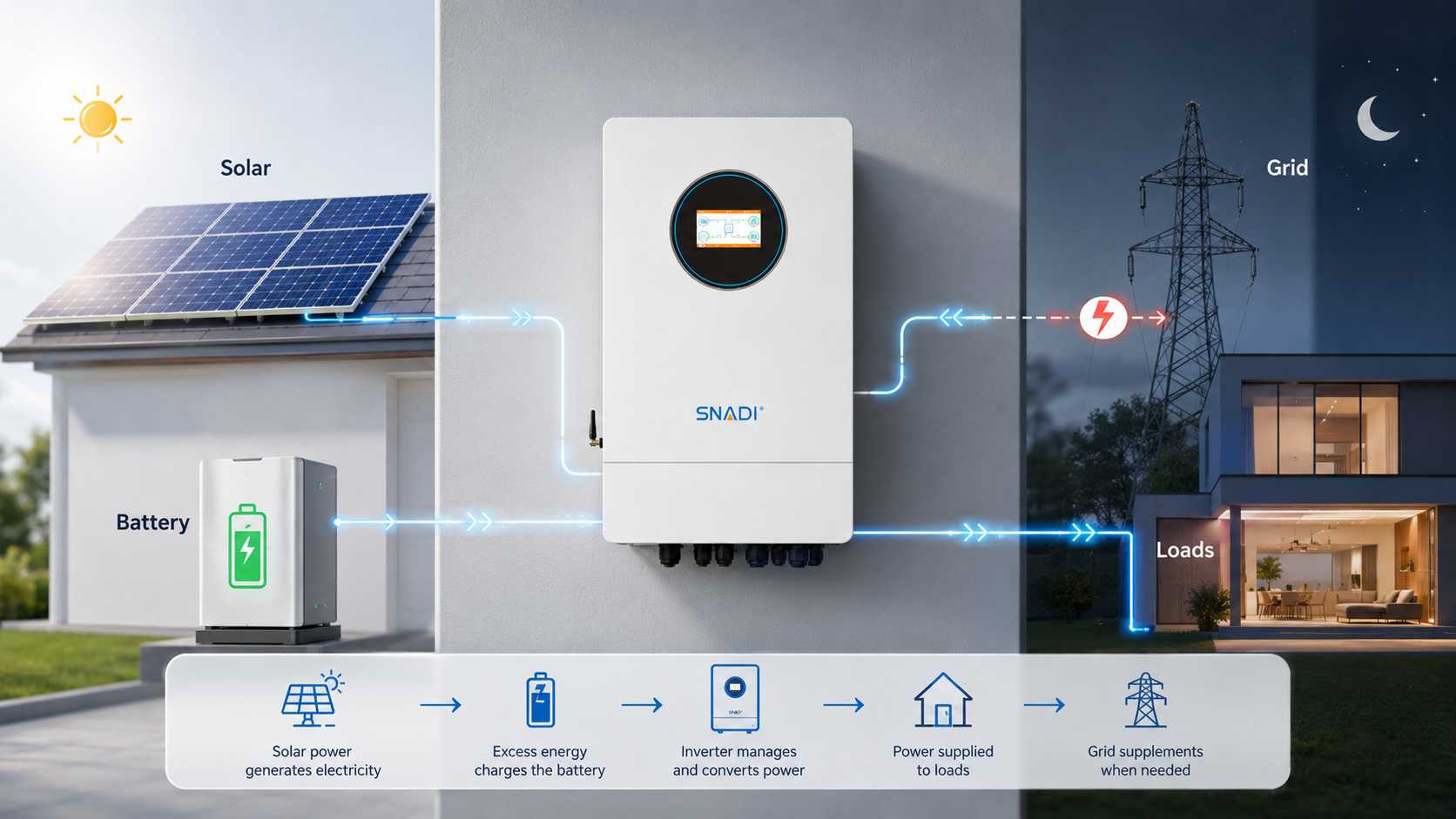
The hybrid inverter working principle is easier to understand by following power through a normal day.
Solar Power During the Day
When PV production is available, solar power can first supply the building's active loads.
If a site is consuming 3 kW while the array is producing 5 kW, the remaining 2 kW may be available for battery charging or grid export, depending on the operating mode and local interconnection rules.
Charging the Battery
When excess PV power is available, the inverter can route energy into the battery.
Battery charging is controlled according to parameters such as battery voltage, state of charge, charging current and communication with the battery management system.
Supplying Loads at Night
After solar production falls, stored energy can be converted back into AC power.
The operating strategy may be configured to preserve a minimum battery state of charge for backup, discharge during expensive tariff periods, or use the battery before taking additional energy from the grid.
What Happens During a Grid Outage?
This depends on the inverter.
A normal grid-tied PV inverter usually shuts down when utility power disappears because of anti-islanding requirements. A hybrid inverter with a suitable backup or off-grid output can isolate designated loads and continue supplying them from the battery, solar array or another permitted source.
Why Hybrid Inverters Matter Financially
The technical diagram only explains half of the buying decision. The other half is the cost of electricity that is purchased, wasted or unavailable.
Battery storage deployment reached 108 GW of new capacity worldwide in 2025, up 40% from 2024, according to the IEA. At the same time, Brazil's distributed micro and mini generation fleet reached 45.0 GW in 2025.
For a buyer, the question is not whether batteries are growing. It is whether a battery and hybrid inverter solve a cost that exists at the site.
Solar Self-Consumption
A grid-tied PV system may produce excess electricity around midday while the customer buys electricity later in the evening.
A battery can move part of that energy from one period to another.
Whether this produces an attractive return depends on the tariff, export compensation, battery cycling pattern and system cost.
Backup Versus Production Loss
For a house, an outage may be inconvenient.
For a bakery, cold room, workshop, hotel, clinic, retail store or production site, downtime can have a direct cost.
In that case, hybrid system economics should include more than monthly electricity savings. Buyers should estimate the value of lost production, spoiled goods, interrupted transactions and restart time.
Peak Shaving and Electricity Cost Control
Where a commercial tariff includes demand charges or higher rates during certain periods, a battery can discharge when grid demand rises.
The value depends heavily on the local tariff structure.
Reducing Generator Dependence
Diesel generators remain useful where long outages occur.
A hybrid system can change how frequently that generator needs to run. Solar may supply daytime loads, batteries may cover shorter interruptions, and the generator may be reserved for longer events or battery recharge when solar production is insufficient.
This can reduce fuel consumption, generator runtime and maintenance exposure, but the control strategy must be designed correctly.
System Design | Initial CAPEX | Ongoing OPEX | Backup Capability | Operating Risk | ROI Logic |
Grid-tied PV only | Lower | Low | Normally none | High exposure to outages | Driven mainly by solar bill savings |
PV + hybrid inverter + battery | Higher | Battery replacement must be considered | Yes, when correctly designed | Lower outage exposure | Stronger where backup, self-consumption or tariff shifting has value |
Hybrid + battery + generator | Highest | Fuel and generator servicing remain | High for longer outages | Lower if controls and fuel supply are reliable | Best judged against downtime and generator cost |
Off-grid solar + battery | High | Battery lifecycle is a major cost | Independent of utility grid | Sensitive to undersizing and low-solar periods | Based on avoided grid extension or generator dependence |
Hybrid Inverter vs Solar Inverter, Off-Grid Inverter and Battery Inverter
A hybrid inverter vs solar inverter comparison starts with battery integration. A standard grid-tied solar inverter is primarily designed around PV-to-grid and PV-to-load power conversion. A hybrid inverter adds storage management.
A hybrid inverter vs grid tied inverter decision therefore depends heavily on whether backup or batteries are part of the present or future project.
A hybrid inverter vs off grid inverter comparison is more subtle. Off-grid inverters are designed to operate without a utility grid. Some hybrid models can also operate off-grid, but others are mainly grid-interactive products with limited backup functions.
A hybrid inverter vs battery inverter comparison concerns system architecture. A dedicated battery inverter commonly converts battery DC power to and from an AC bus, while a hybrid inverter may integrate PV MPPT and battery functions in one device.
Types of Hybrid Inverters
There is no single classification covering every product, but buyers will commonly encounter several design groups.
Grid-Interactive Hybrid Inverters
These operate with the utility grid and battery storage, often supporting solar self-consumption, battery scheduling and export control.
Off-Grid-Capable Hybrid Inverters
These can create an AC supply without the utility grid and may accept generator input.
They are useful where outages are frequent or grid access is weak, provided the model is designed for that operating mode.
Single-Phase and Three-Phase Systems
Homes and smaller businesses may use single-phase equipment, while larger commercial sites may require three-phase supply.
The inverter configuration must match the actual distribution system at the site.
Low-Voltage and High-Voltage Battery Systems
Hybrid systems also differ in battery architecture.
Low-voltage systems often use nominal battery voltages around 48 V. Higher-voltage battery systems can reduce current for the same power level, but require compatible batteries, protection devices and control communications.
Neither approach is automatically better for every project.
Can a Hybrid Inverter Work Without a Battery?
Sometimes.
The answer to can hybrid inverter work without battery depends on the specific model, firmware and operating mode.
Some hybrid inverters can operate from PV and grid without a connected battery. Others require a battery for stable operation or for certain functions.
A buyer planning to install batteries later should confirm battery-free operation in writing before ordering equipment.
Do not assume the word “hybrid” guarantees it.
Can a Hybrid Inverter Work Without the Grid?
Again, this is model dependent.
Some products can create an off-grid AC supply using solar and batteries. Others require the grid except when serving a limited backup output.
If can hybrid inverter work without grid is a project requirement, check:
off-grid output rating
transfer behavior
battery requirement
generator input
maximum surge power
black-start behavior
neutral and grounding arrangement
permitted load types
A pump, compressor or airconditioning unit can demand much more power during starting than its normal running wattage.
Does a Hybrid Inverter Charge a Battery From the Grid?
Many models can, but the function may be configurable.
Grid charging can be useful before a forecast outage, during prolonged low-solar periods or when the generator is unavailable.
It can also increase the electricity bill if charging occurs during expensive tariff periods.
For commercial systems, charging logic should be part of the operating plan rather than left at factory defaults.
Hybrid Inverter Advantages and Disadvantages
The main hybrid inverter advantages and disadvantages are easier to judge in commercial terms.
Advantages include:
battery storage in the same power-management architecture
backup capability on suitable models
higher use of on-site solar production
programmable solar, battery and grid priorities
reduced generator runtime in some applications
easier preparation for future storage expansion
Trade-offs include:
higher CAPEX than a basic grid-tied inverter
more commissioning parameters
battery compatibility requirements
greater dependence on correct system design
battery replacement cost over the project life
possible overspending if the site has little economic reason for storage
A hybrid inverter is not automatically the lower-cost choice. It becomes financially interesting when its extra functions address a real cost or operating risk.
What Size Hybrid Inverter Do I Need?
The answer to what size hybrid inverter do I need starts with power, not monthly energy consumption.
List the loads that may operate simultaneously.
Suppose a small shop has:
refrigeration: 1.2 kW
lighting and electronics: 0.6 kW
communications and POS: 0.2 kW
small air conditioner: 2.0 kW
The operating load is about 4 kW, but starting current may be higher because of compressors.
A 4 kW inverter therefore leaves little margin.
Battery capacity is a separate calculation.
For illustration, a 20 kWh battery with an assumed 80% usable energy allowance provides 16 kWh of usable DC energy. If we use the GS inverter's published 93% maximum battery-inverter efficiency only as a simplified calculation, that represents roughly 14.9 kWh of AC energy. At a constant 4 kW load, theoretical backup time is about 3.7 hours. Actual runtime will normally be lower or different because load level, temperature, battery limits, conversion losses and battery condition vary.
SNADI/SNAT Solar Engineer's Tip:
Size the inverter from the worst realistic simultaneous load and motor-starting requirement. Size the battery from required backup energy. Treat these as two separate calculations. A large battery cannot compensate for an inverter that cannot start the load.
How to Choose a Hybrid Inverter for Latin American Projects
Check the Actual Load Profile
Ask for hourly or interval data when available.
A monthly electricity bill shows energy use but may hide short peaks, motors and daytime-versus-nighttime consumption.
Check PV Input and MPPT Range
The array voltage must remain inside the inverter's permitted range under expected hot and cold module temperatures.
Maximum PV wattage alone is not enough.
Check Battery Compatibility
Confirm:
nominal battery voltage
charge and discharge current
usable capacity
BMS communication
battery protocol
maximum number of parallel battery modules
Check Backup Power Requirements
Separate critical loads from non-critical loads when possible.
Backing up an entire building often requires much more inverter power and battery capacity than keeping refrigeration, controls, communications and lighting online.
Check Generator Integration
For sites already using diesel backup, confirm whether the inverter has a dedicated generator input and how charging and load transfer are controlled.
Check Installation Environment
Latin American projects can range from dry inland sites to humid coastal areas.
Check enclosure protection, allowable temperature, ventilation, mounting position and protection against direct sun and weather exposure.
An IP rating does not remove the need for correct installation.
Check Monitoring and Service Requirements
Remote monitoring matters more when a distributor or installer has dozens of systems in the field.
Fault history, battery data and operating state information can reduce unnecessary service visits.
Where the SNADI GS Hybrid Solar Inverter Fits
The SNADI/SNAT Solar GS Hybrid Solar Inverter (IP65) is a 6.5 kW model designed around a 48 V battery system. This inverter lists up to 9,000 W allowable PV string power, a 500 V maximum DC voltage, an 80–450 V MPPT range, up to 6,000 W battery charging power, and 6,500 W off-grid output.
The enclosure is rated IP65, and Wi-Fi, RS485, dry-contact communication, generator input and support for up to six parallel units.
These specifications make the GS worth evaluating for residential, small commercial and expandable power applications where battery storage, backup operation or generator coordination is required.
Is a Hybrid Inverter Worth It?
For a stable grid building with strong solar export compensation and no need for backup, a simple grid-tied inverter may have the cleaner financial case.
For a home facing repeated outages, a shop protecting refrigeration, or a commercial site where demand charges, generator use or production interruption have measurable costs, a hybrid inverter can provide value that a standard PV inverter cannot.
The best system is not the one with the most operating modes. It is the one sized around the real load, matched to the correct battery and PV voltage, installed for the local environment and configured for the cost the customer actually wants to control.
✉️Email: marketing@snadi.com.cn
Website:
☎️WhatsApp / WeChat: +86 1803929353

FAQ
Some hybrid inverters can operate with solar and grid power before a battery is installed, while others require a battery for certain operating modes. Buyers planning a phased solar and storage project should confirm battery-free operation in the product datasheet before ordering.
2. Can a hybrid inverter provide power during a grid outage?
3. How do I choose the right size hybrid inverter?
4. What is the difference between a hybrid inverter and an off-grid inverter?
5. When does a hybrid inverter make financial sense?