

For a remote house, farm, workshop, telecom site, or business with unreliable utility power, producing solar electricity is only part of the job. The system also has to keep equipment running after sunset, deal with cloudy periods, handle the startup current of pumps or compressors, and protect the battery when its state of charge gets too low.
That is where an off-grid solar system differs from a basic grid-connected installation.
In a typical off-grid setup, solar panels generate DC electricity. An MPPT charge controller or an inverter with built-in MPPT manages the PV input, while a battery bank stores energy that is not needed immediately. The inverter then converts DC power into AC electricity for household or commercial equipment.
When PV generation is lower than the load, the battery makes up the difference. If the project needs longer backup than the battery can reasonably provide, a generator can be integrated as another power source.
For buyers in Latin America and the Caribbean, system design may also have a direct cost impact. World Bank data puts average Caribbean electricity prices at about USD 0.25/kWh, with prices above USD 0.40/kWh in some markets. In areas where power interruptions affect production, refrigeration, sales, or other business operations, reliability can matter just as much as the electricity price itself.
How Does an Off-Grid Solar System Work?
The basic power path is:
Sunlight → Solar Panels → MPPT Control → DC Bus/Battery → Off-Grid Inverter → AC Loads
If generator backup is included, there is another possible path:
Generator → Inverter/Charger → Loads + Battery
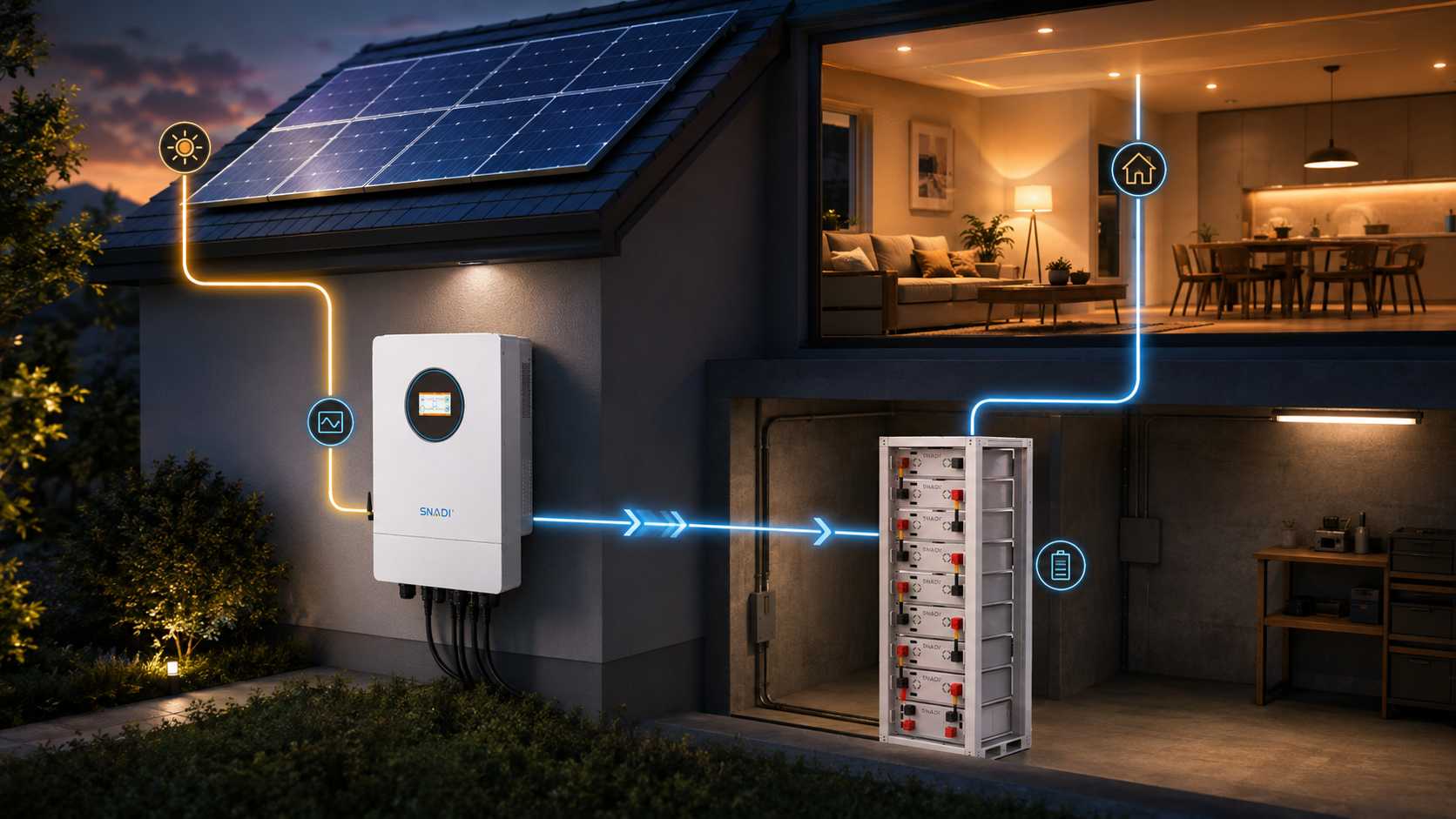
During the day, solar power can serve the loads that are running at that moment. Any available surplus can then be used to charge the battery.
After sunset, the PV array no longer provides useful production, so stored battery energy becomes the main source. Cloudy weather creates a middle condition: the PV array may still be producing power, but not enough to cover the load, so the battery supplies the balance.
Once the battery reaches its programmed lower limit, the response depends on how the system has been configured. It may shed nonpriority loads, shut down its AC output, use another available input, or start a compatible generator.
In practical terms, that continuous balancing of PV generation, battery energy, and load demand is the working principle of an off grid solar system.
What Is an Off-Grid Solar System?
An off-grid solar system operates without relying on the utility grid as its normal source of backup power.
Because there is no grid available to cover a sudden energy shortage, the system has to manage generation, battery charging, storage, AC conversion, protection, load supply, and backup strategy within the installation itself.
This makes off-grid design more sensitive to the actual load profile than many grid-connected systems. Daily electricity consumption matters, but so do weather conditions, seasonal solar availability, battery autonomy, and the starting current of motors and compressors.
A common mistake is to choose an inverter because its kW rating looks large enough and then build the rest of the system around it. In reality, inverter power is only one part of the design. Battery capacity, PV input limits, surge requirements, charging current, and expected operating conditions all have to work together.
How an Off-Grid Solar System Works Step by Step
Step 1 – Solar Panels Produce DC Electricity
Array output is not constant throughout the day. Irradiance, module temperature, orientation, shading, dirt, weather, and system losses all affect how much power reaches the rest of the system.
That is why a 5 kW solar array should not be interpreted as a source that continuously delivers 5 kW whenever the sun is up. Its rated capacity describes the array under specified conditions, not its output every minute of the day.
Step 2 – MPPT Controls the Solar Input
PV voltage and available power change as sunlight and module temperature change. The battery and DC bus, however, operate within their own voltage and current limits.
MPPT, or Maximum Power Point Tracking, manages the PV side of this relationship. It continually adjusts the operating point of the solar array so the system can make better use of the available solar power while keeping charging within the required limits.
A separate MPPT charge controller is not always necessary. Many current off-grid inverters include MPPT charging internally. The SNADI/SNAT NKH off-grid hybrid inverter range, for example, integrates MPPT control for standard system configurations.
Integration does not remove the need for electrical matching. Before connecting the array, designers still need to check the permitted PV voltage window, maximum PV input power, MPPT current, and battery voltage.
Step 3 – Solar Power Feeds Loads and Charges the Battery
Off-grid solar is sometimes explained as if all PV energy first enters the battery and the battery then powers the house. That description is easy to understand, but it does not represent every inverter architecture.
Depending on the inverter and its programmed energy priorities, solar power may serve active loads directly while the remaining PV capacity charges the battery.
For example, if the PV array is producing 4 kW and the house is using 1.5 kW, roughly 1.5 kW may be used to support those loads. The remaining available power can go toward battery charging, subject to conversion losses and the battery's charging limits.
If a cloud then reduces PV production to 800 W while demand stays at 1.5 kW, the battery can provide the missing power.
This kind of split operation happens constantly in a working system. Solar production and load demand rarely remain perfectly matched for long.
Step 4 – The Battery Stores Energy for Later Use
Battery capacity is usually given in kilowatt-hours, but nominal capacity should not be confused with the amount of energy that can be used every day.
A 15 kWh battery bank, for instance, does not automatically provide 15 kWh of daily usable energy. The available amount depends on the battery chemistry, permitted depth of discharge, state-of-charge limits, temperature, BMS settings, charge and discharge current, and system losses.
LiFePO4, or lithium iron phosphate, is now widely used in stationary solar storage applications.
The economics of storage have also changed substantially. IRENA reports that fully installed battery storage project costs fell by 93% between 2010 and 2024. That figure is based on larger storage projects and should not be read as a residential battery quotation, but it does show the broader direction of battery storage costs.
For system sizing, the battery datasheet and operating limits remain more useful than a headline capacity number.
Step 5 – The Inverter Converts DC Power to AC
Most household appliances and commercial equipment operate on AC power, while solar panels and batteries are DC sources. The off-grid inverter sits between these two sides of the system and produces the AC voltage required by the local installation, such as 120 V or 230 V.
Two ratings need to be checked separately: continuous output and surge capability.
Continuous power describes what the inverter can support during normal operation. Surge power relates to short-duration demand, especially when inductive loads start.
Refrigerator compressors, air conditioners, water pumps, workshop motors, and similar equipment may draw significantly more power at startup than while running normally. Because of this, daily energy consumption alone cannot determine inverter size.
A property using 10 kWh per day may need a larger inverter than a property using 15 kWh per day if the first site includes a large motor or pump with a high startup requirement.
Step 6 – Backup Power Covers Energy Shortfalls
A generator is not required in every off-grid solar system. Whether it makes sense depends on the required reliability, local solar conditions, battery autonomy, and budget.
For a site that must continue operating through several low-solar days, one option is to install a larger PV array and more battery capacity. Another is to use a more moderate PV and battery configuration with generator backup.
The second approach can reduce the amount of battery capacity required upfront, but it introduces fuel consumption, maintenance, noise, and generator operating hours.
For farms, remote commercial buildings, and communication sites, can matter more than simply maximizing battery size.
How Power Flows Through an Off-Grid Solar System
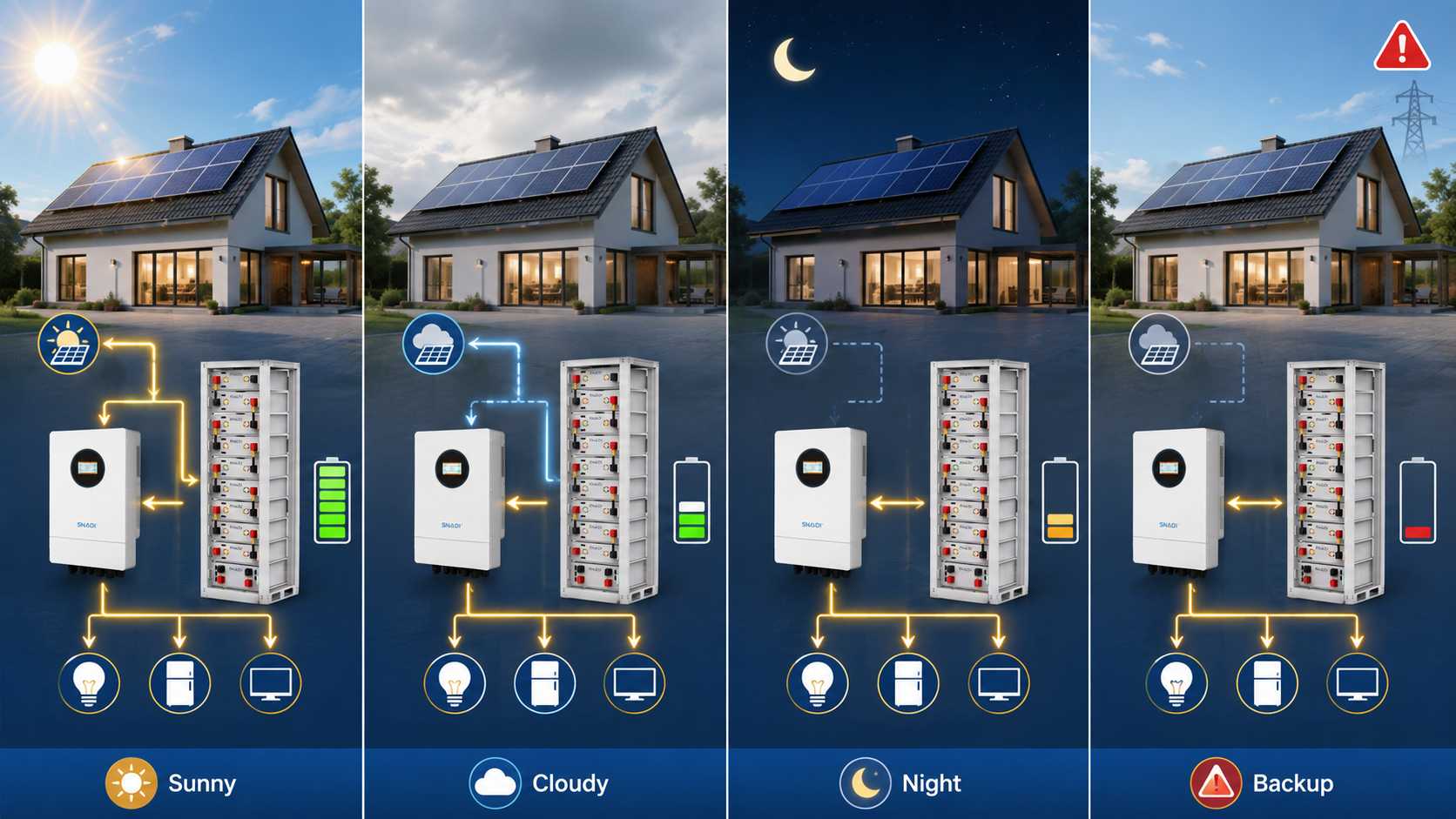
Operating Condition | PV Array | Battery | Inverter | Load Supply |
|---|---|---|---|---|
Sunny daytime | Strong production | Charging or holding SOC | Supplies AC power | Mainly solar |
Cloudy / low solar | Reduced production | Supplements PV | Supplies AC power | PV + battery |
Night | No production | Discharging | Converts battery DC to AC | Battery |
Low battery | Little usable solar energy | At minimum SOC | Follows configured backup logic | Generator, load shedding, or shutdown |
The important point here is that panel wattage tells only part of the story. Battery storage has to cover the timing gap between energy production and energy use, while the inverter must handle the loads connected at that moment.
Main Components of an Off-Grid Solar System
Component | Main Function |
|---|---|
Solar panels | Produce DC electricity |
MPPT controller | Manage PV power and charging |
Battery bank | Store energy |
BMS | Monitor and protect lithium batteries |
Off-grid inverter | Convert DC into AC |
Distribution board | Feed protected AC circuits |
Monitoring system | Track PV, loads, battery SOC, and alarms |
Generator | Provide optional backup power |
Breakers, fuses, and SPDs | Provide electrical protection |
A system built from individually suitable components can still perform poorly if those components are not compatible.
Battery voltage has to match the inverter. PV string voltage must remain inside the MPPT operating range. Lithium battery communication may need to work with the inverter's BMS protocol. Generator input, grounding, current limits, and local electrical requirements also need to be checked as part of the same design.
Off-Grid vs. Hybrid vs. Grid-Tied Solar
Feature | Off-Grid | Grid-Tied | |
|---|---|---|---|
Utility connection | No | Yes | Yes |
Battery | Normally required | Common | Often absent |
Operation during outage | Yes | Yes, if backup is configured | Normally no |
Battery requirement | Higher | Can be smaller | None or optional |
Main design focus | Energy independence | Backup + self-consumption | Energy cost reduction |
Typical application | Remote or no-grid sites | Weak-grid properties | Stable-grid properties |
A full off-grid system is not automatically the most economical answer whenever utility power is unreliable.
If grid power is available for most of the day, a hybrid inverter with a smaller battery may achieve the required backup at a lower cost. Going fully off-grid means installing enough generation and storage to deal with periods when the utility cannot help at all, including poor-weather conditions.
The right architecture therefore depends on how reliable the grid actually is, not simply on whether outages occur.
How to Size an Off-Grid Solar System
A useful sizing sequence is:
Load → Battery → Inverter → PV Array
Starting with the inverter model and trying to make every other component fit around it can easily produce the wrong balance.
Calculate Daily Energy Consumption
For each appliance:
Daily Energy (Wh) = Power (W) × Hours Used Per Day
If a 150 W refrigerator-equivalent load operates for eight effective hours:
150 W × 8 h = 1,200 Wh/day
The same calculation should be made for lighting, fans, pumps, computers, televisions, refrigeration, communications equipment, air conditioning, and any other loads expected to operate from the system.
The result gives the site's approximate daily energy requirement. It does not yet tell you how large the inverter should be.
Check Peak and Surge Loads
Daily kWh and peak kW answer different design questions.
Daily energy helps determine how much energy the battery and PV array need to provide. Inverter sizing depends more heavily on the maximum load that can run at one time and the short surge that occurs when motors or compressors start.
Consider a property with:
800 W of refrigeration
700 W of lighting and electronics
1,000 W of other active loads
one 1.5 kW water pump
Before the pump starts, simultaneous demand might be about 2.5 kW. Startup can push the required inverter output considerably higher for a short period.
For that reason, actual equipment characteristics should be checked wherever possible.
Sizing note: Battery capacity is primarily an energy calculation based on kWh and autonomy. Inverter selection should also account for simultaneous load, startup surge, AC voltage, and the battery's discharge capability.
Calculate Battery Capacity
A preliminary lithium battery estimate can use:
Battery Capacity ≈ Daily Energy × Days of Autonomy ÷ Usable DoD ÷ System Efficiency
For a site using 10 kWh per day, with one day of autonomy, 80% usable depth of discharge, and a preliminary 90% system factor:
10 ÷ 0.80 ÷ 0.90 ≈ 13.9 kWh
A designer could therefore start by evaluating a battery bank in the 14–15 kWh range.
That is still only an initial sizing value. Temperature, maximum charge and discharge current, battery aging margin, seasonal operating conditions, and the manufacturer's specified limits can all change the final selection.
Estimate Solar Array Size
A basic PV estimate is:
PV Array Size ≈ Daily Energy ÷ Peak Sun Hours ÷ System Derating
Using the same 10 kWh/day example and five usable peak-sun-hours:
At a preliminary 75% energy factor:
10 ÷ 5 ÷ 0.75 ≈ 2.67 kWp
The calculation gives a theoretical starting point rather than a finished array size.
An off-grid array may also need enough spare capacity to run daytime loads while recovering the battery after a low-solar period. That recovery requirement can be important in systems expected to operate without regular grid support.
NREL's PVWatts methodology uses a 14% default value for several PV losses that are not modeled separately. An off-grid design also has to account for battery charging, inverter operation, reserve requirements, and the conditions of the actual site.
For the example above, a preliminary design might therefore evaluate something closer to 3.5–4 kWp instead of stopping at the 2.67 kWp mathematical minimum.
Example: A 10 kWh/Day Off-Grid Home
Consider a remote home using about 10 kWh of electricity per day.
A preliminary configuration could be:
Item | Illustrative Size |
|---|---|
Daily energy | 10 kWh |
PV array | 3.5–4 kWp |
Battery | About 15 kWh nominal |
Inverter | Around 5 kW, subject to surge check |
Backup | Optional generator |
At midday, the PV array can run operating loads such as refrigeration, lighting, and electronics while sending available surplus energy to the battery.
By 8 p.m., useful solar production has stopped and the battery becomes the main energy source. On a cloudy morning, the situation may be different again: PV could cover part of the demand while stored energy covers the rest.
Several consecutive low-solar days would put more pressure on the battery. Depending on the design, the site may then need generator support or temporary reduction of non-priority loads.
These figures are intended to show the sizing process, not to specify equipment for a real installation. Final selection requires the site's load profile, local solar resource, battery specifications, inverter surge requirements, wiring calculations, and applicable installation rules.
What Happens When the Battery Is Full or Empty?
When the Battery Is Full
Once the battery reaches its configured upper charge limit, the inverter or charge controller reduces the charging current.
If current loads cannot use the remaining PV energy and there is nowhere else for that energy to go, solar production may be curtailed.
Installing more PV capacity therefore does not automatically mean all of that extra generation can be used. The result depends on daytime load, battery capacity, charging limits, and the system's energy management logic.
When the Battery Runs Low
As state of charge approaches the programmed lower limit, the battery management system and inverter begin protecting the battery against excessive discharge.
Depending on the installation, the next action may be to disconnect non-priority circuits, start a generator, switch to another input, issue an alarm, or shut down the AC output.
If the system regularly reaches its low-SOC limit during normal use, the design deserves another look. Possible causes include insufficient PV generation, inadequate battery capacity, unexpectedly high loads, or a backup strategy that does not match the site's operating pattern.
Does Off-Grid Solar Work on Cloudy Days?
Yes. The PV array can still produce electricity under cloud cover, although output may fall substantially compared with clear conditions.
When solar production drops below the load, the battery supplies more of the required energy. This is one reason battery autonomy should not be calculated only around nighttime consumption. The battery also provides reserve energy through low-solar weather.
Sites with long rainy seasons or strong seasonal variation may need more PV capacity, additional battery storage, generator support, stricter load management, or a combination of these measures.
The right solution depends on how long low-production periods normally last and how much of the site's load must remain powered through them.
What Buyers Should Check Before Choosing a System
Equipment purchase price is only one part of the system cost. Different combinations of PV capacity, battery autonomy, and backup power can shift costs between initial investment and long-term operation.
Design Choice | CAPEX | OPEX | Operating Risk | Best Fit |
|---|---|---|---|---|
Small battery + generator | Lower | Higher fuel cost | More generator dependency | Budget-sensitive sites |
Balanced PV + battery + backup | Medium | Medium-Low | Moderate | Homes, farms, small businesses |
Large PV + long battery autonomy | Highest | Lower fuel use | Lower backup dependency | Remote sites needing high autonomy |
Installers should also review the relevant inverter manuals and technical documents before confirming PV voltage, battery communication, and generator compatibility.
Before equipment is ordered, buyers and installers should verify:
daily kWh consumption
maximum simultaneous load
motor and compressor startup surge
required backup duration
local AC voltage and frequency
single-phase, split-phase, or three-phase requirements
PV string voltage
battery voltage and BMS communication
expected ambient temperature
dust, humidity, rain, and coastal exposure
required IP protection level
generator compatibility
monitoring requirements
local service and spare-parts strategy
For distributors and installers, this check is particularly important. A package can look correctly sized on a quotation and still cause problems after installation if the actual loads, battery current, motor startup requirements, or environmental conditions were never confirmed.
Is an Off-Grid Solar System Right for You?
Off-grid solar generally makes more sense when the alternative is an expensive grid extension, unreliable electricity, long generator operating hours, or no utility connection at all.
Typical applications include remote homes, farms, cabins, rural workshops, telecom sites, islands, water pumping installations, and small commercial facilities.
For commercial users, reliability also has an economic value. A World Bank report on Caribbean firms found that an average business loses around 1.1% of annual sales to power outages. In the same research, 45% of surveyed firms could lose half or more of their daily revenue during a one-day power disruption.
In that situation, the financial case for battery storage is not limited to electricity savings. Avoided production stoppages, continued refrigeration, working payment systems, lower generator runtime, and fewer lost operating hours may all be relevant.
The calculation changes where utility power is stable and relatively inexpensive. Building a fully independent system in that situation can add PV and battery capacity that the property does not really need. A grid-tied or hybrid system may be the more economical option.
Conclusion
An off-grid solar system is constantly dealing with a changing balance between generation and consumption.
During strong solar production, PV power can run the loads and charge the battery. When production falls, stored battery energy fills the gap. The inverter handles the DC-to-AC conversion, while programmed protection and backup logic determine what happens when available energy becomes limited.
This is why two projects with similar daily electricity consumption can still require very different equipment. A water pump may change the inverter requirement. A long rainy season may justify more PV or battery capacity. A site where generator use is acceptable can be designed differently from one that requires long periods of independent operation.
The diagram is the easy part. The useful engineering work is matching the PV array, inverter, battery, and backup strategy to the way the site actually consumes electricity.
For residential, farm, remote-site, and small commercial projects, SNADI/SNAT Solar supplies off-grid and hybrid inverters, LiFePO4 batteries, and energy storage products that can be selected around project load, voltage, battery autonomy, and installation conditions rather than a fixed one-size-fits-all package.

FAQ
During the day, solar panels generate DC electricity that can power active loads while surplus energy charges the battery. At night, useful solar production stops, so the battery supplies DC energy to the inverter, which converts it into AC electricity for connected appliances and equipment.
2. How do you size an off-grid solar system correctly?
3. What happens when an off-grid solar battery is full or runs low?
4. Can an off-grid solar system work during cloudy weather?
5. Is an off-grid solar system better than a hybrid solar system?