

If your solar monitoring app shows power dipping on bright, cloudless days, dirt is almost certainly the culprit. Dust, pollen, soot, and baked on bird droppings can easily shave 15% to 25% off your array's rated output. In dry farming regions or dusty coastal basins, that grime eats straight into your monthly savings.
The instinct is often to grab whatever is under the sink vinegar, glass cleaner, or even a pressure washer. Don't do it. Acidic sprays etch away the microscopic anti-reflective coating (ARC) on the tempered glass, while high-pressure jets blast water past junction box seals. That turns a simple afternoon chore into ground faults, burnt bypass diodes, and a rejected warranty claim.
Cleaning photovoltaic panels doesn't require expensive specialty rigs. You just need the right brush, mineral-free water, and a few basic ground-safety rules. Here is how to wash your array safely from the ground without damaging the glass.
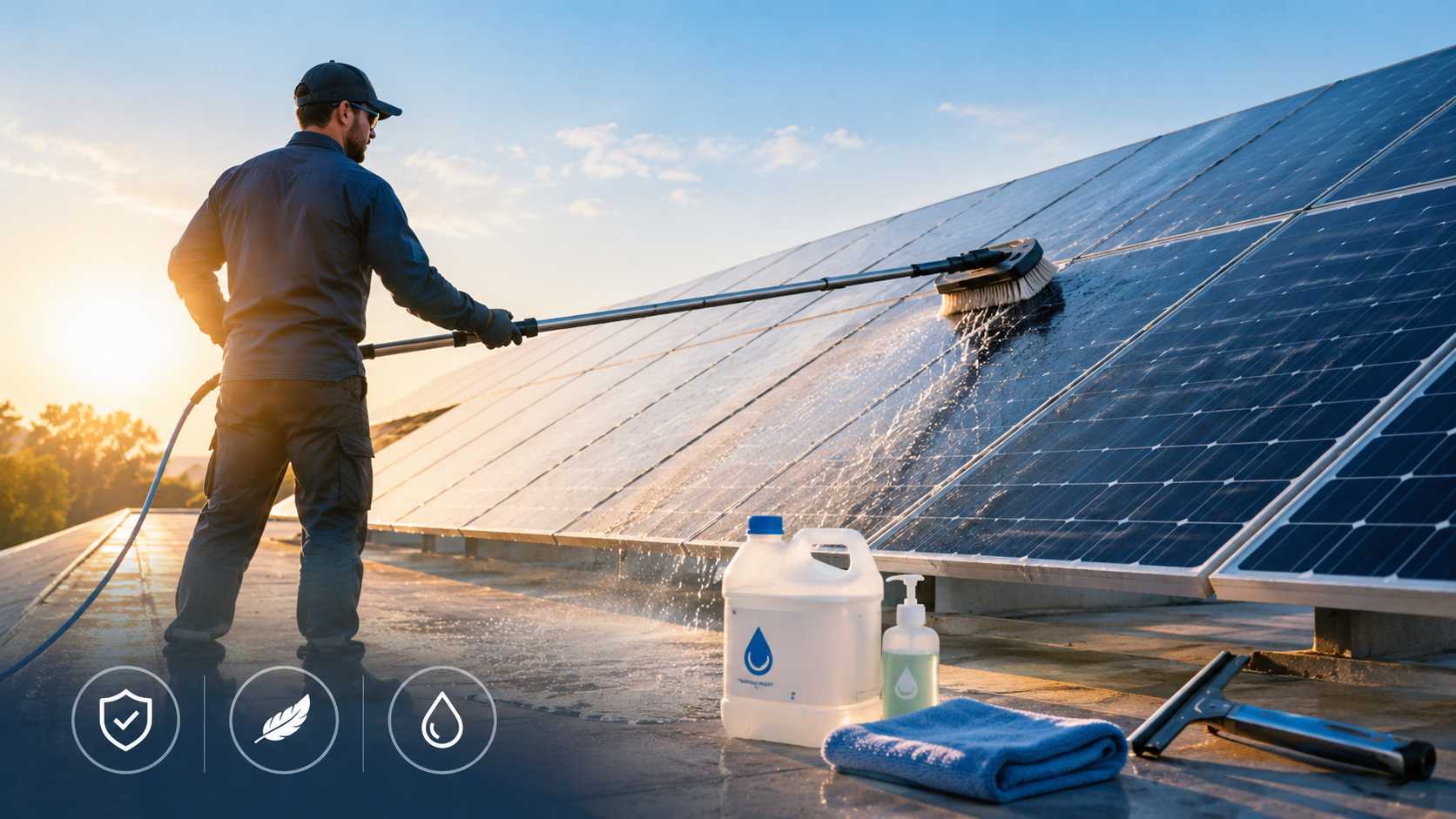
QUICK SUMMARY: WHAT TO USE ON SOLAR PANELS
1. Water: Deionized (DI) or distilled water with low Total Dissolved Solids (<10 ppm TDS) to prevent chalky white lime scale.
2. Soap: Mild, biodegradable dish soap (original Dawn), strictly diluted to 1 teaspoon per gallon of water.
3. Mechanical Tools: A soft-bristle flagged polypropylene brush on a 12–24 ft telescopic pole, paired with a soft rubber squeegee.
4. Spot Treatment: A 20% solution of isopropyl alcohol (IPA) in distilled water for tree sap, oily soot, and stubborn bird droppings.
5. Strictly Prohibited: Vinegar, ammonia glass sprays (Windex), bleach, abrasive scouring pads, and pressure washers.
Solar Panel Cleaning Tools That Protect Your Glass
Solar modules use low iron tempered glass engineered to let as much light into the silicon wafers as possible. On top of that glass sits a nanometer thin antireflective coating that stops sunlight from bouncing off. If you use stiff or abrasive tools, you will scratch that coating. Those tiny scratches scatter light away from the solar cells, permanently hurting your peak output. Here is the field-tested gear to keep on hand:
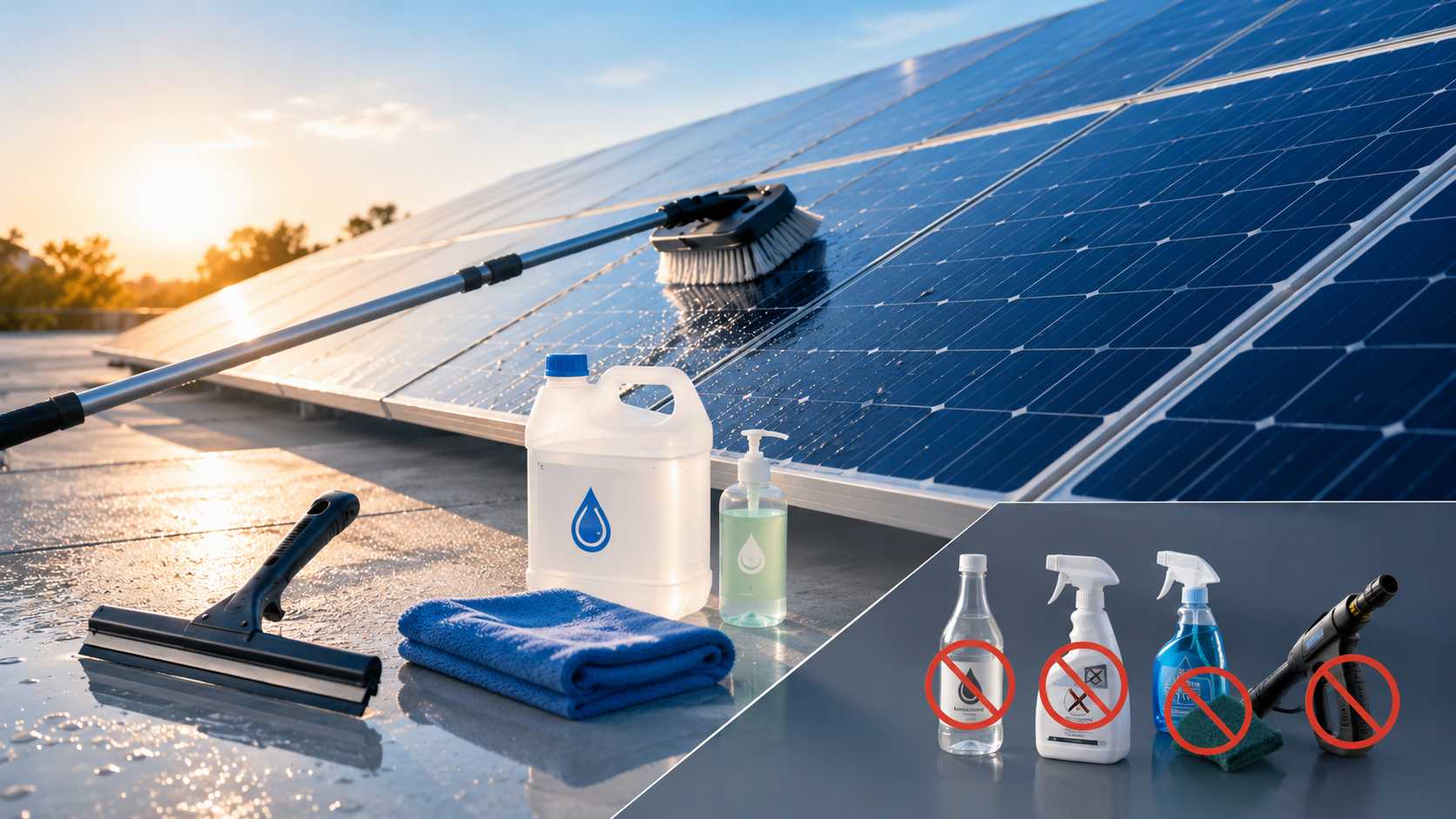
1. Soft Bristle Brushes and Telescopic Poles
Your main workhorse should be a soft bristle brush with flagged polypropylene or nylon heads. Flagged bristles have split, feathered tips that gently lift fine grit rather than grinding it across the glass or scuffing the aluminum frame. Leave the stiff deck brooms in the garage, they trap grit and act like sandpaper.
Pair your brush with a lightweight telescopic fiberglass or carbon fiber pole (12 to 24 feet). This lets you wash roof arrays and elevated carports while keeping both feet planted safely on the ground. If you wash regularly, invest in a water fed pole with built-in spray jets; the continuous low pressure rinse carries away grit as you scrub.
2. Low Pressure Garden Hose with Multi Pattern Nozzle
Standard residential tap pressure (30 to 50 PSI) is plenty for rinsing. Screw on an adjustable nozzle and set it to 'shower' or 'center fan'. You want a wide, gentle blanket of water that floats dirt off without forcing moisture past wire connectors or weather seals.
3. NonAbrasive Rubber and Silicone Squeegees
If you are washing in a sunny climate, rinse water evaporates quickly, leaving mineral deposits behind. A professional window squeegee with a vulcanized rubber or soft silicone blade clears pooled water in seconds. Look for a model with plastic end caps so exposed metal edges cannot strike the aluminum frame.
4. High Density Microfiber Cloths
For ground mount systems, battery shed canopies, or portable panels you can easily reach, 300–400 GSM microfiber cloths work wonders. Microfiber's split fibers trap dust particles deep inside the weave, pulling grit away from the glass instead of smearing it.
What Is the Best Cleaning Solution for Solar Panels?
The liquid you use matters just as much as the brush. The best cleaning solution balances grease cutting power with a neutral pH (6.5 to 7.5) that won't attack rubber gaskets or glass coatings.
Pure Deionized (DI) or Distilled Water (The Gold Standard)
Pure water passed through a deionization resin or reverse osmosis filter is what commercial solar crews swear by. With Total Dissolved Solids (TDS) under 10 ppm, pure water acts like a dirt magnet. It dissolves atmospheric grime, leaves zero mineral residue, and dries crystal clear without needing a squeegee.
Mild Biodegradable Dish Soap (The Kitchen DIY Recipe)
If you're wondering whether you can use Dawn dish soap on solar panels: yes, but only in extreme dilution. Original Dawn breaks up airborne road film, diesel soot, and sticky pollen. The catch? If you use too much, it leaves a sticky residue that attracts fresh dust within days.
The field recipe is simple: stir 1 level teaspoon (5 ml) of mild dish soap into 1 gallon (3.8 liters) of warm water. Never squirt soap directly onto the panel, and always follow with a thorough clean water rinse.
Diluted Isopropyl Alcohol (Targeted Spot Cleaning)
Baked on bird droppings, pine resin, and bee pollen contain sticky binders that water alone won't touch. Mix 1 part isopropyl alcohol (IPA, 70% or 99%) with 4 parts distilled water (a 20% mix). Spray directly on the spot, let it dwell for 60 seconds to soften the resin, and wipe clean with a microfiber cloth.
Dedicated Commercial Solar Wash Concentrates
For agricultural arrays near tilled fields or commercial roofs exposed to diesel exhaust, specialized cleaners (like Chemitek or Polywater Solar Wash) are worth the investment. These formulas are TÜV tested, safe for anti reflective coatings, contain antistatic agents that slow dust buildup, and help neutralize hard minerals in your rinse water.
What to NEVER Use to Clean Solar Panels
Solar modules take a beating from the weather, but improper cleaning causes immediate, permanent damage that manufacturer warranties will not cover. Here is what to avoid:
Prohibited Tool / Chemical | How It Causes Damage | Electrical & Operational Risk | Safe Alternative |
Vinegar & Acidic Solutions | Acetic acid (pH < 3.0) chemically etches the ~100 nm anti-reflective silica coating. | Permanent light scattering; 2% to 4% lifetime yield drop. | Pure DI water or 20% diluted IPA. |
Bleach & Caustic Cleaners | Sodium hypochlorite eats away edge gaskets and degrades rear polymer backsheets. | Moisture leaks, ground faults, and insulation failure. | Mild dish soap (1 tsp / gallon). |
Household Glass Cleaners (Windex) | Ammonia leaves an invisible film that attracts dust and hazes under UV sunlight. | Accelerated re-soiling and surface clouding. | Certified commercial solar wash. |
Pressure Washers (>100 PSI) | High-velocity water jets force past IP67/IP68 junction box seals and induce micro-cracks in cells. | Inverter arc faults, short circuits, and hot spots. | Standard garden hose (30–50 PSI). |
Abrasive Pads & Wire Brushes | Rough scouring fibers gouge the tempered glass and scrape frame coatings. | Irreversible optical haze and trapped dirt lines. | Flagged-tip soft bristle brush. |
Why Hard Tap Water Is a Hidden Hazard
If your local tap water has high mineral content (>100 ppm calcium and magnesium carbonate), letting it dry in the sun causes calcification. Water droplets evaporate quickly, leaving stubborn white chalk rings (lime scale) fused to the glass. Once baked in by the sun, scale is nearly impossible to remove without abrasive polishing, creating permanent localized shading.
How to Clean Solar Panels Safely from the Ground
Safety comes first. Follow this five-step field procedure to clean your array safely without risking electrical shock or hardware damage:
Step 1: Shut Down the System at the Inverter
Always de-energize the system before spraying water. Flip the AC breaker in your main electrical panel to 'OFF', then turn the DC disconnect switch on your solar inverter to 'OFF'. This stops live DC current from flowing through the string wiring, eliminating arc flash risks if wash water encounters a cracked connector or worn cable.
Step 2: Time It Right (Avoid Thermal Shock)
Never spray cold water onto hot panels in the middle of the day. In direct sunlight, dark silicon cells easily reach 65°C to 75°C (150°F to 167°F). Hitting hot tempered glass with cold tap water (15°C / 59°F) causes severe thermal shock. The sudden contraction can crack the tempered glass or shear the internal solar cell layers. Schedule cleaning for early morning (before 8:00 AM), late evening, or on overcast days.
Step 3: Dry Sweep Loose Debris First
Before turning on the hose, take your dry, soft bristle extension brush and sweep off dry leaves, pine needles, and loose sand. If you hose down dry sand right away, you create a gritty sludge that acts like sandpaper when you start scrubbing.
Step 4: Soak and Scrub with Light Pressure
Mist the array from top to bottom with low pressure water and let it soak for a minute or two. Dip your soft brush into the diluted soap mix (or turn on your water fed pole's DI supply) and scrub in smooth, vertical strokes. Let the bristles do the work never lean your body weight into the pole against the glass.
Step 5: Final Rinse and Squeegee Dry
Rinse thoroughly from top to bottom with clean water to flush off all soap foam. If you're using municipal tap water, immediately follow with your rubber squeegee to prevent mineral spots. Wipe the squeegee edge with a clean rag between passes to avoid trailing dirty waterlines.
SNADI/SNAT SOLAR ENGINEER'S TIP: • Spot Inactive Modules: If a single module is heavily fouled by bird droppings, its internal bypass diodes kick in, causing a sudden step-down drop in total string voltage (Vmp). • Check Post-Wash Gains: Turn the inverter back on after washing and check your peak noon output. A clean array in a dusty climate typically yields an immediate 8% to 18% jump in generation. • Inspect Glands & Seals: From the ground, take a quick look under the array. Make sure conduit fittings are snug and never spray water jets directly up into wire junction boxes. |
How Often Should You Clean Solar Panels?
How often you clean depends on your regional dust levels, roof pitch, and local weather. Arrays tilted steeper than 20 degrees shed dust naturally in heavy rain, while low-slope roofs (<10 degrees) tend to trap ponding water and muddy lines along the lower frame edge.
Operating Environment | Typical Dirt & Debris Sources | Recommended Wash Interval | Expected Yield Recovery |
Arid & Desert Basins | Fine windblown sand, mineral dust, zero rain. | Every 6 to 8 weeks (dry season). | 15% – 25% |
Agricultural & Rural Sites | Field dust, harvest chaff, bird droppings, organic spray. | Every 2 to 3 months (post-harvest). | 12% – 20% |
Urban & Industrial Corridors | Diesel particulate soot, highway film, smog. | Every 4 to 6 months. | 8% – 14% |
Suburban High-Rainfall Areas (Tilt > 15°) | Tree pollen, light ambient dust, leaf litter. | 1 to 2 times a year (spring/fall). | 3% – 6% |
The ROI of Cleaning
Take a typical 20 kW array on a dusty rural packing facility. In clean conditions, that system churns out roughly 2,800 kWh a month. An 18% soiling loss wipes out 504 kWh each month—costing you around $100 monthly ($1,200 annually) at standard $0.20/kWh commercial rates.
A sturdy 20 feet extension pole, soft flagged brush, squeegee, and mild cleaner cost roughly $120 as a one-time purchase. Two quick washes during the dry season fully pay for the tools within 40 days, delivering pure power gains for the rest of the year.
Conclusion
Keeping your solar glass clean is only half of the performance puzzle. The other half is efficiently converting, storing, and managing that energy. SNADI / SNAT Solar designs heavy-duty hybrid inverters, off-grid power systems, and lithium battery storage built for tough residential, commercial, and agricultural environments. With built-in MPPT tracking and detailed real-time string diagnostics, our inverters make it easy to spot soiling losses early and get the most out of every clean watt you produce.
Explore our high efficiency hybrid inverters and lithium storage systems, or reach out to our engineering team for expert system sizing and O&M guidance.
✉️Email: marketing@snadi.com.cn
Website:
☎️WhatsApp / WeChat: +86 1803929353

FAQ
Yes, original Dawn is safe if you keep it extremely diluted (one teaspoon per gallon of water). Its neutral surfactants lift road soot and pollen without harming glass seals. Never pour concentrated dish soap directly on panels, and always rinse thoroughly so no soapy film remains.
Can you pressure wash solar panels on a low setting?
Will regular rain clean solar panels effectively?
Does cleaning solar panels void the warranty?
How do I tell if lost production is from dirty panels or an equipment fault?