

If a storm knocks out the local feeder line in Guadalajara or electricity rates spike during the 6:00 PM peak in São Paulo, standard grid-tied solar panels won't help. Without an energy storage bank, antiislanding regulations force conventional string inverters to shut down instantly leaving homes dark and refrigeration dead despite full sunlight on the roof. At the same time, shifting utility policies across Latin America are slashing the credit value of exported solar power, making behind the meter self consumption the only reliable way to protect solar savings.
Installing modern battery storage systems for homes addresses both grid vulnerability and tariff erosion in one build. Surplus midday generation is banked for high rate evening hours, while automatic transfer switches restore critical power in milliseconds during a blackout. However, securing long term reliability requires balancing four practical variables: cell chemistry safety, AC vs. DC coupling topology, continuous inverter power versus motor inrush surge, and balance of system installation costs.
What Drives the Shift to Home Battery Energy Storage Systems?
Across Latin America and emerging distributed solar markets, the rapid transition toward residential energy storage is accelerated by two distinct forces: chronic distribution grid instability and sweeping tariff restructuring.
Grid Instability, Brownouts, and Diesel Generator Replacement
In many suburban and peri-urban regions across Mexico, Colombia, Central America, and Brazil, localized distribution networks face chronic voltage sags, phase imbalances, and weather-driven outages. Historically, residential properties, home offices, and light commercial sites relied on small diesel or gasoline generators for emergency backup.
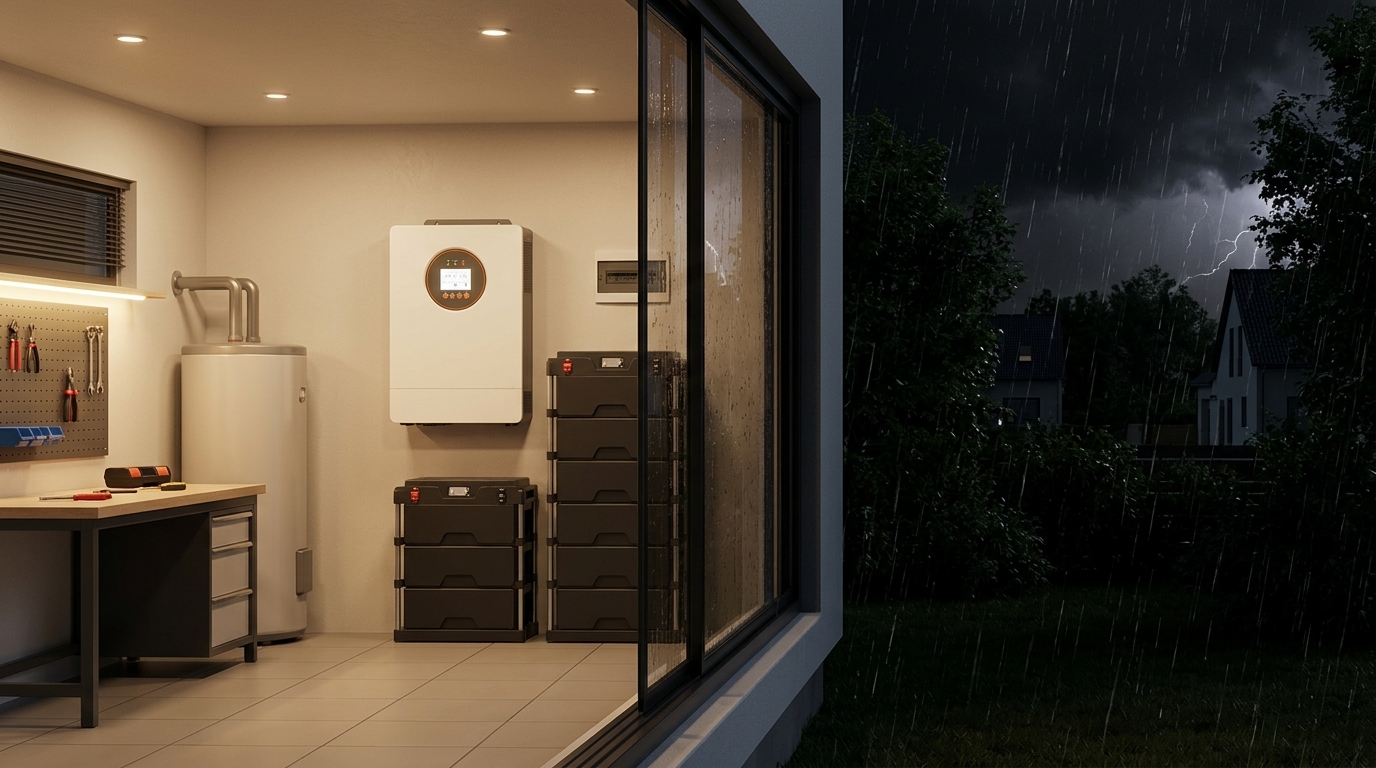
Yet running small combustion generators imposes substantial operational drag: noisy running conditions, toxic exhaust, frequent oil and filter service intervals (every 100 to 250 operating hours), and volatile fuel costs that run between $0.35 and $0.58 per delivered kilowatt-hour. In contrast, modern lithium battery storage systems paired with hybrid inverters switch over seamlessly in under 10 milliseconds—supplying clean, silent power with virtually zero scheduled mechanical maintenance.
Tariff Reform: The Death of 1:1 Net Metering and the Rise of Self-Consumption
The traditional solar model of exporting unlimited midday power for full retail credit is rapidly ending. In Brazil, Law 14.300 (Marco Legal da Micro e Minigeração Distribuída) continues to phase in the 'Fio B' distribution wire tariff on grid-injected energy, reducing exported solar compensation by 20% to 55% through 2028/2029. In Mexico, high consumption domestic tariffs (CFE Tarifa DAC) heavily penalize peak evening grid consumption.
When utilities purchase surplus solar power at low wholesale rates but bill nighttime imports at peak retail prices, grid injection becomes an economic loss. A dedicated home battery energy storage system captures excess daytime solar production behind the meter, discharging it during evening peak rate windows to keep expensive utility imports near zero.
Core Chemistries Compared: LiFePO4 vs. NMC vs. Deep Cycle Lead-Acid
A battery bank's operating life, thermal resilience, and safety profile come down to its underlying cell chemistry. Residential installations primarily utilize three technologies: Lithium Iron Phosphate (LiFePO4 / LFP), Nickel Manganese Cobalt (NMC), and deep cycle Lead-Acid (AGM/Gel).
LiFePO4 vs NMC Home Battery Safety
When evaluating lifepo4 vs nmc home battery safety, cell level chemical bonding dictates how the system behaves under high ambient temperatures, heavy cycling, and electrical faults.
LiFePO4 utilizes a robust phospho-olivine crystal lattice with covalent phosphorus oxygen bonds (P-O). This structure remains structurally intact under thermal abuse, exhibiting a high thermal runaway threshold exceeding 270°C (518°F). Even in the event of cell puncture or overcharging, LFP releases negligible oxygen, preventing self sustaining fires. Premium Tier-1 LFP cells deliver 6,000 to 8,000 charge discharge cycles at 80% Depth of Discharge (DoD), translating to 15+ years of dependable daily cycling.
NMC chemistry provides higher volumetric energy density, making it a standard choice for electric vehicles where chassis space is tightly constrained. However, NMC's layered oxide structure begins thermal breakdown at approximately 210°C (410°F), releasing oxygen that can accelerate combustion if thermal dissipation fails. NMC packs also degrade faster under high ambient heat, typically yielding 2,500 to 3,500 cycles before capacity drops to 70%. For stationary residential storage, where wall footprint is readily available. LiFePO4 is the engineering benchmark for safety and longevity.
Why Lead-Acid Costs More Over a 10 Years Lifecycle
Flooded and sealed AGM/Gel lead-acid batteries appear economical on an initial quote, but their operating physics impose severe lifecycle penalties:
· Restricted Usable Capacity: Discharging lead-acid batteries beyond 50% DoD triggers severe plate sulfation and permanent capacity loss. A 10 kWh lead-acid bank delivers only 5.0 kWh of usable energy, whereas a 10 kWh LiFePO4 bank yields 9.0 to 9.5 kWh of usable capacity (90–95% DoD).
· Frequent Replacements: Deep-cycle AGM batteries yield only 500 to 1,000 cycles under daily cycling conditions, requiring complete bank replacements every 2 to 3 years. Over a decade, that means buying three to four separate battery banks.
· Poor Round-Trip Efficiency: Lead-acid internal resistance creates high thermal losses during charging (75%–80% round-trip efficiency), wasting up to 25% of harvested rooftop solar power compared to 94%–96% efficiency in lithium systems.
SNADI/SNAT Solar Engineer's Note: Sourcing Grade-A Cells Always verifying Grade-A cell batch matching. Budget battery assemblers frequently buy 'Grade-B' or repurposed EV cells with mismatched internal impedances. Under daily cycling, mismatched cells trigger premature Battery Management System (BMS) low-voltage cutoffs on the weakest cell, stranding up to 25% of total rated capacity. |
Performance Parameter | LiFePO4 (LFP) | NMC Lithium | Deep-Cycle AGM / Gel |
Cycle Life (@ 80% DoD) | 6,000 – 8,000+ Cycles | 2,500 – 3,500 Cycles | 500 – 1,000 (at 50% DoD) |
Usable Depth of Discharge | 90% – 95% Usable | 80% – 90% Usable | 50% Max Recommended |
Round-Trip Efficiency (RTE) | 94% – 96% | 91% – 94% | 75% – 80% |
Thermal Runaway Point | > 270°C (High Stability) | ~ 210°C (Needs Cooling) | N/A (H2 Off-Gas Risk) |
Calendar Lifespan | 12 – 15+ Years | 8 – 10 Years | 2 – 4 Years |
Levelized Cost (LCOS) | $0.10 – $0.16 / kWh | $0.18 – $0.26 / kWh | $0.38 – $0.55 / kWh |
Environmental & Safety | Non-toxic, no cobalt | Cobalt/nickel, thermal risk | Hazardous lead/acid |
AC Coupled vs DC Coupled Battery Storage
Integrating solar panels, hybrid inverters, and battery storage requires choosing between two core electrical topologies: DC coupling and AC coupling.
DC-Coupled Hybrids
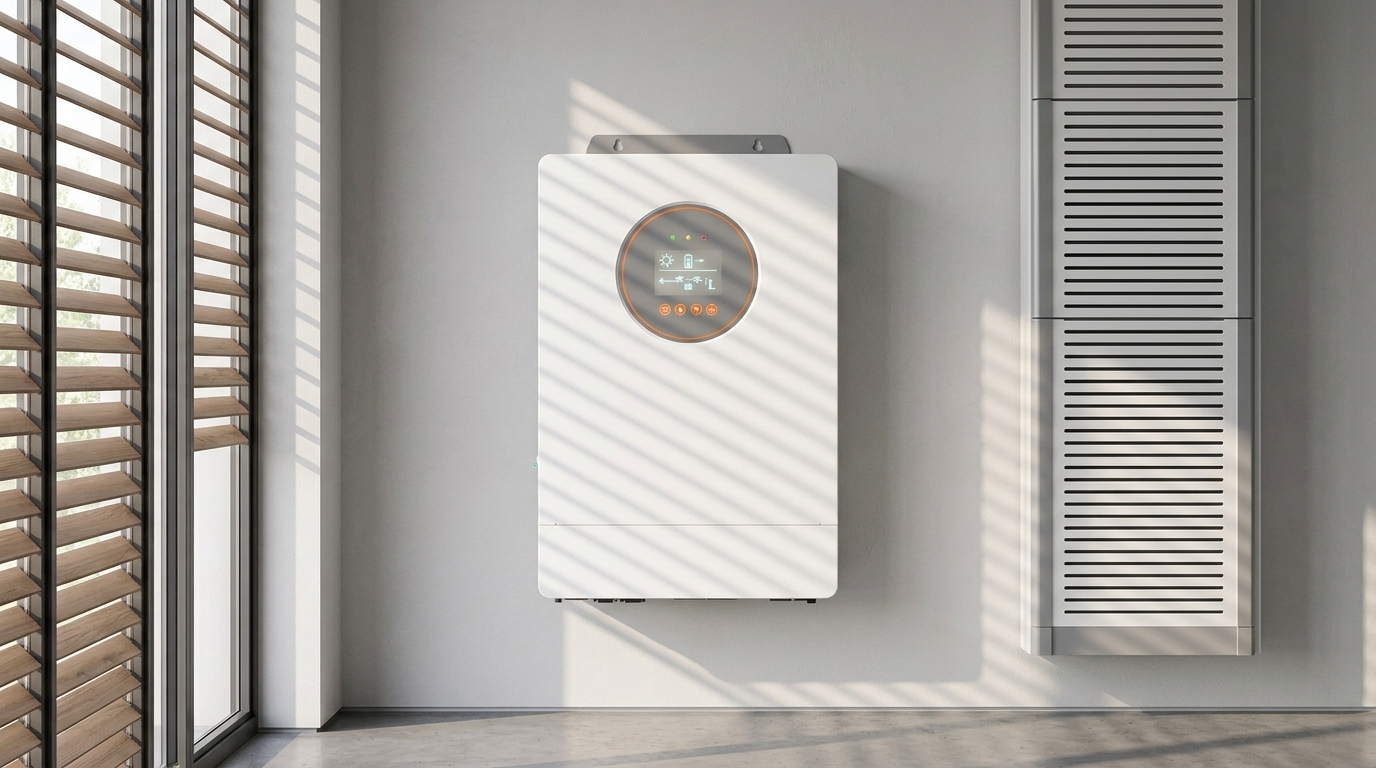
In a DC-coupled architecture, solar PV strings and the lithium battery bank connect directly to a shared multi-port hybrid inverter (such as the SNADI/SNAT BLD single-phase or GS three-phase hybrid series). Solar DC energy charges the battery bank directly through internal Maximum Power Point Tracking (MPPT) charge controllers without unnecessary AC conversions.
· Maximum Efficiency (96%–98%): Direct DC-to-DC battery charging eliminates double-inversion power losses.
· Unified System Management: A single hybrid inverter controls solar generation, battery charging, utility grid export, and generator dry-contact start sequences through one consolidated interface.
· Lean Balance of System: Eliminates duplicate inverters, subpanel disconnects, and redundant AC wiring runs, reducing wall footprint and labor.
AC-Coupled Storage
In an AC-coupled configuration, an existing grid-tied string inverter remains in place on the home's AC bus. A dedicated battery inverter/charger is wired to the main distribution panel, converting AC power to DC to charge the battery bank, and reversing the process during discharge.
· Non-Disruptive Retrofits: Allows installers to add battery backup to existing solar installations without altering rooftop string layouts or voiding existing inverter warranties.
· Triple-Inversion Losses: Solar power converts from DC (panels) to AC (string inverter), AC to DC (battery charging), and back to AC (household loads). This chain reduces overall round-trip efficiency to 86%–90%.
High Voltage vs Low Voltage Home Battery Configurations
When comparing high voltage vs low voltage home battery configurations, installers must evaluate voltage safety thresholds against cable cross-section requirements:
· Low-Voltage (LV 48V / 51.2V) Systems: The established standard for residential hybrid and off-grid builds. Operating under 60V DC minimizes shock risk and avoids stringent high-voltage conduit mandates. Standard 51.2V rack-mount or wall-mount packs (such as SNADI 5.12kWh and 10kWh modular units) parallel easily up to 15 units (75kWh+). However, lower voltage means high amperage: a 10 kW load draws ~200A at 48V, requiring heavy 50 mm² to 70 mm² copper cables and keeping inverter-to-battery cable runs under 3 to 5 meters.
· High-Voltage (HV 200V–500V) Systems: Series-connected battery modules supply high DC voltage directly to matching hybrid inverters. High voltage dramatically lowers operating current (e.g., 20A at 400V for 8kW output), allowing smaller 4 mm²–6 mm² wiring, minimal resistive heat loss, and exceptional surge delivery for large geothermal or heat pump loads. However, HV stacks require specialized DC arc-fault protection and offer less flexibility when expanding single module capacity years later.
How Many kWh Battery Do I Need for My Home?
Improper system sizing remains the leading cause of residential storage warranty disputes. Installers and clients frequently confuse continuous inverter power output (kW) with total usable stored energy capacity (kWh).
Power (kW) vs. Usable Capacity (kWh)
Power (kW) determines how many appliances can run at the exact same moment. Capacity (kWh) determines how many hours those appliances can stay energized:
· Continuous Power (kW): If a home runs a mini-split air conditioner (1.8 kW), a refrigerator (0.3 kW), LED lighting (0.2 kW), and an espresso machine (1.5 kW) simultaneously, the hybrid inverter must deliver at least 3.8 kW of continuous AC output.
· Usable Energy Capacity (kWh): Running that combined 3.8 kW load continuously for 4 hours consumes 15.2 kWh of stored energy.
· Surge & Inrush Current (kVA): Inductive loads like well pumps and traditional HVAC compressors demand 3x to 5x their rated running wattage for 2 to 5 seconds during startup (Locked Rotor Amperage / LRA). The hybrid inverter must provide robust momentary surge headroom (e.g., 2x continuous rating for 10 seconds) to prevent nuisance fault trips.
Engineering Capacity Sizing Formula & Practical Load Profiles
To determine the exact battery capacity required for a residential property, apply the standard engineering formula:
Battery Capacity Calculation Formula Required Usable Capacity (kWh) = [ Total Daily Critical Energy Demand (kWh) ] / [ Usable DoD × Inverter RTE × Temperature Derating Factor ] |
· 1. Essential Circuits Backup (5 kWh – 7.5 kWh): Engineered for 6 to 12 hours of core load coverage during localized brownouts. Powers LED lighting, WiFi routers, laptops, home security systems, and an inverter refrigerator (average continuous load of 400W–600W).
· 2. Standard Family Self-Consumption & Outage Protection (10 kWh – 15 kWh): Engineered for daily peak shaving and 12 to 24 hours of autonomous runtime. Supports all essential loads plus a 12,000 BTU inverter mini split, water pressure booster pump, TV, and kitchen circuits (paired with a 6kW to 8kW hybrid inverter such as the SNADI BLD-8000).
· 3. Whole Home Energy Independence (30 kWh – 45 kWh): Engineered for large residences, ranches, or small commercial facilities. Delivers 24 to 48 hours of autonomous operation powering central air conditioning, deep well pumps, commercial refrigeration, and EV charging (paired with parallel hybrid inverters like the SNAT ES Series up to 37.2kW or 15kW/45kWh modular power stations).
⚠️ Field Installation Warning: Paralleling Low-Voltage Battery Modules When installing multiple 48V/51.2V LiFePO4 battery modules in parallel (e.g., three 5.12kWh rack-mount packs), never daisy chain DC power cables from pack to pack. Daisy chaining introduces uneven internal resistance, forcing the first module closest to the inverter to cycle harder and degrade up to 40% faster. Always connect each battery module with identical-length cables to a shared heavy duty DC copper busbar before feeding the main inverter DC disconnect. |
Residential Battery Storage Cost, Payback, and Financial Economics
Evaluating residential battery storage cost requires looking past raw hardware pricing to assess full turnkey installed expenditures and levelized lifecycle returns.
Hardware vs. Turnkey Installed Costs ($/kWh Analysis)
Factory-direct hardware pricing for modular residential LiFePO4 storage packs sits between $220 and $380 per usable kWh at the distributor tier. However, complete turnkey residential installation pricing ranges from $700 to $1,100 per installed usable kWh. Turnkey budgets include three core categories:
· Pure Sine Wave Hybrid Inverter: $1,200 to $3,200 depending on continuous power rating (5kW to 12kW) and outdoor ingress rating (IP65/IP66).
· Balance of System (BOS) Electricals: DC combiner enclosures, Class T high interrupt fuses, thermal magnetic DC circuit breakers, Type II Surge Protection Devices (SPD), and high strand copper conductors ($400 to $900).
· Engineering, Permitting, and Commissioning: Critical load subpanel rewiring, Automatic Transfer Switch (ATS) integration, and utility grid interconnection filing ($800 to $1,800).
Financial Modeling: Maximizing Returns via Peak Shaving and Tariff Arbitrage
In regions with flat electricity rates, battery storage primarily delivers resilience value. However, in markets with Time-of-Use (TOU) tariffs or grid export wire fees, battery storage actively accelerates project payback:
· Brazil Law 14.300 Case (Group B Residential): Under the phased Fio B wire tariff, grid-exported solar credits lose 30% to 50% of their monetary value. For a residence consuming 30 kWh/day with an 8 kWp solar array, cycling 10 kWh through an LFP battery bank to avoid purchasing grid power at the full retail rate ($0.18/kWh) generates an extra $650 to $800 in annual savings. This compresses the battery payback period to 5.5–7.5 years on hardware warrantied for 10 to 15 years.
· Mexico CFE Tarifa DAC Case: High demand residential and small commercial consumers face steep graduated rate tiers. Deploying automated peak shaving via hybrid inverters (e.g., SNAT BLD series) to discharge batteries during expensive 6:00 PM – 10:00 PM peak windows prevents accounts from crossing into DAC surcharge tiers, delivering full capital payback in under 5 years.
Practical Installation Standards and Operating Risks in Warm Climates
Deploying residential energy storage in tropical and high temperature environments requires strict adherence to electrical and thermal practices:
· 1. Thermal Management and Placement: Sustained operation above 35°C (95°F) accelerates lithium electrolyte breakdown, while charging below 0°C (32°F) causes dangerous lithium plating on anodes. Install battery banks and inverters in shaded, well-ventilated utility rooms or covered exterior walls. For outdoor installations, specify IP65-rated enclosures equipped with smart forced air cooling fans.
· 2. Sub-10ms Transfer Switching (UPS Functionality): For home offices, commercial servers, and medical equipment, transfer speed is critical. Verify that the hybrid inverter supports automatic transfer times under 10 milliseconds to prevent sensitive electronics from rebooting during grid drops.
· 3. Closed-Loop BMS Protocol Compatibility: Ensure the battery BMS communicates natively with the hybrid inverter via CAN or RS485 protocols. Closed loop communication prevents State of Charge (SOC) drift, protects cells from over discharge, and enables dynamic charging current throttling based on real-time cell temperatures.
Conclusion
Adding battery storage to a residential solar array is no longer a speculative luxury, it is the only way to protect solar ROI against wire tariffs and chronic grid outages. By specifying Grade-A LiFePO4 chemistry and pairing it with high efficiency hybrid inverters, solar distributors, installers, and property owners secure resilient, scalable power with predictable lifecycle payback.
When designing a residential system, start by measuring peak inductive motor surge loads, prioritize DC coupling for new builds, and select modular 51.2V or high voltage battery stacks that support parallel expansion. Explore SNADI and SNAT Solar's lineup of BLD and ES Series hybrid inverters, wall mounted lithium batteries, and modular storage power stations to build reliable, high performance distributed energy systems.
✉️Email: marketing@snadi.com.cn
Website:
☎️WhatsApp / WeChat: +86 1803929353

FAQ
Yes, provided the continuous output of the hybrid inverter and the surge rating match the home's simultaneous load profile. A hybrid inverter with an integrated transfer switch isolates the property from the grid in under 10ms, creating a stable micro-grid supplied by solar panels and the battery bank.
Q2: How long will a 10 kWh battery run typical household loads?
Q3: What is the primary difference between continuous power (kW) and surge power?
Q4: Is Lithium Iron Phosphate (LiFePO4) fireproof?
Q5: Can I add a battery bank to an existing grid-tied solar system?