

Two inverter listings can carry the same true sine wave label and still leave a buyer with very different levels of confidence. One listing may identify output voltage, frequency, distortion, continuous power, surge duration and temperature. The other may only show a large watt number beside a product image. The first listing gives an engineer something to check. The second gives a buyer a question list.
Inverter true sine wave, the short answer is simple: true sine wave is commonly used as another name for pure sine wave. The longer answer matters more for a purchase decision. It describes a general shape of AC output. It does not by itself prove the voltage is correct for the site, the frequency is stable, the inverter can start a compressor, the battery can supply the DC current or the installation is safe.
The United States Department of Energy explains that an inverter converts direct current into alternating current through rapid switching and that filters and electronics can produce a clean repeating sine wave. It also notes that connected equipment is designed to operate at particular frequencies and voltages. We therefore begin with documented conditions rather than a marketing adjective. The conversion and application context is explained by the United States Department of Energy inverter overview.
Reconstruct the AC Output
RMS Voltage Is the Working Value
AC voltage is normally stated as an RMS value. A 230 V appliance and a 120 V appliance are not interchangeable merely because both connect to an inverter. Check the nameplate of the load, the intended site voltage and the inverter output setting. A voltage label without its regulation condition tells only part of the story.
Frequency Must Match the Equipment and Site
Frequency is the number of AC cycles per second. Motors, timing circuits and some appliances can be sensitive to a 50 Hz or 60 Hz mismatch. Request the rated frequency and tolerance, then confirm that it matches the equipment and applicable local requirements. Do not use a general article to bridge a voltage or frequency mismatch.
THD Needs a Test Condition
Harmonics are voltage or current components at integer multiples of the fundamental frequency. Fluke describes THD as the aggregate of harmonic effects and notes that voltage and current context differ. For a true sine wave inverter THD figure to be useful, ask whether it is voltage THD or current THD, at which load, at which input voltage and with which measurement method.
Put Every Claim on a Four Rung Evidence Ladder
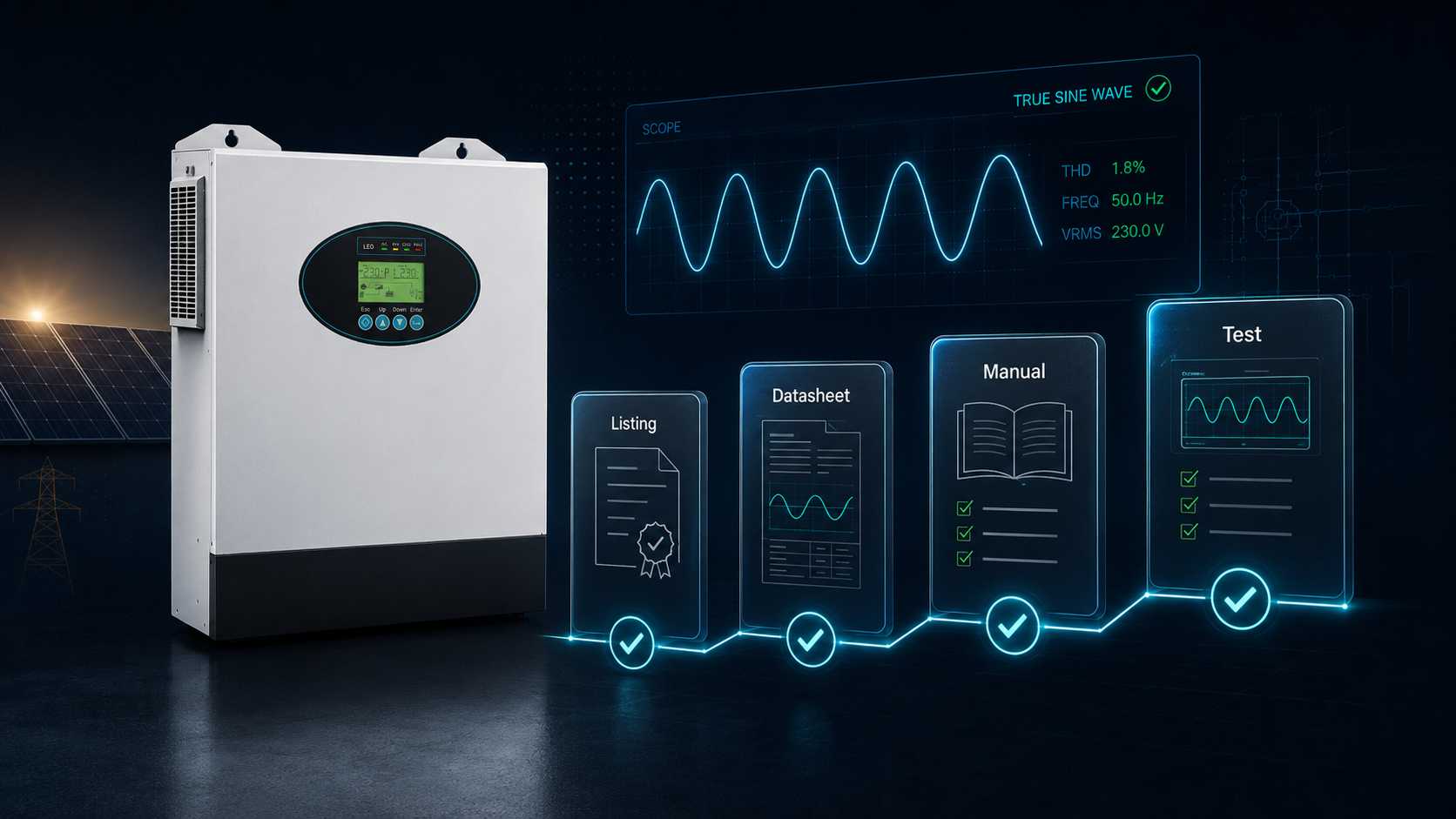
Rung One: Listing Language
A product title or marketplace listing can identify a model family. It cannot prove the operating condition behind a waveform claim. Missing model codes, copied tables and an undefined peak value are reasons to pause, not reasons to reject a product automatically.
Rung Two: Current Model Specific Datasheet
The datasheet should identify the exact variant and show continuous output, surge output, AC voltage, frequency, DC range, temperature and standby figures. If it includes THD, record the condition next to the number. If the condition is absent, mark the field as not documented.
Rung Three: Manual and Certificate Scope
The manual reveals connection limits, protection settings and installation instructions. A certificate must be checked for the model family, market, holder, edition and current status. IEC 62109 Part 1 is a safety standard for photovoltaic power conversion equipment, while IEC 62093 focuses on design qualification of that equipment. Neither title turns into a universal waveform or appliance compatibility certificate. (The safety scope is in IEC 62109 Part 1, The qualification scope is in IEC 62093)
Rung Four: Traceable Test Evidence
For a medical device, production measurement system or other critical load, request documented compatibility evidence from the device maker and a suitable test record. Energized measurements belong to competent personnel using suitable instruments and protection. A retail product page is not an acceptance test.
Claim on the page | Field to verify | Condition to request | What the claim does not prove |
True sine wave | Voltage THD and waveform | Load, input voltage and method | Appliance approval |
6 kW output | Continuous W and VA | Ambient temperature and duration | Motor start capability |
12 kW surge | Surge magnitude | Duration and battery state | Repeated compressor starts |
Fast transfer | Transfer time | Mode and output state | Zero interruption for every load |
IEC reference | Certificate scope | Model, market and holder | THD or grid approval |
Four Scenarios Change the Decision
Sensitive Electronics and Audio
For a true sine wave inverter for sensitive electronics, waveform quality is one input. Grounding, interference, transfer behavior, outlet arrangement and the equipment maker instructions can also decide the result. Ask what happens when utility input changes or the battery reaches its low voltage limit.
Refrigeration, Pumps and Compressors
A refrigerator or pump can need high starting current. Continuous power alone is not the deciding field. Confirm surge magnitude, surge duration, battery voltage under load, cable and protective device sizing.
Medical, Measurement and Critical Loads
Do not infer medical equipment approval from a true sine wave label. Obtain written device maker guidance and define a backup plan with the responsible technical team. The correct next action may be a different power architecture, not a larger inverter.
Simple Resistive Loads
Heaters and lamps can make waveform less decisive, while steady demand, battery capacity, cable heating and runtime become more influential. A lower purchase price can still lead to higher operating risk when the DC system is too small for the duty cycle.
SNADI/SNAT Solar NKH 6000
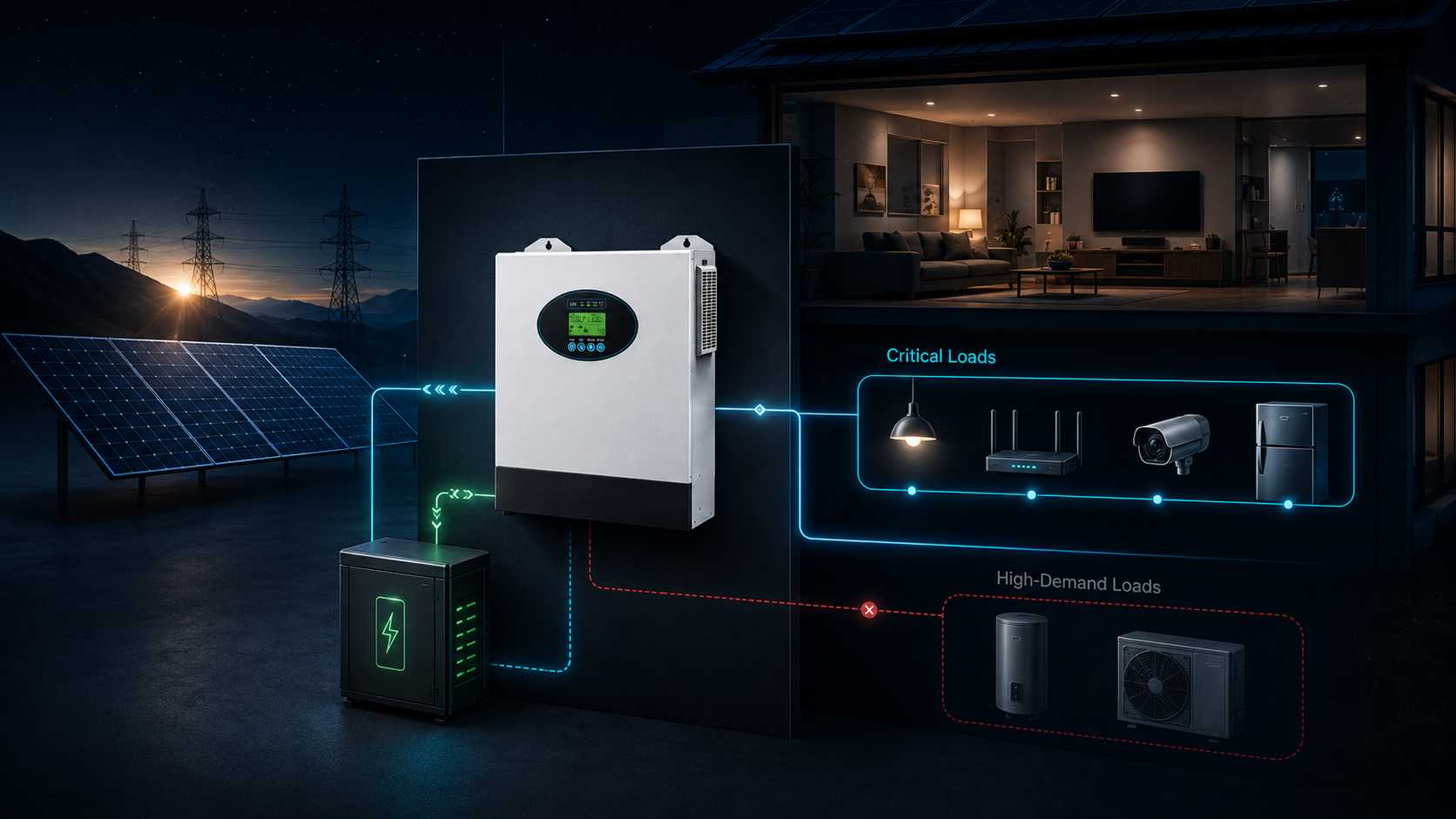
When the system needs solar charging, battery storage and selected AC backup in one off grid architecture, the SNADI/SNAT Solar NKH 6000 Off Grid Hybrid Solar Inverter is a documented option to review after the evidence request. The official product page identifies 6000 W rated power, 12 kW surge power, 48 V battery input, 9 kW maximum PV array power, a 60 to 450 V MPPT operating range, 500 V maximum PV open circuit voltage and 10 ms transfer time. It also describes the NKH series as pure sine wave output with integrated MPPT.
That set of fields makes the NKH 6000 relevant for a house or small business that has a defined critical load panel and a 48 V battery design. It is not a promise to place every circuit on backup. Refrigeration control, communications, security, lighting and selected sockets may be prioritised while high demand heating loads remain outside the backed up circuit
Our NKH 6000 adds pure sine wave output, 230 V rated output, configurable 208 V, 220 V, 230 V or 240 V AC voltage, 50 Hz operation, 93 percent peak inverter efficiency and 62 W no load consumption. It also has 12 kW surge capacity for five seconds.
Design option | CAPEX effect | OPEX and operating risk | Evidence needed before selection |
Inverter only with unknown load | Lower initial spend | High overload and service call risk | Load data and DC system design |
NKH 6000 with defined critical panel | Focused equipment spend | Easier runtime and surge review | Manual, battery data and protection plan |
Larger inverter without circuit control | Higher equipment spend | Can still overrun battery capacity | Simultaneous load and battery current study |
Critical equipment backup path | Project specific | Lower uncertainty when approved | Device maker approval and documented test |
Separate Waveform, Power, Architecture and Safety
Buyers often put four decisions into a single question. A pure sine wave inverter for solar system use requires all four answers. The same is true for a true sine wave inverter for solar system use, because inverter output, battery design, PV limits and installation scope must agree.
1. Waveform: What voltage, frequency and THD condition are published?
2. Power: What continuous W or VA, surge duration and ambient condition apply?
3. Architecture: Does the system need solar charging, battery charging, utility input, backup transfer or grid parallel operation?
4. Safety: Which product documents, wiring practices, protection devices and qualified installation requirements apply at the site?
The trade off is clear. More backup circuits may feel convenient, but they expand battery current, PV energy, protective coordination and installation scope. More inverter power can help only when the battery and wiring can sustain it. A pure sine wave claim remains useful, yet it is one line of a larger design record.
Conclusion
An inverter true sine wave label answers a terminology question, not a whole procurement decision. Treat true and pure sine wave as a starting category, then verify voltage, frequency, THD condition, continuous power, surge duration, DC limits, architecture and safety evidence.
For a true sine wave inverter buying guide, the strongest comparison is not the loudest label. It is the file that shows which claim is verified, conditional, undocumented or mismatched for the intended loads. Send the evidence request before price comparison, then let the response determine whether a model such as the SNADI/SNAT Solar NKH 6000 belongs in the system design.
✉️Email: marketing@snadi.com.cn
Website:
☎️WhatsApp / WeChat: +86 1803929353

FAQ
Usually, yes. Both terms describe the same broad output class. Verify the measured conditions behind the label for the exact model.
Does a True Sine Wave Label Have One Universal THD Limit?
Can True Sine Wave Output Guarantee a Refrigerator Start?
What Is the First File to Request?
Does IEC Certification Prove Appliance Compatibility?
What Should an NKH 6000 Quote Include?