

Choosing among PV inverter types is a system decision. The right unit has to suit the roof, the electrical service, the loads that matter during an outage and the work required to maintain the site. A clean roof with predictable daytime use calls for a different architecture from a shop that must keep refrigeration running or a remote site that depends on a pump after sunset.
At SNADI/SNAT Solar, we begin with the loads, roof layout and electrical boundary. The inverter comes after that review. It is a simple order of work, but it prevents many costly changes later in the project.
Start With the Project Constraint
A product category does not tell the whole story. Before selecting an inverter, establish what the site is trying to protect or improve. The five questions below turn a broad solar conversation into an engineering brief.
· Is the array on one clear roof plane or divided across directions and elevations
· Does shade move across any modules during the useful production period
· Will the owner add a battery now, later or not at all
· Which circuits must keep operating when utility power is unavailable
· Does the site have single phase supply or a three phase commercial service
These questions affect both capital cost and operating risk. A lower priced inverter can become the expensive option when a battery retrofit needs added conversion equipment, when one shaded module pulls down a string or when a motor load causes repeated trips. More equipment is not automatically better. The added cost needs a clear purpose, such as preserving productive hours, avoiding a redesign or reducing time spent finding faults.
Ask for a site record before the equipment list is final. It should show the roof planes, locations of regular shade, proposed module groups, inverter position, cable route and the circuits intended for backup. This record gives the buyer a way to test whether the quotation matches the site. It also gives the installer a cleaner handover point when responsibility moves from design to commissioning.
Compare the Main PV Inverter Types
The comparison below is a decision aid, not a quotation. It gives the buyer a starting point for conversations about roof geometry, service access and backup priorities.
Architecture | Typical fit | Cost direction | Check before purchase |
String inverter | Clear roof planes with similar modules | Lower | Shade, module mismatch and DC string design |
Microinverter | Complex roof or staged expansion | Higher | Roof access and replacement labour |
Power optimizer system | Partial shade with central inverter preference | Middle to higher | Approved device pairing and string rules |
Hybrid inverter | Battery plan or selected backup loads | Middle to higher | Battery voltage, BMS and backup wiring |
Off grid hybrid inverter | No reliable utility service | Project dependent | Battery, surge demand and solar resource |
Three phase inverter | Small commercial three phase supply | Project dependent | Phase balance, peaks and interconnection |
The best result comes from matching the architecture to the loss mechanism. A home with a clear roof and no backup need may benefit most from a simple string design and thoughtful module placement. A retail site with critical refrigeration may value a defined backup path more than the lowest equipment price.
Match the Architecture to the Roof and Load
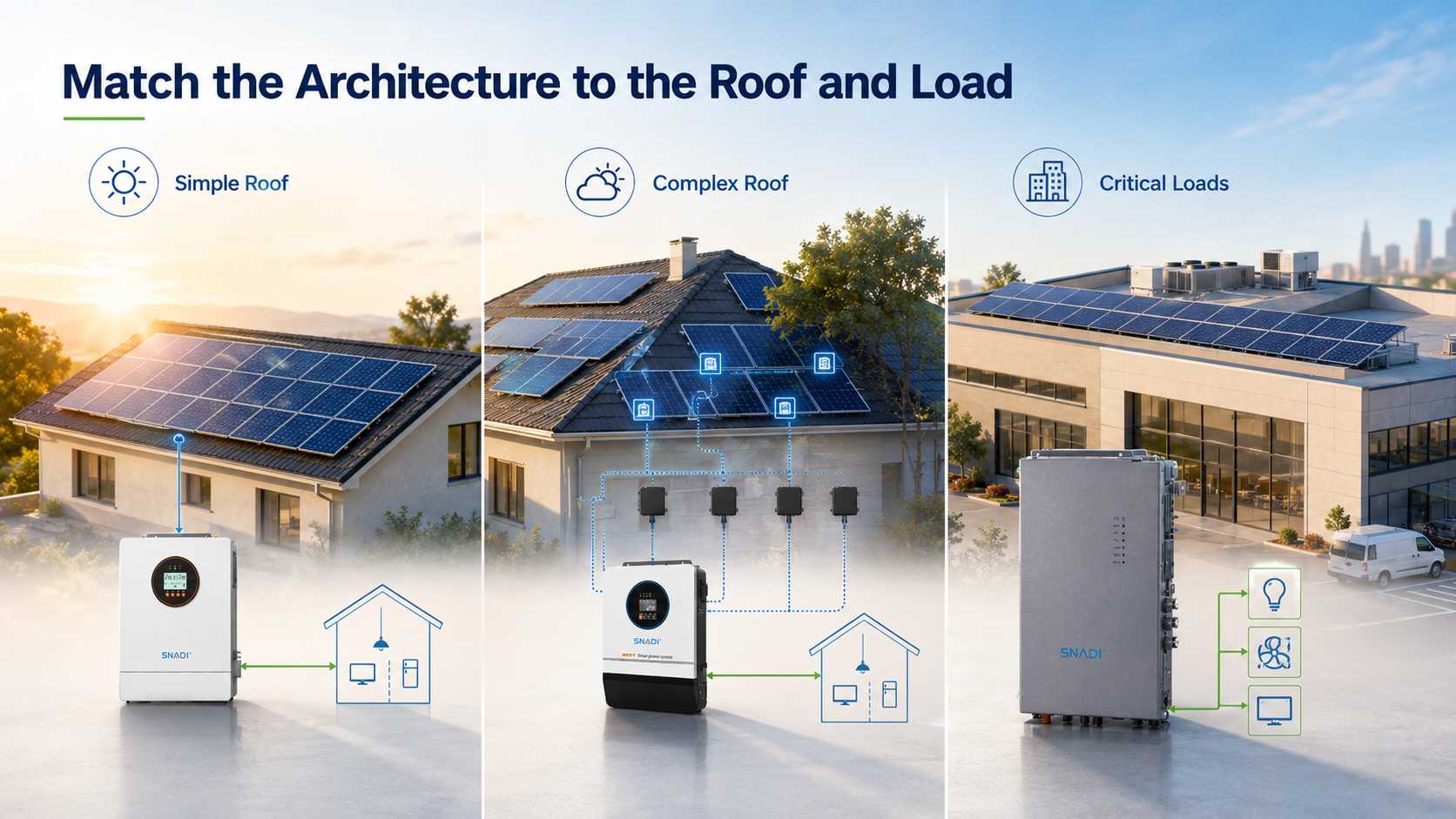
String inverter for a simple array
A string inverter combines the DC output from groups of modules in a central unit. It is often a practical cost path when roof planes share orientation, modules see similar sunlight and the service team can reach a wall mounted inverter without roof work. Central access can keep routine inspection and replacement straightforward. The limitation is shared string behaviour. Shade, soiling or mismatch at one module can influence the group. That does not make string equipment unsuitable. It means the roof needs to be honest about its exposure and layout.
Microinverter for module level control
A microinverter converts power at each module. This can make sense around chimneys, dormers, several roof directions or a plan for small additions over time. Module level visibility can also help an installer isolate a weak module more quickly.
The lifecycle cost deserves the same attention as the initial purchase. Electronics on the roof may require more access time during a replacement. Use this approach where module level control has a visible production or diagnostic benefit, not simply because the category sounds more sophisticated.
Power optimizer for a mixed condition array
Power optimizers retain a central inverter while adding equipment at module level. They can offer a middle path when part of the roof is affected by recurring shade and the buyer still wants a central service point. Confirm the permitted optimizer and inverter pairing, string limits and service responsibilities before ordering.
An optimizer cannot repair a poor layout. Moving a few modules away from a regular shadow may offer a better return than putting electronics on every module. The site survey should establish that before the bill of materials is fixed.
Hybrid inverter for defined backup loads
A hybrid inverter deserves early attention when a battery is planned or when selected loads must continue through an outage. The target is not necessarily whole building backup. In many projects, a critical load panel for refrigeration, communications, point of sale equipment, lighting and a small pump gives a more useful result than placing every circuit on storage.
Our ES IP54 on off grid solar inverter is available in 6.2KW and 12KW versions, with IP54 protection and on off grid operation. It can be considered where the site design calls for PV, battery, utility or generator input and selected household or office loads. Battery type, charging priority, cable size and backup panel design still need to be checked as part of the complete system.
Treat Off Grid Selection as a Reliability Review
An off grid inverter must establish usable AC power without the utility. It therefore has to work with battery current, motor starting demand, the daily solar charging window and any generator input. A grid connected product with a battery attached is not automatically a suitable substitute.
Our NKH off grid hybrid solar inverter range runs from 1.2KW to 12KW and includes integrated MPPT with pure sine wave output. For a workshop, farm or rural service point, we match the selection to a load list rather than an array headline number. Lighting, computers and refrigeration may run comfortably at one power level, while the starting demand of a pump or compressor may change the required inverter size.
1. List daily energy use in kWh and separate essential loads from optional loads
2. Record the highest simultaneous demand and the motor with the most difficult start
3. Set the needed backup hours or days from the actual operating risk
4. Confirm battery voltage, allowable charging current, BMS communication and the utility or generator fallback path
This review also needs cable sizing, overcurrent protection, grounding, ventilation and a clear commissioning plan. A configurable charging priority is useful only when those physical details are correct.
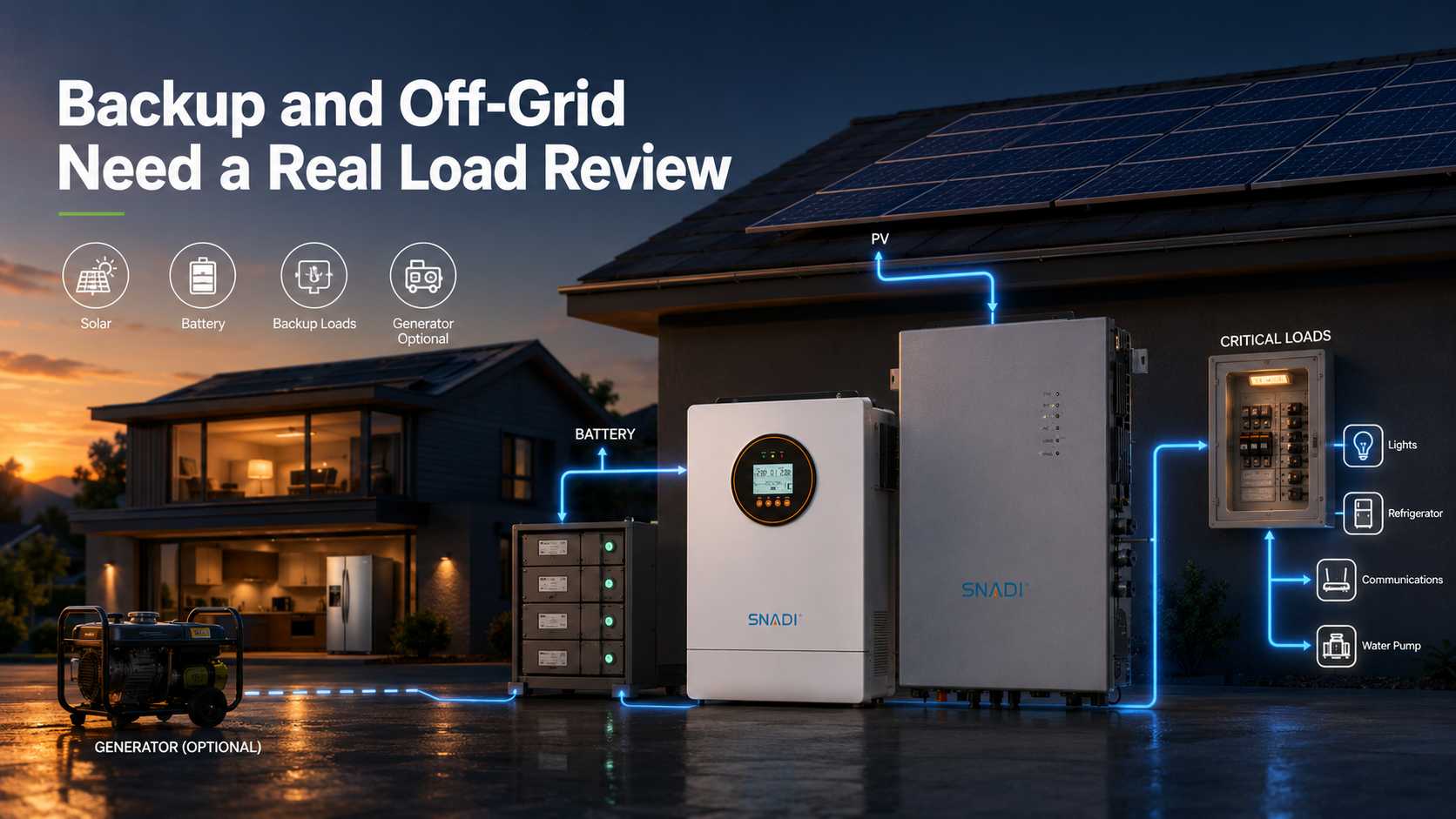
Generator support needs the same discipline. Confirm the generator rating, voltage behaviour and transfer arrangement under the load combinations that are likely to occur. A generator that runs lighting can still struggle when charging a battery while a motor starts. The goal is to define an operating sequence that the owner and service team can follow, rather than relying on an assumption that all available sources will work together without limits.
Smart inverter functions can include active or reactive power control, voltage response, frequency response and communications. Grid forming is more specific. Under suitable conditions, it can establish voltage and frequency for an islanded system. These capabilities matter as inverter connected generation grows, but they are not a default purchase requirement for every rooftop project.
IEA PVPS describes the potential for PV and PV hybrid systems to support frequency related services as grid requirements develop. For a household or small business, the practical questions are more direct: what does the utility require at the connection point, does the site need outage support, can the battery provide the intended power and energy, and who will configure the communication settings after handover.
We focus on the function that serves the operating case. A sound load and battery design should come before feature language. That keeps the scope understandable for the owner and workable for the installer.
Check the Commercial and Installation Boundary
A small commercial three phase design should not be evaluated like a household backup system. Check phase balance, motor loads, demand peaks, protection coordination and local interconnection terms. A pharmacy, shop or professional office should start with the cost of lost trading time or spoiled goods, then decide which circuits justify storage support.
For a remote location, begin with the load audit and local solar resource, then size inverter power and battery capacity together. For a home with stable grid service, a battery may remain optional. This distinction helps avoid a large battery that protects low value loads while leaving the actual business risk unresolved.
Monitoring should be assigned before commissioning ends. Decide who receives alerts, who has authority to change settings and how a fault is escalated when the owner cannot resolve it locally. A monitoring portal is useful when it supports a real response process. Without named responsibility, data can identify a problem without reducing the duration or cost of that problem.
Procurement Checks Before Signing
· PV array voltage, current and MPPT window at local temperature conditions
· Continuous output rating and motor starting demand
· Battery chemistry, voltage, BMS compatibility and usable capacity
· Critical load panel scope and realistic backup duration
· Enclosure position, dust, humidity, cooling clearance and cable routing
· Local grid approval, anti islanding settings and protection requirements
· Monitoring access, commissioning ownership, warranty terms and local service path
Safety is part of procurement, not an item to leave for the last visit. IEC 62109 3 covers safety requirements for electronic devices used with PV elements. Confirm applicable certification and local installation rules for the complete system, rather than comparing power ratings alone.
Conclusion
The right PV inverter type starts with the constraint that costs the buyer money. It may be shade, difficult roof geometry, a future battery, interrupted operations or a remote load that cannot wait for utility power. Simple arrays can favour a string architecture. Complex roofs can justify module level equipment. Storage and backup can justify a hybrid path, while remote systems need a genuine off grid load and battery review.
Bring us the roof layout, single line diagram, load profile, battery plan and installation environment. We can use those inputs to define an inverter architecture that fits the project, can be installed safely and remains practical to service.
✉️Email: marketing@snadi.com.cn
Website:
☎️WhatsApp / WeChat: +86 1803929353

FAQ
The main categories are string inverters, microinverters, power optimizer systems, hybrid inverters, off grid hybrid inverters and three phase commercial inverters. The right option depends on roof complexity, battery plans, backup loads and the available electrical service.
Is a string inverter or microinverter better?
Do I need a hybrid inverter for a future battery?
What inverter works best for an off grid site?
How should a small commercial buyer assess three phase inverter options?
What should be checked before an inverter is ordered?