

The practical answer to solar panels on ground vs roof is site dependent. A roof array can use existing space and keep equipment close to the point of use. A ground array can offer more control over placement, tilt and service access. Those advantages disappear when the roof needs early replacement, the ground drains poorly, the cable route is expensive or the production models use different boundaries.
We advise buyers to decide in three passes. Reject any location that cannot satisfy basic site conditions. Compare the remaining options with matching production inputs. Then price the complete work scope, future access and change risk. This produces a decision that an owner can audit and an installer can price.
Reject an Infeasible Location Before Comparing Cost
Pause a roof proposal when roof condition, remaining service life, structural capacity, waterproofing responsibility or usable area has not been confirmed. Pause a ground proposal when soil, drainage, setbacks, equipment access, cable route or land use approval remains uncertain. An attractive equipment price cannot resolve those omissions after contract signing.
A roof is often the practical starting point when it has adequate remaining life, a usable surface with manageable shade, documented structural suitability and a straightforward electrical route. A ground array deserves a complete review when roof shape or shade limits output and the property has stable, usable land close enough to the connection point.
Ground mounting does not guarantee more energy. Roof mounting does not guarantee lower lifetime cost. The first preferred option is simply the location that passes feasibility checks with fewer unresolved responsibilities and fewer assumptions likely to become change orders.
Build One Evidence Pack for Both Designs
Ask the installer to use one evidence pack for both options. It should include twelve months of electricity bills, the target solar capacity, roof age and material, available roof drawings, photographs of every candidate roof plane, shade observations, ground area dimensions, slope and drainage notes, the proposed cable route, equipment locations, access requirements and any future expansion plan.
Set the comparison boundary before a model is run. A roof quote sized to available roof area is not directly comparable with a ground quote sized to annual consumption. Decide whether the proposals will share the same DC capacity, annual energy target or project budget. Make that boundary visible in both quotes.
An aerial image is useful for preliminary dimensions but it is not a complete solar site assessment. It cannot confirm roof condition, framing, soil, buried services, drainage or the installed cable path. These items need site evidence and qualified review.
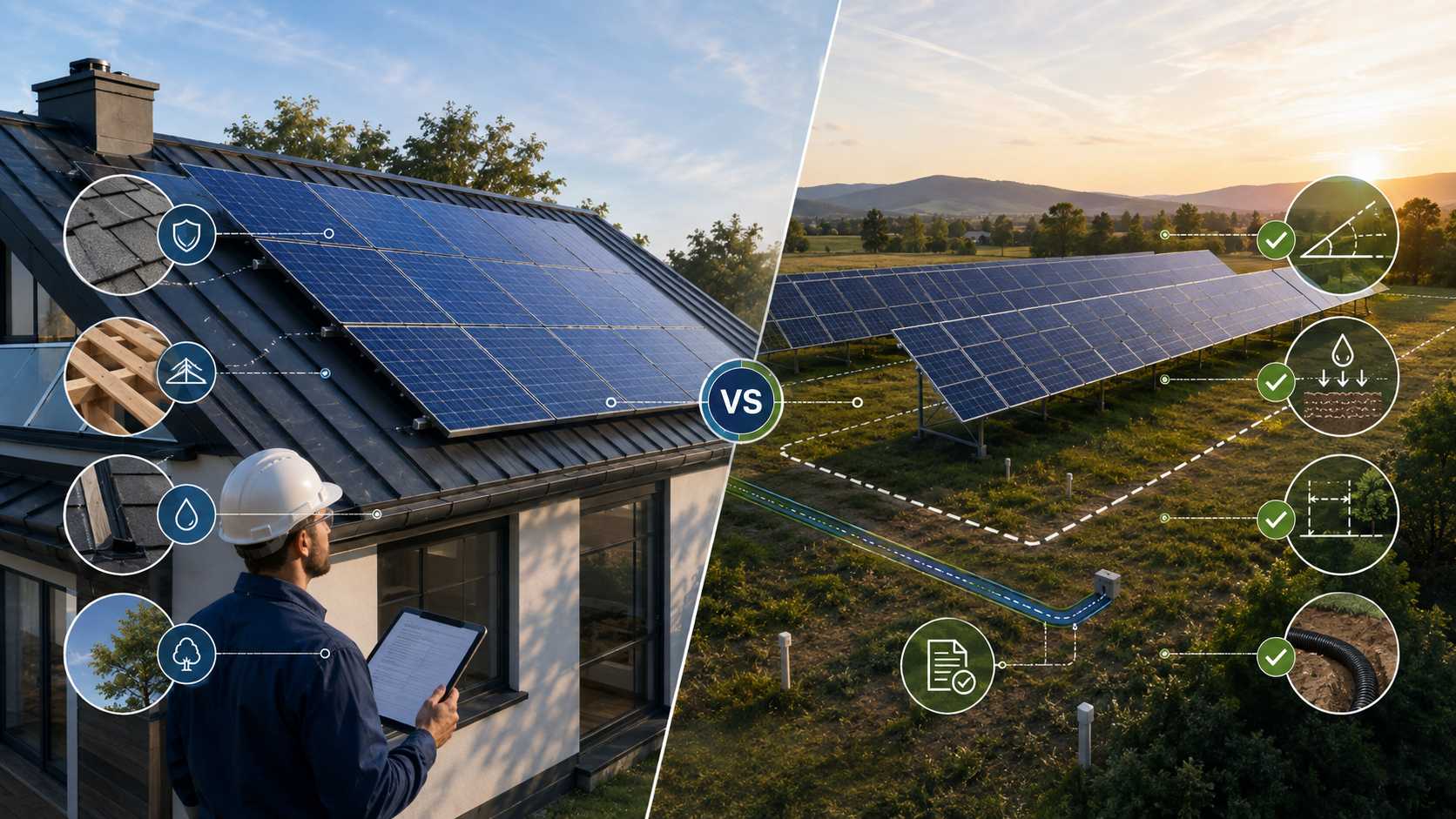
Pass Four Site Feasibility Gates
Roof Condition Structure and Waterproofing
Start with the roof timeline. Ask when the covering is expected to need replacement and whether the solar service period could extend beyond it. When replacement may be needed soon, compare coordinated roof work now with the future cost and disruption of module removal and reinstallation. The answer depends on actual condition and written contractor scope, not a generic roof age rule.
Request confirmation that the roof and attachment design can carry the applicable dead, wind and weather loads. The United States Department of Energy explains that photovoltaic arrays need stable and durable mounting structures for long exposure to wind, rain, hail and corrosion. The proposal should also name the party responsible for flashing details, leak response and roof warranty coordination.
Usable Area Orientation and Shade
Usable roof area is smaller than total roof area. Edges, access paths, vents, skylights, chimneys, fire clearances and separate roof planes can break the layout into sections. Shade also should be reported by roof plane and relevant time period. Trees, parapets, nearby buildings and roof objects can affect modules differently through the day.
A roof angle that differs from a textbook ideal can still be workable. The useful comparison is modeled annual and seasonal energy, load timing and installed cost. Orientation alone should not reject a roof that produces valuable energy at the time the site uses it.
Ground Conditions Drainage and Land Use
An open yard is not automatically buildable solar space. The installer should document slope, soil or foundation assumptions, surface water flow, flood exposure, vegetation control, equipment clearance and maintenance access. Construction equipment must reach the location without creating unpriced damage elsewhere on the property.
Ground access can simplify inspection and cleaning, but it creates different operating work. Vegetation, drainage, fencing and damage protection may become owner responsibilities. Put those tasks in the maintenance plan before assigning financial value to easier access.
Future land use also matters. A ground array can reserve a substantial area for years. Confirm whether the layout conflicts with vehicles, landscaping, agriculture, future buildings, boundary setbacks or planned expansion.
Cable Route Approvals and Future Change
Measure the installed route from the array to the inverter, electrical panel or other connection point. A straight map distance can omit bends, elevation, protected crossings and equipment placement. The electrical design needs conductor sizing, voltage drop, protection, trench method and local requirements.
Trenching cost is project work, not a universal price per metre. Rock, buried utilities, pavement, drainage crossings and surface restoration can change the scope. Ask the proposal to state the assumed route and define what happens when site conditions differ.
For either mounting type, the proposal should identify planning, building, fire, electrical and interconnection responsibilities. IEC 62548 Part 1 covers array design topics including DC wiring, protection, switching, earthing, mounting and cable requirements. Local rules and qualified engineering still determine the final design for the actual site.
Normalize the Roof and Ground Production Model
Once both locations pass, run matching production cases. SNADI/SNAT Solar provides separate fixed roof mounted and fixed open rack inputs and accepts system capacity, module type, losses, tilt and azimuth. It is useful for comparison only when each changed input is supported by site evidence.
Keep location, DC capacity, module class, DC to AC ratio, inverter efficiency and financial assumptions the same. Change tilt, azimuth, shade, soiling, cable loss or array type only when the designs genuinely differ. Save the model inputs with the results so another reviewer can reproduce the comparison.
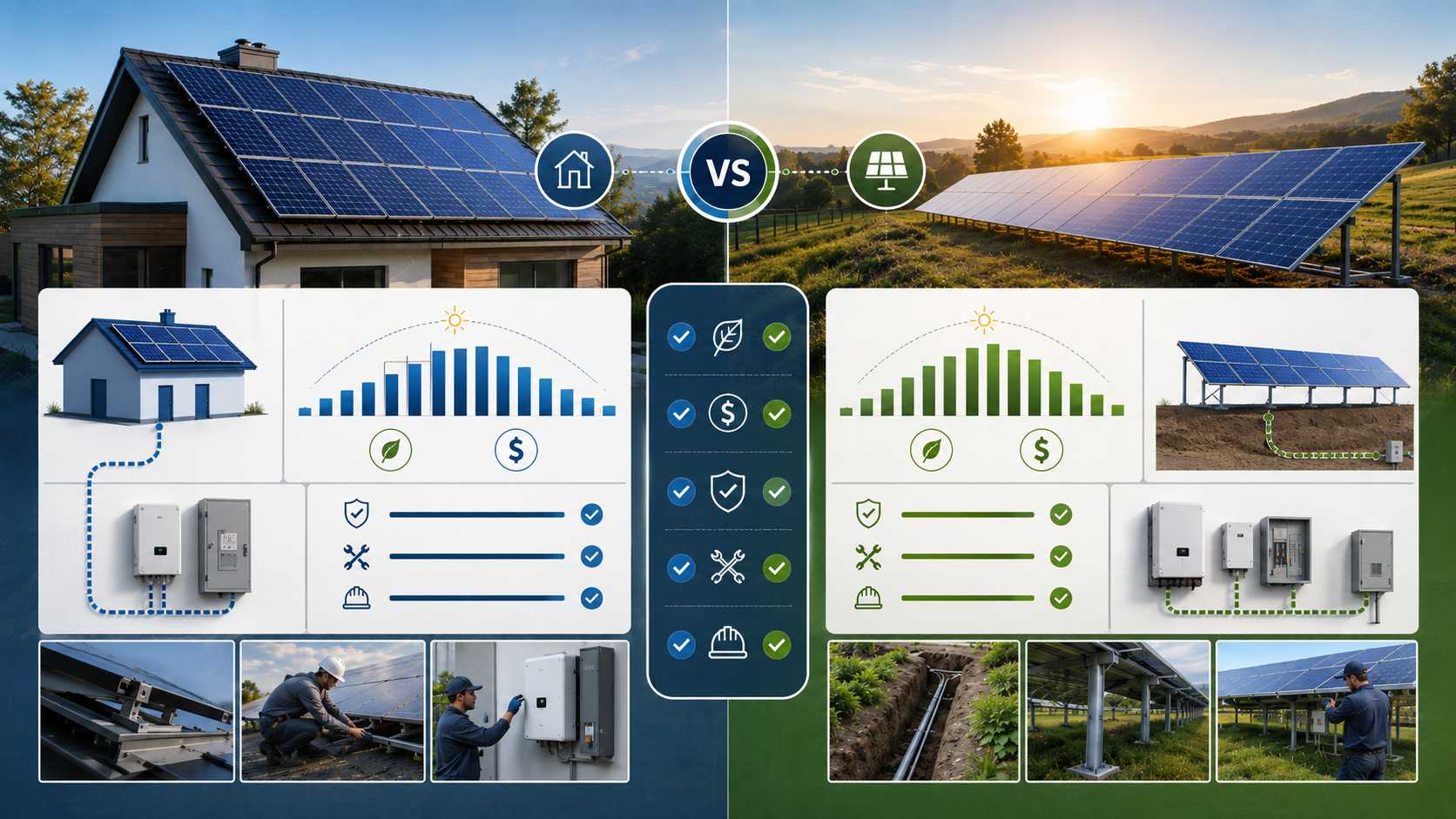
Model input | Roof case | Ground case | Evidence required |
DC capacity | Same comparison capacity | Same comparison capacity | Module count and wattage |
Array type | Fixed roof mounted | Fixed open rack | Mounting layout |
Tilt and azimuth | Measured roof planes | Proposed rack geometry | Site drawing |
Shade and soiling | Roof survey assumptions | Ground survey assumptions | Shade report and maintenance plan |
Electrical loss | Designed cable route | Designed cable route | One line diagram and cable schedule |
Annual energy | Output with uncertainty | Output with uncertainty | Exported inputs and report |
If the ground case reports more energy, ask which input creates the difference. Better orientation may help, while a longer route, row spacing, shade or additional installation work can reduce its value. If the roof case is lower, test whether a different roof plane or a smaller unshaded array produces a better financial result than adding complexity.
Decision note: Compare energy that serves the real load, not only annual kilowatt hours. A west facing roof may produce later in the day, while an open rack may be aimed at annual yield. When timing affects the business case, request monthly or hourly output instead of relying on one annual total.
Price Complete Work and Future Service
Ground mount vs roof mount solar cost cannot be judged from module and inverter prices alone. Roof work may include structural review, attachments, flashing, access controls and possible future module removal. Ground work may include survey, foundation design, posts or piles, earthwork, trenching, conductors, fencing and restoration.
Use the quote to expose uncertain work. A provisional allowance can be reasonable when it states the assumed quantity, unit basis and change process. A vague allowance only moves cost risk from the proposal into construction.
Work package | Roof risk | Ground risk | Evidence before contract |
Structure | Unknown framing or attachment detail | Unknown soil or foundation condition | Signed design basis |
Weather control | Flashing and roof warranty boundary | Drainage and erosion control | Responsibility statement |
Electrical route | Roof penetration and equipment access | Trench length and restoration | Route drawing |
Service access | Height and roof safety | Vegetation fencing and vehicle access | Maintenance plan |
Future change | Roof replacement and module removal | Land use change or array expansion | Written change scope |
A roof system can preserve yard space and shorten wiring but may be harder to service. A ground system can support a clean layout and easier access but may need more civil work and land care. The better proposal makes those operating and future change costs visible instead of claiming that one mounting method is universally cheaper.
Match Module Choice After Site Feasibility
The mounting location should be supported before module selection is used to sell the project. Once usable area and target capacity are known, we can match module dimensions, wattage, voltage and current with the layout, inverter design and handling plan.
Our High Efficiency N Type Monocrystalline Solar Panel range lists 200W, 300W, 430W and 590W options. The published options have different dimensions, weights and electrical values. Replacing one wattage with another therefore requires a fresh check of layout, handling, string voltage, current limits and mounting approval.
For a constrained roof, module dimensions and power density can help use limited clear area. For an open rack, module size affects rack geometry, row layout, wind design and service access. We use selected module data with inverter limits and site temperature assumptions. High module wattage alone does not prove that either location is feasible.
Conclusion
The decision about solar panels on ground vs roof becomes manageable when it is treated as a site and contract review. Reject locations with unresolved roof, land, drainage, cable or approval risks. Model the remaining options with matching assumptions. Then compare the complete installation, operating work and future change scope. We can then review the verified site information and module requirements for a residential or small commercial system. That sequence gives the buyer a defensible mounting decision and gives the installer a clearer project to price.
✉️Email: marketing@snadi.com.cn
Website:
☎️WhatsApp / WeChat: +86 1803929353

FAQ
They are better at the location that passes structure, shade, access, cable and approval checks with the stronger financial case. Roof solar often uses existing space. Ground solar often gives more placement freedom. Neither advantage decides the project alone.
Will a ground array always produce more electricity?
Can solar panels be installed on an older roof?
How can roof and ground quotes be compared fairly?
Can one project use both roof and ground arrays?
Which option is easier to maintain?