

Choosing a three phase hybrid inverter vs single phase is no longer just an electrical wiring decision. In 2026, the bigger question is how your inverter, LiFePO4 battery, backup load, smart meter, diesel generator, and future expansion plan work as one energy storage system. The wrong choice can create nuisance shutdowns, poor backup performance, wasted battery spending, and phase imbalance issues. The right choice gives you stable off grid backup, cleaner solar usage, and a system that still makes sense when your load grows.
Why Phase Selection Matters More in 2026
Solar PV is now a mainstream energy asset rather than a niche product. IEA PVPS reported in October 2025 that new PV capacity reached 601 GW in 2024, bringing global cumulative PV capacity to more than 2.2 TW at the beginning of 2025. The same report said PV should supply at least 10% of world electricity consumption in 2025.
At the same time, storage is becoming the real purchasing trigger. The IEA reported on February 13, 2026 that global lithium ion battery deployment in 2025 was six times the 2020 level, and that battery energy storage represented more than 15% of total lithium ion battery deployment. It also noted that LFP accounted for more than 90% of global battery energy storage systems.
That means buyers are no longer asking only, What solar inverter should I buy? They are asking, Which hybrid inverter architecture protects my battery investment and runs my loads during outages?
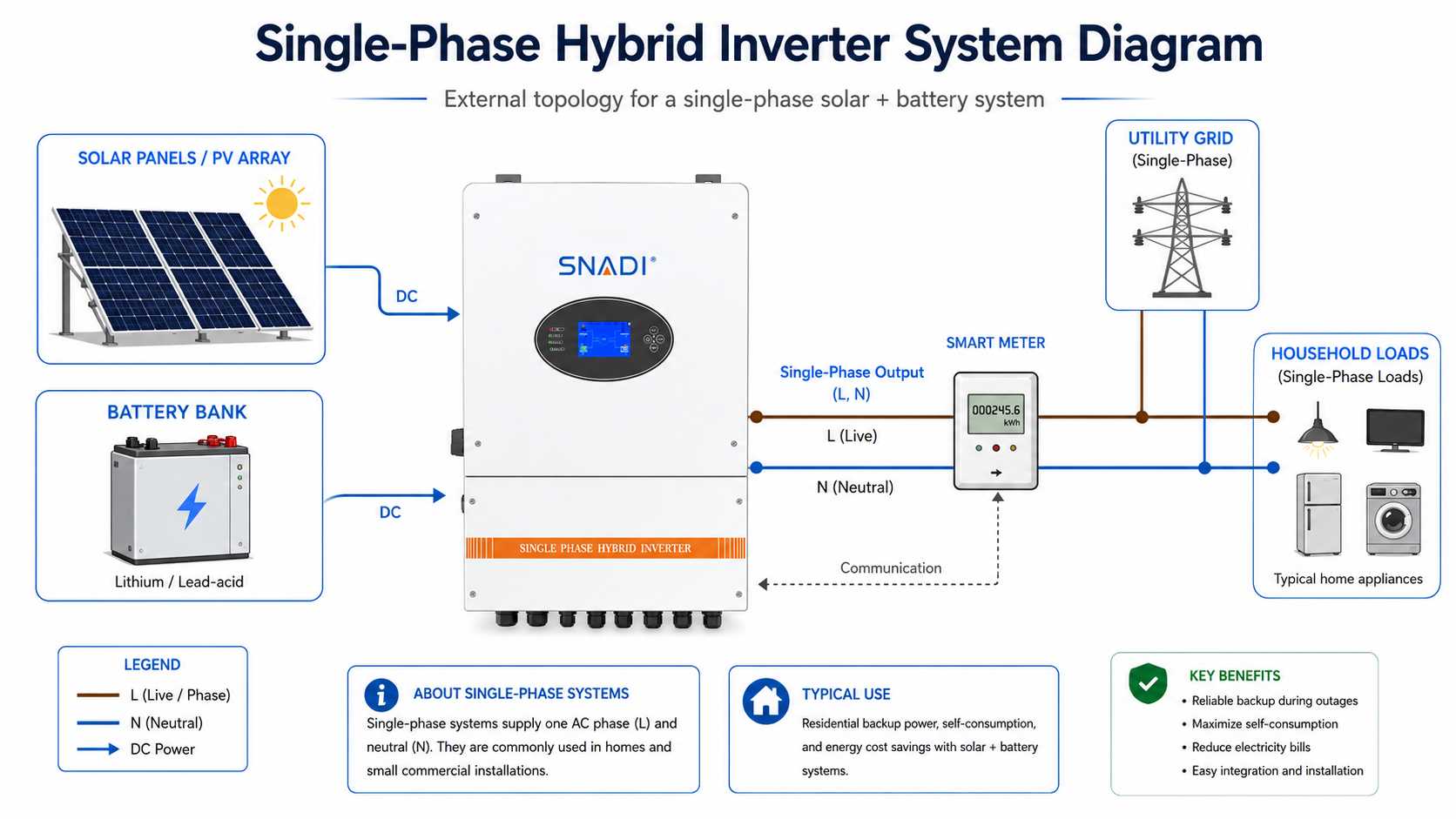
What Is a Single Phase Hybrid Inverter
A single phase hybrid inverter supplies power through one live conductor and one neutral conductor. In many residential markets, this is the normal electrical service for homes with lighting, refrigerators, air conditioners, pumps, sockets, routers, and small appliances. In energy storage systems, single phase models are often paired with 48 V class battery banks. This matters because 48 V LiFePO4 batteries are widely available, modular, easier to ship, and simple for residential installers to understand. For a normal villa, guest house, small shop, or rural home, this is usually the simpler route.
What Is a Three Phase Hybrid Inverter
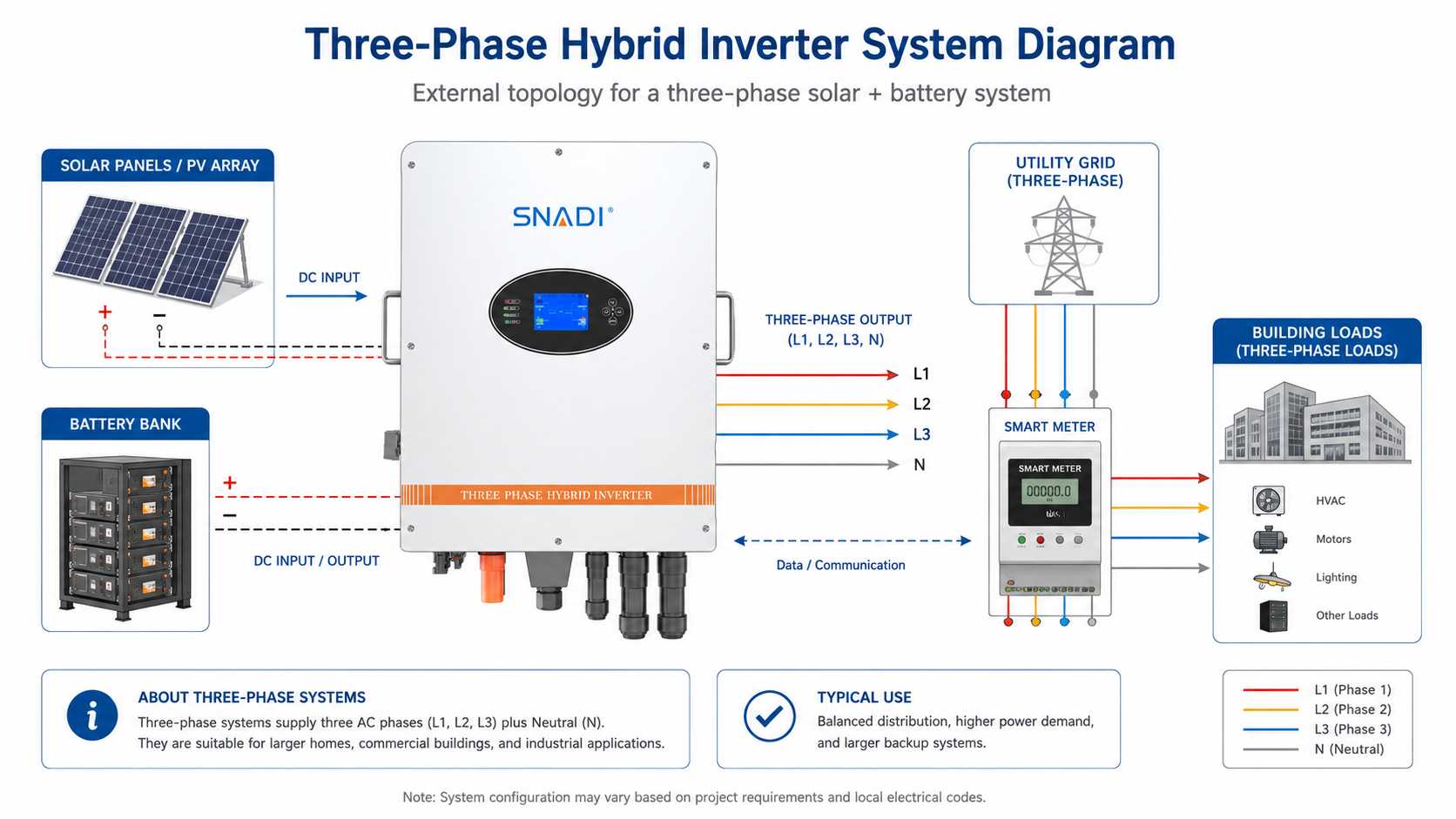
A three phase hybrid inverter supplies power across three live conductors, usually with neutral and protective earth in modern systems. It is used where loads are larger, more continuous, or more motor intensive. Think of water pumps, compressors, elevators, workshop machines, cold room equipment, commercial air conditioning, industrial fans, and EV charging clusters. Three phase power distributes load more evenly and handles larger machines more naturally than a single phase system.
Core Comparison: Single Phase vs Three Phase Hybrid Systems
Selection Factor | Single Phase Hybrid Inverter | Three Phase Hybrid Inverter |
|---|---|---|
Best Fit | Homes, villas, small shops, small farms, telecom rooms | Large villas, workshops, factories, farms, hotels, cold rooms |
Typical Power Range | 3 kW to 12 kW | 6 kW to 60 kW, or larger C&I systems |
Grid Type | Single phase supply | Three phase supply |
Output Structure | One live wire plus one neutral wire | Three live wires, usually with neutral and earth |
Battery Voltage | Usually 48 V low voltage LiFePO4 battery | Smaller models may use 48 V, larger systems often use high voltage battery packs |
Battery Cost | Usually lower and easier to expand step by step | Usually higher, especially for high voltage battery systems |
Load Type | Lighting, refrigerator, sockets, router, small pump, small air conditioner | Motors, compressors, pumps, elevators, central air conditioning, machines |
Backup Use | Critical load backup for homes and small businesses | Whole property or heavy equipment backup when correctly sized |
Installation Complexity | Lower | Higher |
Main Technical Risk | Undersizing surge load | Ignoring phase imbalance and unbalanced output capability |
Recommended SNADI/SNAT Solar Product | ||
Typical Buyer | Homeowner, small shop owner, small farm operator | Installer, EPC, factory owner, hotel owner, agricultural project buyer |
100% Unbalanced Output and Why It Matters
This is the professional buying point.
A three phase site rarely uses equal power on all three phases. One floor may run air conditioning, another may only run lights. A workshop may start one compressor on phase A while refrigeration equipment is on phase B. A farm may run pumps at uneven intervals. A weak three phase hybrid inverter may trip, derate, or fail to support backup mode if the phase loads are not balanced. A better unit can output different power on each phase within its design limit.
For B2B buyers, this is deciding whether the system will survive real operating conditions.
Backup Power and Off Grid Performance
A hybrid inverter is valuable because it manages PV, battery, load, and backup source. In remote regions, it may also coordinate with a diesel generator. The World Bank Tracking SDG 7 report, published June 20, 2025, said 666 million people still lacked electricity in 2023, and that most unconnected populations are in remote areas, low income regions, or places where extending the grid is difficult. The same page states that decentralized renewable energy, including solar home systems and mini grids, offers flexible solutions for these areas.
That is why hybrid inverters are relevant beyond urban net metering. They are also used in remote schools, mining camps, agriculture, island resorts, telecom stations, and clinics.
How to Calculate Inverter, Battery, and PV Capacity
Use this checklist before asking for a quotation.
Calculation Step | What to Check | Practical Engineering Note |
|---|---|---|
Daily Energy Use | Add each appliance wattage multiplied by daily working hours | This gives daily energy demand in kWh |
Peak Running Load | Add all loads that may run at the same time | This determines inverter continuous power |
Surge Load | Check pumps, compressors, motors, and air conditioners | Motor starting power can be 2 to 5 times higher than running power |
Inverter Margin | Add at least 25% margin above realistic peak load | Use more margin for hot areas, motor loads, and weak ventilation |
Battery Capacity | Daily kWh demand multiplied by backup days | Do not design LiFePO4 batteries around full discharge every day |
Battery Voltage | Confirm whether the inverter uses 48 V or high voltage battery | Battery voltage is a major cost and compatibility factor |
PV Array Size | Daily kWh demand divided by peak sun hours and system efficiency | Increase PV size for rainy season, dust, heat, and shading |
Phase Type | Check site supply and equipment nameplates | Do not choose phase type by total kW alone |
Generator Input | Confirm generator voltage, frequency, and phase type | Generator and inverter must match correctly |
Expansion Plan | Estimate load growth over the next 3 years | Choose parallel capable equipment when future growth is likely |
Why does inverter margin matter? Because inverters are power electronics, not magic boxes. High ambient temperature, poor ventilation, long DC cable runs, low battery state of charge, and repeated motor starts reduce the safe operating window.
SNADI 125 kW integrated system with a working temperature range from minus 25°C to 60°C and derating above 45°C. That is a useful reminder for desert, mining, and containerized projects.
When to Choose Single Phase
Choose a single phase hybrid inverter when your property is a regular home, small villa, small shop, or farm office with mostly single phase appliances. A good rule is to start here when the critical load is roughly 3 kW to 10 kW, the battery target is 5 kWh to 30 kWh, and the customer wants simple LiFePO4 integration.
For solar inverter buyers, the BLD Single Phase Hybrid Inverter is the natural equipment for this segment. It gives 8 kW, 10 kW, and 12 kW options, a 40 to 60 V battery voltage window, and remote monitoring choices. For North American split phase projects, do not substitute a standard single phase or three phase model without checking the service type. We provide AS Split phase On/Off Grid Solar Inverter for 120/240 V dual voltage systems, with some versions allowing 1 to 6 units in parallel.
When to Choose Three Phase
Choose a three phase hybrid inverter when the site has heavy machines, pumps, compressors, multiple air conditioners, large cold storage, a workshop panel, or commercial operating hours. A load above 10 kW does not automatically require three phase, but it is a strong signal. The deciding factor is the equipment nameplate. If critical machines are three phase, the backup inverter architecture should be three phase.
BLS is a strong equipment for high end residential and light commercial projects because it covers 6 kW to 20 kW and supports 100% unbalanced loads. For factories, hotels, farms, EV charging sites, and community energy projects, SNADI 125 kW 241 kWh integrated solar storage hybrid power system is a more appropriate CTA. It includes 125 kW output, 241 kWh storage, 228 pieces of 590 W panels in the listed configuration, EMS control, remote monitoring, and optional diesel generator support.
Can I Use a 3 Phase Hybrid Inverter on a Single Phase Supply
Usually, no.
A three phase hybrid inverter is designed to see and produce a three phase electrical environment. A single phase supply does not provide the same phase structure, phase rotation, voltage relationship, or protection behavior.
Some advanced systems can be specially configured for split phase, parallel, or phase conversion applications, but that is not the same as simply connecting a three phase inverter to a single phase supply. Victron Energy’s parallel, split phase, and three phase system manual, updated March 4, 2026, states that multi unit systems require careful design, matching units, same firmware families, and correct phase configuration.
For buyers, the safe answer is this: match the inverter phase to the site service and load panel. For North America, confirm whether the site is single phase, split phase, or true three phase. For Europe, Africa, the Middle East, and Asia, confirm the voltage, frequency, neutral system, and local protection rules.
Inquiry Checklist Before You Contact SNADI/SNAT Solar
Country and site voltage
Frequency, such as 50 Hz or 60 Hz
Single phase, split phase, or three phase service
Daily kWh consumption
Maximum simultaneous load
Motor list with start method
Required backup hours
Battery preference, such as 48 V or high voltage LiFePO4
PV roof or ground space
Peak sun hours and rainy season pattern
Generator size if already installed
Smart meter or CT installation position
Indoor or outdoor installation
Maximum ambient temperature
Need for remote monitoring by phone or computer
Expansion plan for the next 3 years
Local certification and import requirements
Whether export or net metering approval is required
Conclusion
The best hybrid inverter is not chosen by phase count alone. It is chosen by load type, battery voltage, backup expectation, site voltage, temperature, future expansion, and installer capability. The real buying question is not only single phase or three phase. It is whether the inverter, battery, PV array, smart meter, backup output, and installer design can support your real loads on the worst day of the year.
✉️Email: exportdept@snadi.com.cn
Website:

FAQ
You generally cannot connect a three phase inverter directly to a single phase supply. A three phase system expects a specific phase structure, voltage relationship, and phase rotation that a single phase grid does not provide. Doing so could result in immediate system errors or a failure to sync with the grid. Always match your inverter architecture to your site service unless using highly specialized phase conversion equipment.
Q: Why is the ability to handle completely unbalanced loads important for commercial solar setups?
Q: Should I upgrade to a high voltage battery system if I choose a three phase inverter?
Q: How do I know if my current electrical loads require a three phase system architecture?