

For small and medium sized businesses in Latin America, electricity is no longer just an operating expense. It is a production risk, a cash flow variable, and in many facilities, a hidden limit on growth. A factory that loses power during a production shift does not only lose kilowatt hours. It loses labor time, product quality, delivery reliability, and sometimes expensive raw materials. A cold-chain warehouse that cannot control demand peaks may pay more for grid capacity than for actual energy consumption. A shopping center, workshop, hotel, clinic, or agro processing facility may have a perfectly good solar roof, but still fail to reduce the most expensive part of its electricity bill.
This is why commercial hybrid solar system design has become a strategic topic for Latin American C&I facilities. A well-designed system does more than combine solar panels, batteries, and inverters. It coordinates PV generation, battery energy storage, grid import, backup power, and energy management software around one business objective: lower risk and better energy economics. Latin America’s clean energy investment is already accelerating. The IEA reported that clean energy investment in Latin America and the Caribbean has grown by nearly 25% since 2015 and reached about USD 70 billion in 2025, while also noting that grid and storage investment needs to grow faster to support the region’s energy transition.
For C&I owners, EPCs, and solar installers, the opportunity is clear: the next winning projects will not be residential-style solar systems scaled up. They will be engineered commercial hybrid systems designed around load curves, demand charges, battery dispatch logic, and ROI. Looking for a tailored C&I solution? Explore our small to medium commercial energy storage systems for factories, warehouses, hotels, farms, and commercial buildings.
Why Mid-Sized Businesses in Latin America Need Hybrid Solar Systems
A grid-tied solar system can reduce daytime energy consumption, but it has one major weakness: when the grid fails, most grid-tied inverters shut down for safety. For a commercial facility, that means solar panels may be producing power on the roof while the production line, refrigeration unit, or critical office equipment still goes offline. A fully off-grid system solves the independence problem, but it often creates another one: oversizing. To operate without the grid, a business needs enough PV, battery capacity, inverter capacity, and backup margin for worst case conditions. That can make the system unnecessarily expensive for many small and medium sized C&I facilities.
A commercial hybrid solar system sits between these two extremes. It uses solar power when available, stores excess energy in a battery energy storage system, imports from the grid when economical, and discharges the battery when the grid is expensive, unstable, or unavailable.
For Latin American businesses, the value usually comes from four areas.
First, hybrid solar improves business continuity. Instead of treating batteries as a luxury add on, the system reserves enough energy for critical loads such as refrigeration, lighting, servers, security, pumps, point of sale equipment, or selected production lines. Second, it increases solar self-consumption. In many facilities, PV production peaks around midday, while the load peak may happen later in the afternoon or evening. Batteries shift excess solar generation to higher value hours. Third, it supports peak shaving. Many commercial and industrial tariffs include demand based charges linked to maximum power draw, not just total kWh consumption. Mexico’s CFE GDMTH tariff, for example, applies to medium voltage users with demand equal to or above 100 kW. For these customers, reducing a short demand spike can materially improve the monthly bill. Fourth, it gives EPCs and project developers a stronger sales argument. A simple grid-tied PV proposal often sells “energy savings.” A hybrid solar plus storage proposal can sell energy savings, demand charge control, operational resilience, and a more defensible ROI model.
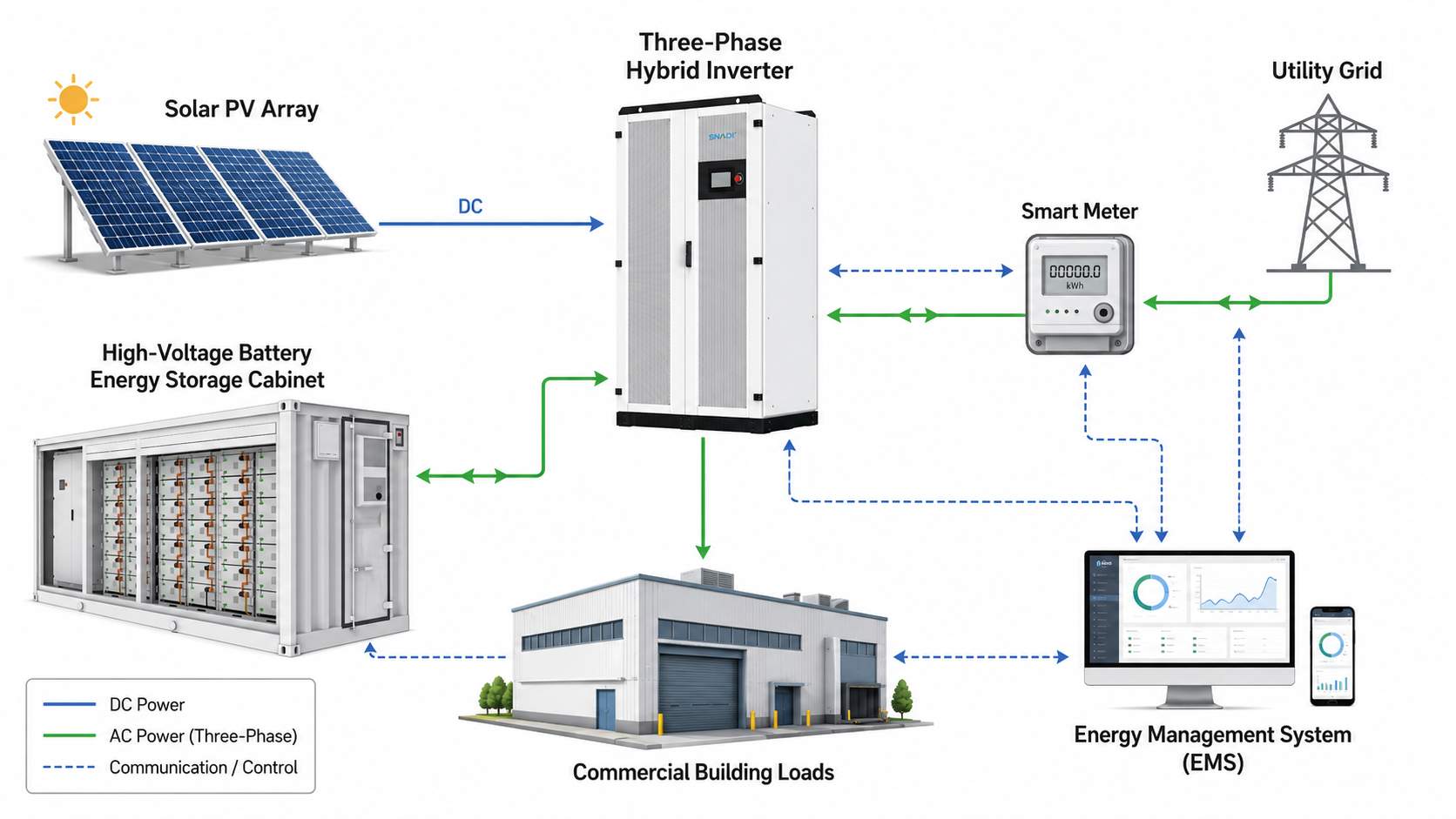
Core Architecture: Designing for C&I, Not Residential
The most common mistake in commercial hybrid solar system design is starting with residential assumptions. A home system may use single phase power, low voltage batteries, a small inverter, and simple backup logic. A C&I facility is different. Commercial buildings and light industrial sites often require three phase power, higher surge capacity, larger battery racks, stronger thermal management, more complex protection devices, and a smarter energy management system. The system must handle variable load curves, unbalanced phases, motor starting currents, and local grid requirements.
DC Coupled vs. AC Coupled in Commercial Setups
In a DC coupled hybrid system, solar PV connects to the DC side of the hybrid inverter or battery system. Solar energy can charge the battery directly before being converted to AC. This can improve efficiency in new installations because fewer conversion stages are required when PV energy is stored.
In an AC coupled system, PV inverters and battery inverters are connected on the AC side. This architecture is often useful when adding storage to an existing solar installation. It can also simplify modular expansion, especially when the existing PV system is still in good condition.
For new small to medium C&I projects, DC coupled designs are often preferred when the business wants high self-consumption, integrated backup, and streamlined control. For retrofit projects, AC coupling may be more practical because the EPC can preserve existing PV assets. SNADI/SNAT Solar Engineer’s Tip: Do not choose coupling architecture only by theoretical efficiency. Choose it based on site conditions: existing PV equipment, interconnection limits, backup requirements, roof expansion potential, battery dispatch strategy, and the local utility approval process.
The Role of Three Phase Hybrid Inverters
A commercial hybrid inverter is not just a bigger home inverter. In C&I applications, the inverter must synchronize with three phase loads, manage phase balance, respond quickly to demand spikes, and communicate with the battery management system and EMS. For facilities with motors, compressors, elevators, pumps, HVAC systems, or refrigeration equipment, inverter overload capacity and response time matter. A poorly selected inverter can look acceptable on a datasheet but fail to support actual operating conditions.
For this reason, inverter sizing should include:
Rated continuous power
Peak overload capacity
Three phase output quality
Response time during grid failure
Compatibility with high voltage battery racks
EMS communication protocol
Zero export or export limiting capability
Local certification and grid code compliance
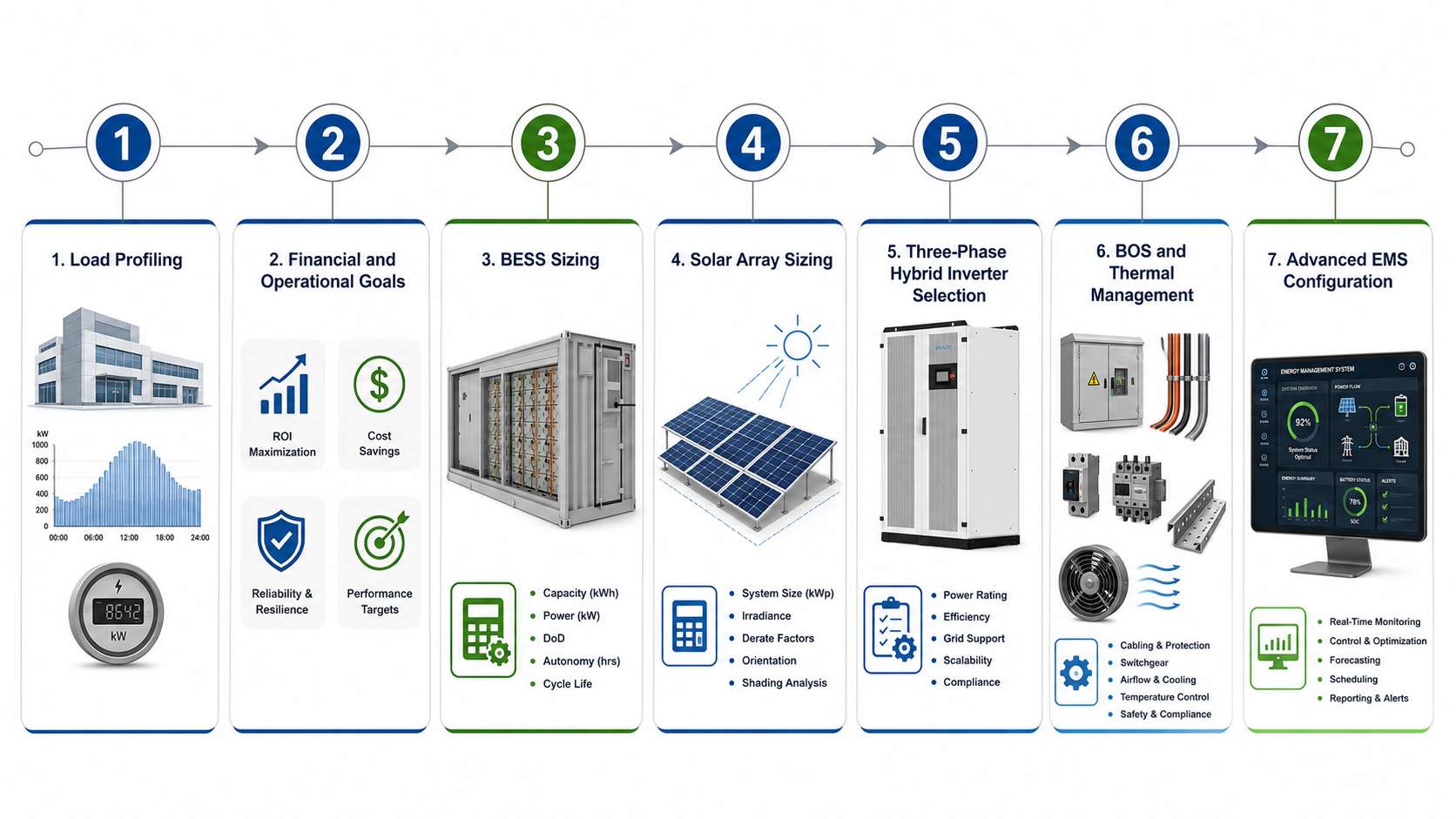
The 7-Step Commercial Hybrid Solar System Design Process
A profitable C&I hybrid system starts with data, not equipment. The following seven steps process helps EPCs and business owners move from a generic solar proposal to an engineered commercial hybrid solution.
Step 1: Load Profiling and Interval Data Analysis
The first step is to understand how the facility consumes power. Monthly electricity bills are useful, but they are not enough. A C&I hybrid system should be designed using interval data, ideally 15 minutes or hourly load data.
This reveals:
The true peak demand
The time of day when peaks occur
Base load versus variable load
Weekend and weekday differences
Seasonal operating patterns
Motor starting or compressor starting spikes
Critical loads that require backup
For example, a cold chain warehouse may have a high base load from refrigeration, plus short spikes when compressors cycle. A textile workshop may show sharp production peaks during shift changes. A hotel may have evening peaks from HVAC, lighting, kitchen equipment, and guest activity. Without interval data, battery sizing becomes guesswork.
Step 2: Define Financial and Operational Goals
Not every hybrid solar project has the same objective. Some businesses want backup power. Others want peak shaving. Some want maximum solar self-consumption. Others want to reduce exposure to time of use tariffs.
Before selecting equipment, define the hierarchy of goals:
Reduce grid energy consumption
Reduce peak demand charges
Provide backup for critical loads
Shift solar energy to expensive tariff periods
Limit grid export where required
Improve power reliability for sensitive equipment
Shorten payback period
A system optimized for backup may reserve more battery capacity and discharge less aggressively during normal operation. A system optimized for peak shaving may cycle the battery daily to control demand peaks. A system optimized for TOU arbitrage may charge and discharge based on tariff windows. The design cannot maximize everything at once. The EMS strategy must reflect the business priority.
Step 3: Battery Energy Storage System Sizing
Commercial BESS sizing should be based on power, energy, discharge duration, and cycle strategy.
Power rating, measured in kW, determines how much load the battery can support at one time. Energy capacity, measured in kWh, determines how long the battery can support that load. A 125 kW / 241 kWh battery cabinet, for example, can deliver 125 kW for roughly two hours under ideal conditions before considering depth of discharge, efficiency, reserve settings, and thermal derating. For C&I projects, high voltage batteries are usually more appropriate than low voltage residential battery banks. High voltage battery racks can reduce current, lower cable losses, improve system efficiency, and support higher power applications.
The key sizing questions are:
What peak demand must be shaved?
How many hours of backup are required?
Which loads are critical and which can be disconnected?
How many cycles per day are expected?
What minimum state of charge must be reserved?
What ambient temperature will the battery experience?
Is future expansion required?
SNADI/SNAT Solar Engineer’s Tip: Do not size the battery only for “hours of backup.” In C&I projects, a smaller battery with a strong EMS strategy may deliver better ROI than an oversized battery that sits idle most of the year.
Step 4: Solar Array Sizing for Commercial Roofs
Commercial roofs create opportunities and constraints. A large roof does not automatically mean a large PV system is feasible. The EPC must evaluate roof structure, usable area, shading, orientation, drainage, fire access, mounting restrictions, and local wind conditions. PV sizing should match the load profile and battery strategy. Oversizing the PV array can improve winter or cloudy day generation, but it may also increase curtailment if export is limited. Undersizing the array may reduce upfront cost but weaken battery economics.
For commercial hybrid systems, the solar array should be sized to:
Cover a meaningful share of daytime load
Charge the battery during solar production hours
Avoid excessive export where compensation is limited
Support future load growth
Fit safely within roof and electrical constraints
In Brazil, distributed generation rules are governed by Law No. 14.300 and ANEEL regulations. ANEEL states that microgeneration is up to 75 kW, while minigeneration is above 75 kW and generally up to 3 MW, with specific cases allowing up to 5 MW under the law. For C&I projects, this makes accurate capacity planning and compensation modeling especially important.
Step 5: Three Phase Hybrid Inverter Selection
The inverter is the control center of the power conversion system. In a commercial hybrid installation, it must manage PV input, battery charge and discharge, grid interaction, load output, and protection functions.
Selection criteria should include:
Three phase output capacity
Maximum PV input power
MPPT range and number of trackers
Battery voltage compatibility
Backup output capability
Parallel operation support
Anti-islanding protection
Grid code compliance
EMS and BMS communication
IP rating and thermal performance
Serviceability and remote monitoring
For facilities with inductive loads, the EPC should also evaluate surge capacity. Motors and compressors can demand several times their rated current at startup. If this is ignored, the inverter may trip even when the average load appears acceptable.
Step 6: Balance of System and Thermal Management
Balance of system design is where many commercial projects succeed or fail. BOS includes cables, breakers, combiner boxes, protection devices, switchgear, meters, communication wiring, mounting structures, grounding, fire protection, and enclosures. In Latin America, thermal management deserves special attention. High ambient temperatures reduce equipment performance and accelerate component aging. Inverter rooms, battery cabinets, and outdoor enclosures must be designed with ventilation, spacing, and temperature control in mind. For a 100 kW class system in a high temperature region, cable sizing and inverter placement should be checked against local ambient conditions, not only standard test assumptions. Apply appropriate derating factors for temperature, altitude, enclosure type, and installation method.
Step 7: Advanced EMS Configuration
The energy management system turns hardware into financial performance. Without a good EMS strategy, a hybrid system may charge and discharge at the wrong times, preserve too much battery unnecessarily, or fail to reduce the facility’s actual bill. A C&I EMS should support:
Peak shaving thresholds
TOU charge and discharge schedules
Critical load backup reserve
Zero-export control
PV self-consumption optimization
Remote monitoring
Alarm management
Load prioritization
Historical performance reporting
The EMS should be configured after reviewing the utility tariff. In some markets, the best strategy is to discharge during demand peaks. In others, the best strategy is to shift solar energy into high-price time windows. For sites with unstable grids, backup reserve may be more valuable than aggressive daily cycling.
Sizing for Profitability: Peak Shaving and Load Arbitrage
In commercial hybrid solar system design, battery sizing should never be based only on backup hours. For C&I facilities, the battery is not just an emergency power source. It is a financial tool. The most profitable commercial hybrid systems are usually designed around three questions:
When does the facility reach its highest demand?
How much does that peak demand cost every month?
How much battery power is required to reduce that peak without oversizing the system?
This is where peak shaving becomes critical. Many commercial and industrial customers are charged not only for energy consumption in kWh, but also for maximum demand in kW. In Mexico, for example, CFE’s GDMTH tariff applies to medium voltage users with demand equal to or greater than 100 kW. A battery energy storage system can discharge during short demand spikes, reducing the facility’s maximum grid import. Instead of allowing the grid demand to jump from 180 kW to 300 kW for a short production peak, the battery can supply part of that temporary load and keep grid demand below a target threshold.
For example:
Design Parameter | Example Value |
|---|---|
Normal operating demand | 180 kW |
Short peak demand | 300 kW |
Target grid demand after peak shaving | 220 kW |
Required battery discharge power | 80 kW |
Typical peak duration | 1.5 hours |
Estimated usable battery energy required | 120 kWh+ |
A simplified battery sizing formula for peak shaving is:
Battery Power Required = Peak Demand – Target Grid Demand
Usable Battery Energy Required = Battery Power × Peak Duration
In practice, engineers must also account for depth of discharge, battery efficiency, reserve state of charge, temperature derating, and future load growth. A 120 kWh usable requirement may therefore require a larger nominal battery capacity, depending on the BESS specification.
LATAM Specific Design Rules for Solar and BESS
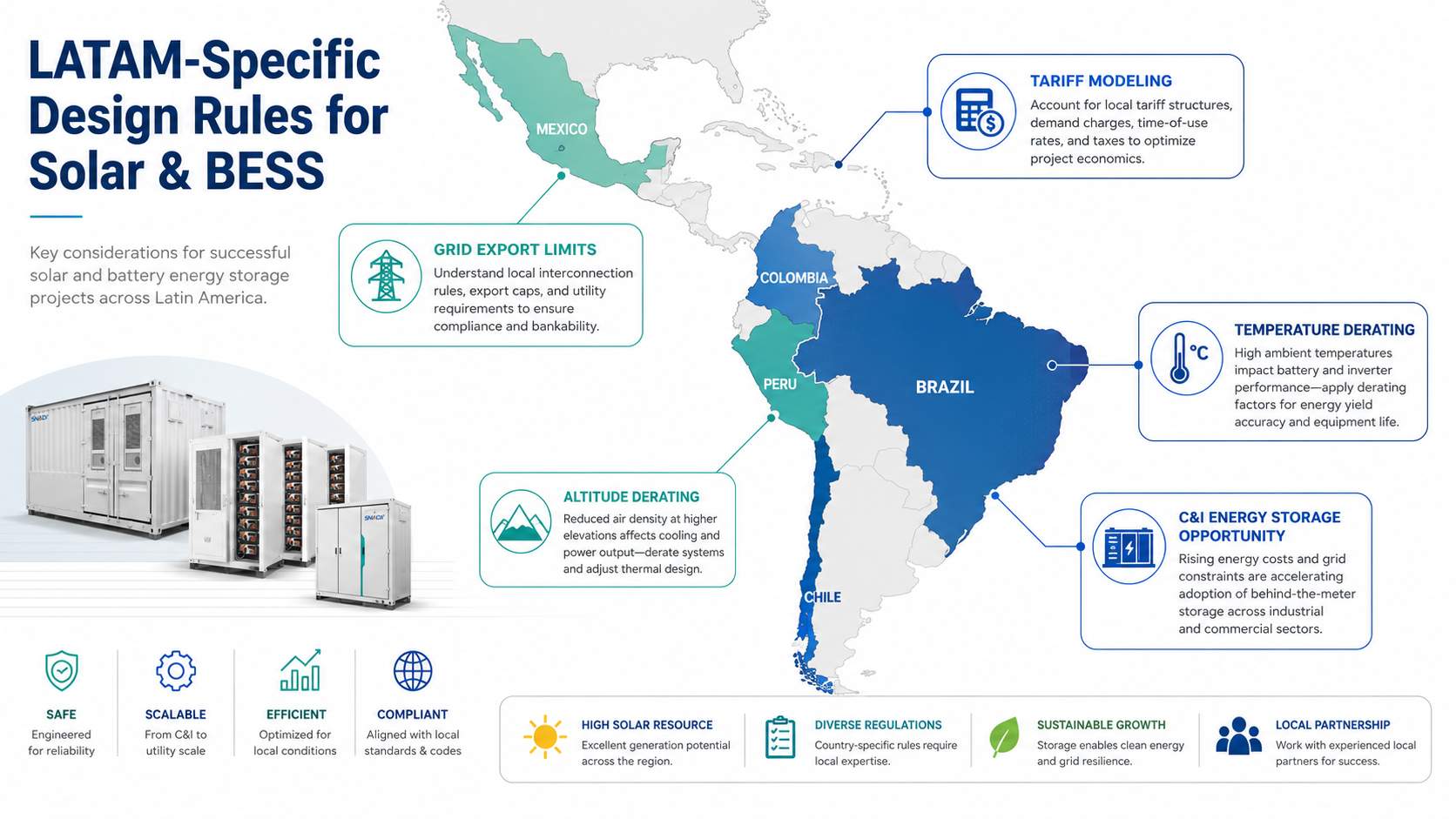
Latin America is not one uniform energy market. A commercial hybrid solar system that works well in Brazil may need a different configuration in Mexico, Chile, Colombia, Peru, or Central America. Grid rules, tariff structures, solar compensation mechanisms, ambient temperature, altitude, and utility approval processes can all affect the final design. For EPCs and C&I project owners, this creates a clear opportunity: hybrid solar systems with BESS can help businesses manage grid instability, energy cost volatility, and increasing demand for reliable power.
1. Model the Local Tariff Before Selecting Equipment
A 125 kW / 241 kWh battery cabinet may deliver strong ROI in one country and weak ROI in another. The difference often comes from tariff design.
In Mexico, demand based and time of use tariffs make peak shaving and load shifting especially important for many commercial and industrial users. CFE’s GDMTH tariff is specifically designed for medium-voltage users with demand equal to or greater than 100 kW. In Brazil, distributed generation projects must be evaluated under the country’s microgeneration and minigeneration rules. ANEEL defines microgeneration as systems up to 75 kW and minigeneration as systems above 75 kW and up to 3 MW, with some cases allowing up to 5 MW under Law No. 14.300/2022.
For C&I hybrid systems, this means the EPC should not simply maximize PV capacity. The correct approach is to model:
Energy charges
Demand charges
Time of use periods
Export compensation
Contracted demand
Grid interconnection limits
Battery cycling strategy
Payback period and LCOE
2. Prepare for Zero Export or Export Limiting Requirements
Some commercial facilities cannot export freely to the grid, either because of utility limits, interconnection restrictions, or weak compensation for exported energy. In these cases, the system should include zero export or export limiting control. A zero export design requires fast coordination between the inverter, meter, EMS, and BESS. If PV production suddenly exceeds load, the system must either charge the battery, curtail PV output, or adjust inverter output to avoid backfeeding into the grid. For C&I sites, this function is not optional. It should be tested during commissioning under different operating conditions, including low load weekends, full sun midday operation, and sudden load drop events.
3. Apply Temperature and Altitude Derating
Latin America includes hot coastal regions, high altitude cities, humid tropical zones, and dusty industrial areas. These conditions directly affect system performance. High ambient temperature can reduce inverter output, shorten battery life, increase HVAC requirements for battery cabinets, and reduce cable ampacity. High altitude can also affect cooling performance and electrical insulation assumptions. Facilities in cities such as Mexico City, Bogotá, Quito, or La Paz may require additional derating review. Always check the manufacturer’s derating curves before finalizing inverter and battery placement. A system that performs well at 25°C in a datasheet may perform differently in a 40°C equipment room with poor ventilation.
4. Prioritize Fire Safety and Battery Certifications
Commercial BESS projects require stronger safety documentation than standard grid-tied PV projects. Battery selection should include product safety, cell chemistry, enclosure design, thermal management, BMS protection, and emergency response planning. For industrial lithium batteries, IEC 62619:2022 specifies safety requirements and tests for secondary lithium cells and batteries used in industrial applications, including stationary energy storage applications. For energy storage system safety, UL 9540 covers energy storage systems and equipment, including electrical, electrochemical, mechanical, control, protection, and communication aspects. UL 9540A is a test method used to evaluate thermal runaway fire propagation in battery energy storage systems. For C&I buyers, these certifications help reduce technical risk and improve confidence during procurement, permitting, insurance review, and project financing.
5. Design for Maintenance and Remote Support
A commercial facility cannot afford long system downtime. Component selection should consider not only efficiency and price, but also serviceability.
A good C&I hybrid solar system should support:
Remote monitoring
Real time fault alarms
Battery state of health tracking
Modular replacement
Accessible spare parts
Clear O&M documentation
Local installer training
Safe shutdown procedures
The easier the system is to diagnose and maintain, the stronger the long term ROI.
Component Selection Checklist for C&I Projects
The following checklist can help EPCs, distributors, and business owners evaluate whether a proposed hybrid solar system is truly commercial grade.
1. Three Phase Hybrid Inverter
A commercial hybrid inverter must be selected for actual site conditions, not only nominal system size.
Key requirements include:
Three phase output
Sufficient continuous power rating
Strong overload capacity for motors and compressors
Fast transfer response during grid failure
Compatibility with high voltage batteries
Parallel operation support
Remote monitoring
EMS communication
Zero export control
Grid code compliance
For factories, warehouses, hotels, farms, and commercial buildings, the inverter is the core power conversion platform. If it is undersized or poorly matched, the whole system will underperform.
2. High Voltage Battery Cabinet
For commercial and light industrial projects, high voltage battery systems are generally more suitable than 48V residential battery banks. Higher battery voltage reduces current, which can reduce cable losses and improve system efficiency in larger power applications.
A C&I battery cabinet should be evaluated based on:
Nominal capacity
Usable capacity
Rated charge and discharge power
Depth of discharge
Cycle life
Cooling method
BMS protection
Fire safety design
Modularity
IP rating
Certification documents
Expansion capability
Do not compare batteries only by nominal kWh. A lower cost battery with limited discharge power, weak thermal management, or poor service support may reduce project ROI.
3. Solar PV Modules
Commercial rooftops require careful PV module selection. EPCs should consider:
Module efficiency
Temperature coefficient
Mechanical load rating
Warranty terms
Degradation rate
Roof layout compatibility
Mounting system compatibility
Maintenance access
Local availability
For C&I projects, PV capacity should be matched with load profile and BESS strategy. Oversizing PV without export control or storage capacity can lead to curtailment and weaker financial performance.
4. Energy Management System
The EMS is what turns hardware into measurable savings. A commercial EMS should be able to execute multiple operating strategies, including:
Peak shaving
Time of use arbitrage
Solar self-consumption optimization
Backup reserve control
Zero export control
Load prioritization
Battery cycling management
Real time monitoring
Historical performance reports
For business owners, EMS reporting is also important for verifying ROI. Monthly reports should show PV generation, battery charge/discharge behavior, grid import reduction, peak demand reduction, and system availability.
5. Balance of System
A commercial hybrid solar system is only as reliable as its BOS design. The BOS includes:
DC and AC cables
Breakers
Fuses
Combiner boxes
Surge protection devices
Disconnect switches
Meters
Communication cables
Grounding system
Fire protection
Mounting structures
Enclosures
Labels and safety signage
Residential grade BOS design should not be reused for C&I systems. Commercial projects require stronger protection coordination, larger current handling, clear isolation points, and safe maintenance access.
6. Thermal and Environmental Design
Thermal design should be reviewed before installation, not after a fault occurs.
Key checks include:
Ambient temperature range
Equipment room ventilation
Battery cabinet spacing
Direct sunlight exposure
Dust and humidity protection
Corrosion risk
Cooling system redundancy
Manufacturer derating curves
Maintenance clearance
For tropical, coastal, desert, or high altitude sites, environmental design can directly affect battery life and inverter output.
7. Documentation and Commissioning
Professional documentation is a strong trust signal for C&I buyers and utility reviewers.
A complete commercial project package should include:
Load analysis
System sizing report
Single line diagram
PV layout
Battery sizing calculation
Inverter datasheets
Battery certificates
Protection device list
EMS control logic
Grid interconnection documents
Commissioning checklist
O&M manual
Warranty documents
A well documented project is easier to approve, operate, maintain, and finance.
Conclusion
Commercial hybrid solar system design is not about adding batteries to a PV system. It is about engineering an energy asset that improves business continuity, reduces electricity cost, manages peak demand, and strengthens long term energy independence. For small and medium sized C&I facilities in Latin America, the best hybrid systems are built on three principles.
First, design from real load data. Monthly bills are not enough. Interval data shows when demand peaks occur, how long they last, and how much battery power is required to reduce them. Second, use commercial grade architecture. Three phase hybrid inverters, high voltage battery cabinets, advanced EMS control, and properly rated BOS components are essential for reliable C&I performance. Third, optimize for financial return. Backup power is valuable, but the strongest business case often comes from a combination of solar self-consumption, peak shaving, TOU arbitrage, demand charge reduction, and reduced downtime risk.
A residential style approach is not enough for commercial facilities. A C&I project requires precise engineering, tariff modeling, safe equipment selection, and local market knowledge. Ready to design a commercial hybrid solar system for your facility? Contact our engineering team today for a custom load analysis, BESS sizing plan, and ROI focused system proposal.
✉️Email: exportdept@snadi.com.cn
Website:

FAQ
The primary financial advantage comes from peak shaving and load shifting. By storing solar energy during low-demand periods and discharging it during peak utility rate hours, businesses can drastically reduce expensive demand charges, accelerating the payback period of their energy investment.
Q: How does the system ensure stability during unstable grid conditions?
Q: Can the storage capacity be scaled as business energy needs grow?
Q: What maintenance is required for a commercial hybrid solar setup?